The city of Compiègne lies 60 km north of Paris. To the east of the city near the village of Rhetondes is the Clairière de l'Armistice, (Glade of the Armistice), the scene of two significant events in European history; the signing of the Armistice in 1918 that brought an end to the First World War and the surrender of France in 1940 during the Second World War.
Clairière de l'Armistice Compiègne
Clairière de l'Armistice Compiègne IJ
At 05:00 on November 11 1918 the Armistice that would come into force at 11:00 that day was finalised in a railway carriage in a forest clearing near the village of Rhetondes.
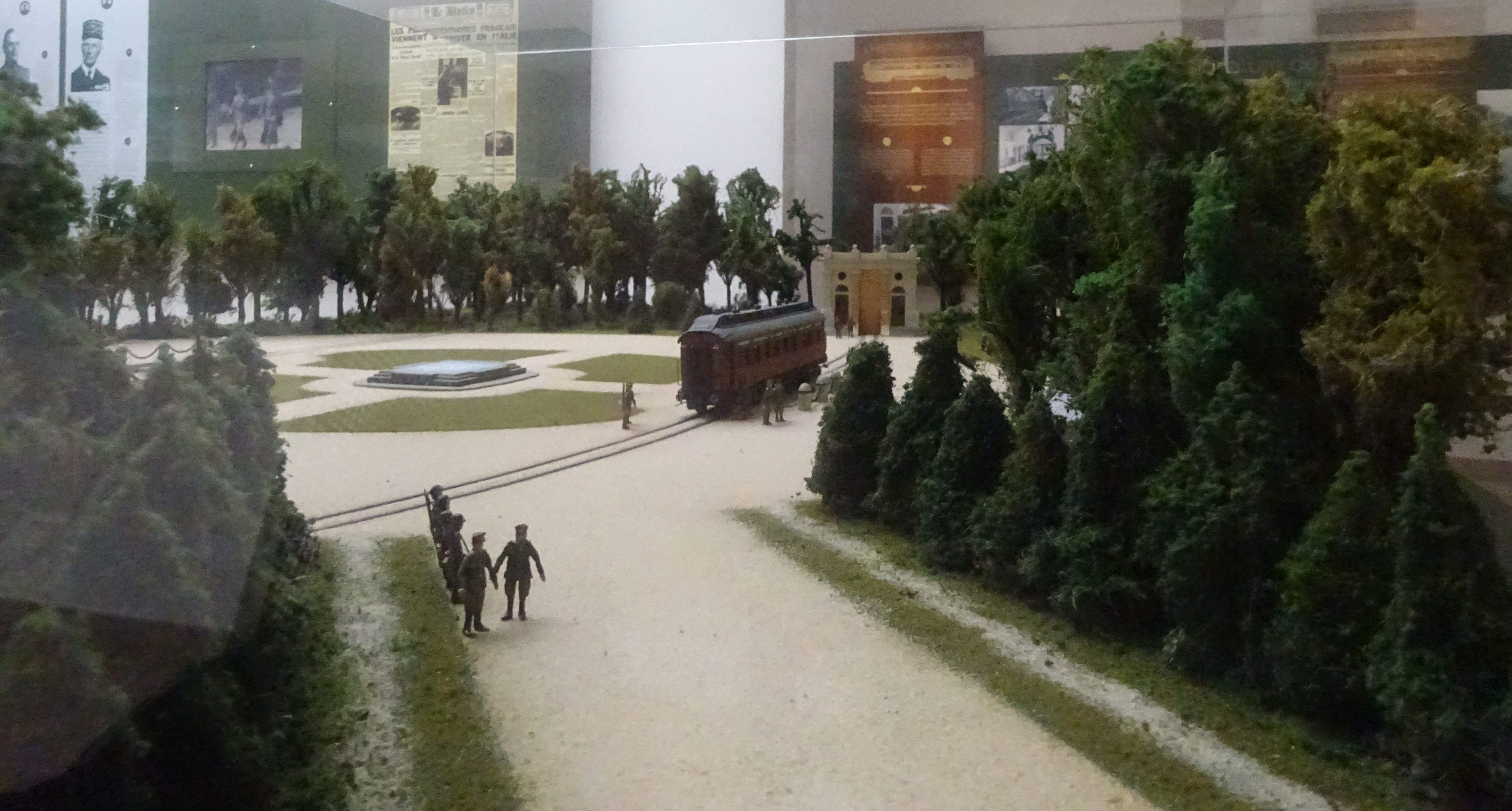
The location was chosen as it was near the front line and it was in a secluded woodland that could be accessed by two trains; one carrying the French delegation and one carrying the German delegation. The actual site was a clearing which was used to store artillery ammunition supplied by train.
Rhetondes artillery clearing 11th November 1918 The two trains are within two parallel spurs
The railway carriage where the Armistice was agreed was a converted Compagnie Internationale des Wagons-LitsRestaurant Car, No. 2419D, which was part of a personal train for Marshall Foch.
Armistice negotiations 11th November 1918
Allied Delegation 11th November 1918
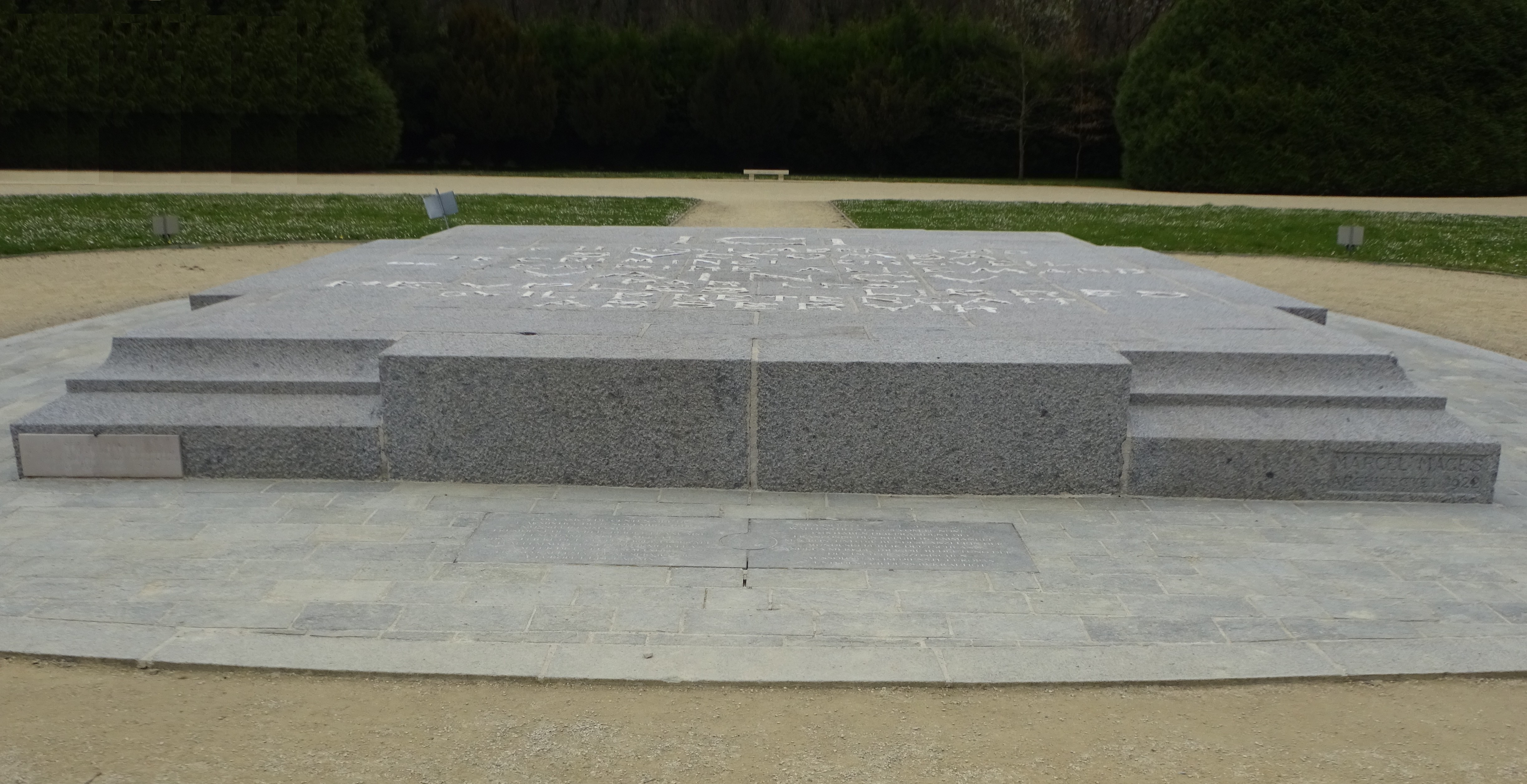
The significance of the Clairière de l'Armistice, (Glade of the Armistice) to the French nation was such that the site would become a memorial. Two sections of railway tracks were restored with signs marking the location of the Allied and the German trains. In the centre of the memorial area was a large granite slab inscribed:
ICI LE 11 NOVEMBRE 1918 LE CRIMINEL ORGUEIL DE L’EMPIRE ALLEMAND VAINCU PAR LES PEUPLES LIBRES QU’IL PRÉTENDAIT ASSERVIR
Here, on 11 November 1918, the criminal pride of the German empire was vanquished by the free peoples it had sought to enslave
On the 11th November 1922 the Clairière de l'Armistice memorial was opened by Marshal Ferdinand Foch and the President of France Alexandre Millerand in the presence of of the French veterans.
Clairière de l'Armistice Opening Ceremony 1922
Clairière de l'Armistice Memorial Slab Opening Ceremony 1922
The Alsace-Lorraine Monument made of pink granite from the French Vosges mountains was also unveiled on 11th November 1922. It commemorated the return of Alsace-Lorraine to France which was lost to Prussia when France was defeated during the Franco-Prussian War 1870-71.
Clairière de l'Armistice Unveiling Alsace-Lorraine Monument 1922
Clairière de l'Armistice Alsace-Lorraine Monument 1922
After the First World War one ended the Compagnie Internationale des Wagons-Lits donated Armistice Car No. 2419D to the French nation. It went on display in Les Invalides in Paris from April 1921 to April 1927. After restoration 2419D was transported to the Clairière de l'Armistice where a carriage shelter had been built serving as the Musée de l'Armistice (Museum of the Armistice).
Opening of Musée de l'Armistice 1927
Musée de l'Armistice Carriage Shed
Musée de l'Armistice Carriage Shed No2419D Armistice Carriage
On the 20th March 1929 Marshal Ferdinand Foch passed away. He was buried near to Napoleon Bonaparte in the Hotel des Invalides. A statue was erected in the Clairière de l'Armistice to commemorate his contribution to the French nation.
Musée de l'Armistice Marshall Foch Statue
Marshall Foch Statue
Clairière de l'Armistice
On the 3rd September 1939 Britain and France declared war on Nazi Germany after they had invaded Poland. On 10th May 1940 Hitler launched his assault in the West. The Low Countries soon capitulated and German troops penetrated into France. The British Army was forced to withdraw through Dunkirk and on 17th June 1940 France capitulated.
Hitler ordering the signing of the armistice agreement between France and Germany would take place in the same railway carriage in the exact same spot in Compiègne where the armistice of 1918 was signed. To do so German engineers removed Armistice Carriage 2419D from the Museum of the Armistice carriage shed and positioned it where it was on 11th November 1918.
Armistice Carriage 2419D removed from Carriage Shed
Armistice Carriage 2419D repositioning
Clairière de l'Armistice 21st June 1940
On the afternoon of 21st June Adolf Hitler arrived at the Clairière de l'Armistice. He and the German delegation toured the site and then boarded the Armistice Carriage. They were followed later by the French delegation. Hitler would leave in the evening as the Armistice negotiations continued into the night. At 6.50 p.m. German summertime on June 22 1940 the Armistice was signed.
Hitler Clairière de l'Armistice 21st June 1940
Hitler Clairière de l'Armistice 21st June 1940
Hitler and German delegation board Armistice Carriage
French delegation board Armistice Carriage
Armistice Carriage June 1940
Armistice Signing June 1940
After the Armistice signing Hitler ordered the destruction of the Clairière de l'Armistice as it symbolised the victory of France over Germany in 1918. The central memorial slab, the Alsace-Lorraine Memorial and the Armistice Carriage were removed and taken to Berlin. The Clairière de l'Armistice with it's markers stones was leveled to the ground. The only thing left was the statue of Marshall Foch who now looked over a site of desolation, not a site of French victory.
Musée de l'Armistice Carriage Shed Destruction
Marshal Foch statue Clairière de l'Armistice 1940
Clairière de l'Armistice 1940
France would remain under German occupation until September 1944. On the 6th June 1944 Allied troops landed in Normandy, the start of the liberation of Nazi Occupied Europe. The invading troops would breakout from Normandy and liberate Northern France. There were further Allied landings in August in Southern France with forces proceeding to liberate Southern France.
On the 11th November 1944, French, British, Polish and American representatives paraded at Marshall Foch's statue to commemorate the Liberation of France.
Clairière de l'Armistice 1944 Liberation Commemoration
After the war was over work began to restore the memorials and marker stones. On 11th November 1946 the restored site was inaugurated.
Restored Clairière de l'Armistice 1946 Inauguration
The actual Armistice Carriage 2914D taken away to Berlin in 1940 was destroyed during the war. The Compagnie Internationale des wagons-lits which donated 2914D to the French nation after WW1 donated a carriage from the same series, 2439D, after WW2. This was restored to the same appearance as Armistice Carriage 2914D in 1918. A new carriage shed and museum were built and artefacts that were hidded away in 1940 were returned to the museum.
The opening ceremony of the new Musée de l'Armistice Carriage Shed took place on November 11, 1950.
Musée de l'Armistice Carriage Shed 1950
------o------
Paris 2025 - Glade of the Armistice
Marshall Foch Statue and Memorial Slab
Memorial Slab and Carriage Markers
Memorial Slab
Marshall Foch Statue
Marshall Foch Statue
Alsace-Lorraine Memorial
Armistice Carriage Marker and Musée de l'Armistice
The Messines Ridge runs North South from Hill 60 to south of Messines. It had been in German hands since 1914 and it’s capture was essential to the forthcoming offensive that would launch the Third Battle of Ypres.
The planning for the capture of the ridge began in August 1915 when the Royal Engineers began tunnelling under the German defences with the intent of mines filled with tons of explosives.
Royal Engineer Tunnellers
Over a period of two years 25 mines containing 500,000 kilograms of explosive would be dug under the Messines Ridge prior to the battle.
On the eve of the Battle of Messines, General Sir Charles Harrington, Chief of Staff Second Army, remarked to press reporters;
"Gentlemen, I don’t know whether we are going to make history tomorrow, but at any rate we shall change geography"
Messines Mine Explosions
One of the largest mines was located at Spanbroekmolen. The 41,000 kgs of explosive at Spanbroekmolen left a crater 27 metres deep and a diameter of 76 metres which is now filled with water.
Messines Ridge Spanbroekmolen Crater
Messines Ridge Spanbroekmolen Crater IJ
The assault on the Messines Ridge would be conducted by the British Second Army, X Corps on the left, X Corps centre and II ANZAC Corps on the right.
The capture of the village of Messines would be conducted by the New Zealand Division.
Messines Ridge view towards New Zealand positions
New Zealand Division attack on Messines
The effect of the mine explosions coupled with the preliminary bombardment were devastating. Defences were destroyed or neutralised, many who survived were so traumatised they surrendered or ran away. The creeping barrage successfully supported the infantry assault and the German defences were breached, the Messines was captured and the New Zealanders consolidated their position.
Messines assault on Messines Ridge
The New Zealanders' success was replicated along the Messines Ridge which now lay in British hands.
The capture of the vital ground of Vimy Ridge was an essential pre-requisite to the Arras offensive. The ridge dominated the Douai Plane and Scarpe Valley which were the areas where the operation would be conducted.
Vimy Ridge view across Douai Plane
The capture of Vimy Ridge was entrusted to the Canadians.
At 05:30 9th April 1917 the Canadian assault on Vimy Ridge commenced.
Canadian Troops Vimy Ridge
The four assault divisions of the Canadian Corps left their trenches after a five minute hurricane bombardment, a technique developed by the Russians during the Brusilov Offensive.
Canadian TArtillery Vimy Ridge
A creeping barrage saw the Canadian infantry moving forward on predicted fire lines at 2 rounds per minute, lifting 100 yards every 3 minutes.
Barrage Map Vimy Ridge
By the afternoon 9th April most of Vimy Ridge was under Canadian control, the remaining part being captured the following day.
Canadian Soldiers Vimy ridge overlooking village of Vimy
The significance of Vimy Ridge to the Canadians was such that it was chosen as the Canadian National Memorial dedicated to the memory of the soldiers of the Canadian Expeditionary Force killed during the First World War.
The foundation stones were laid in 1925 and construction took 11 years. It was unveiled by King Edward VIII on 26th July 1936.