Blog Search


Showing posts with label 251 Brigade RFA. Show all posts

Friday, 13 March 2020

Ypres 2020 - Lijssenthoek Military Cemetery Northumbrian Gunners

   
Buried in Lijssenthoek Military Cemetery are three  Northumbrian Gunner Officers;

1st Northumbrian Brigade RFA -  Lt Veron Parker 
315 Brigade RFA                          -   2/Lt Bert Berry
4th Northumbrian Brigade RFA - Major Charles Chapman   
-----o------

Lt Victor Parker
1st Northumbrian Brigade RFA

Victor Parker was born in Newcastle on 29th August 1877, the son of The Honourable Reginald Parker. He was the oldest  child with 3 sisters.  Victor was educated at Eton. He was an officer in the Volunteer Artillery rising to the rank of Captain, resigning his commission in 1908 on the formation of the Territorial Force. On the outbreak of the First World War, Victor Parker re-joined the Colours and was appointed a Second Lieutenant in the 1st Northumbrian Brigade Royal Filed Artillery. He promoted to Lieutenant in March 1915, deploying to France in April.

The War History of the 1st Northumbrian Brigade RFA records in March 1916 ;


He went up the trenches to do his turn as F.O.O. on March 4th, after the show [Re-capture of the Bluff] was over. The weather was intensely cold, and snow lay everywhere. It was his first experience of front line work; he did not realize what he was going to have to put up with, and did not take enough warm things with him. Whatever the cause, he came back to the Battery with a severe chill, and died in hospital two days later.

-----o------

Second Lieut. George Herbert Berry
315 Brigade RFA

George Herbert (Bert) Berry was born in Alberta, Canada, 18th May 1894. He attended Upper Canada   College Toronto from 1910 to 1912, then Toronto University where he was awarded a BA in 1915.

On completion of his degree, he enlisted into the Canadian Army Medical Corps as a private soldier. Berry joined No 2 Stationary Hospital in Lemnos, in the Aegean, as part of the Gallipoli Campaign. The unit moved to France in 1916. Bert Berry attended the Royal Field Artillery no 1 Officer Cadet School, St John’s Wood, commissioning in November 1916.   He joined 315th Brigade in France in June 1916.

Second Lieutenant  Bert Berry was carrying out the duties of a Forward  Observation Officer when he received a severe abdominal wound whilst  locating a new OP near Hooge Crater, just outside Ypres.
He was taken to no 10 Casualty Clearing Station at  Remy Siding, where he died 3 days later on 9th March 1917, aged 23.

2/ Lieutenant Bert Berry is buried in Lijssenthoek Military Cemetery.

2nd Lt. George Herbert Berry
315 Brigade RFA

An officer from his battery wrote;

A few weeks prior his death he was recommended for the Military Cross for bravery under fire, when he put out two burning gun pits and carried two wounded men to safety. He was never the least bit afraid and we have lost an officer who can never be replaced. I have been out here three years now and have seen many men go, but some how they weren’t like Bert. He was a clean manly chap and the Battery seems empty now; the men were all so fond of him because he was such a splendid section officer. Somehow I can’t realize it even yet and even when I stood by the little mound of earth in the cemetery it seemed    unreal and that he would grip me by the arm in the old way and say, ‘Well, John, how goes it?’”
-----o------

Major Charles Lancelot Chapman MC
4th Northumbrian Brigade RFA

Charles Lancelot Chapman was born in South Shields August 1st 1892. He was the son of local Chartered Accountant Henry Chapman and his wife Dora. He would be one of eleven children (7 boys and 4 girls). All the boys would attend South Shields Grammar School. Charles left scholl in 1909 to join his fathers Chartered Accountant’s office. 

Like all his brothers, Charles played for Westoe Rugby club. Brother Frederick played for England and is credited with scoring the first try, first conversion and first penalty goal at Twickenham.
Charles Lancelot Chapman was commissioned into the 4th Northumbrian (County of Durham) (Howitzer) Brigade, Royal Field Artillery 2nd November 1911. He was promoted to Lieutenant in July 1913.

He mobilised with the 4th Northumbrian Brigade RFA in Augut 1914 at the start of WW1. He was promoted temporary Captain in November 1914. Captain Chapman deployed with the 4th Northumbrians to France in April 1915 . 

His brother Robert , who would later command the Battery, the Brigade and ultimately become Honorary Colonel  74 (Northumbrian) Field Regiment was with him.
Lieutenant (Temporary Captain) CL Chamman was awarded the Military Cross (MC) in the New Years Honours list  for 1915. His brother Robert was awarded the Distinguished Service Order (DSO).

In spring 1916, Captain Chapman was posted back to England. He would return to the Western Front and by March 1917 was 2 I/C of     D Battery 173 Brigade RFA, taking over command in the June. The Brigade was part of the 36th (Ulster) Divisional Artillery.

Major Chapman was wounded when a shell hit his dugout. He died of wounds 22nd August 1917 aged 25. 

Major CL Chapman MC  is buried in Lijssenthoek Military Cemetery 
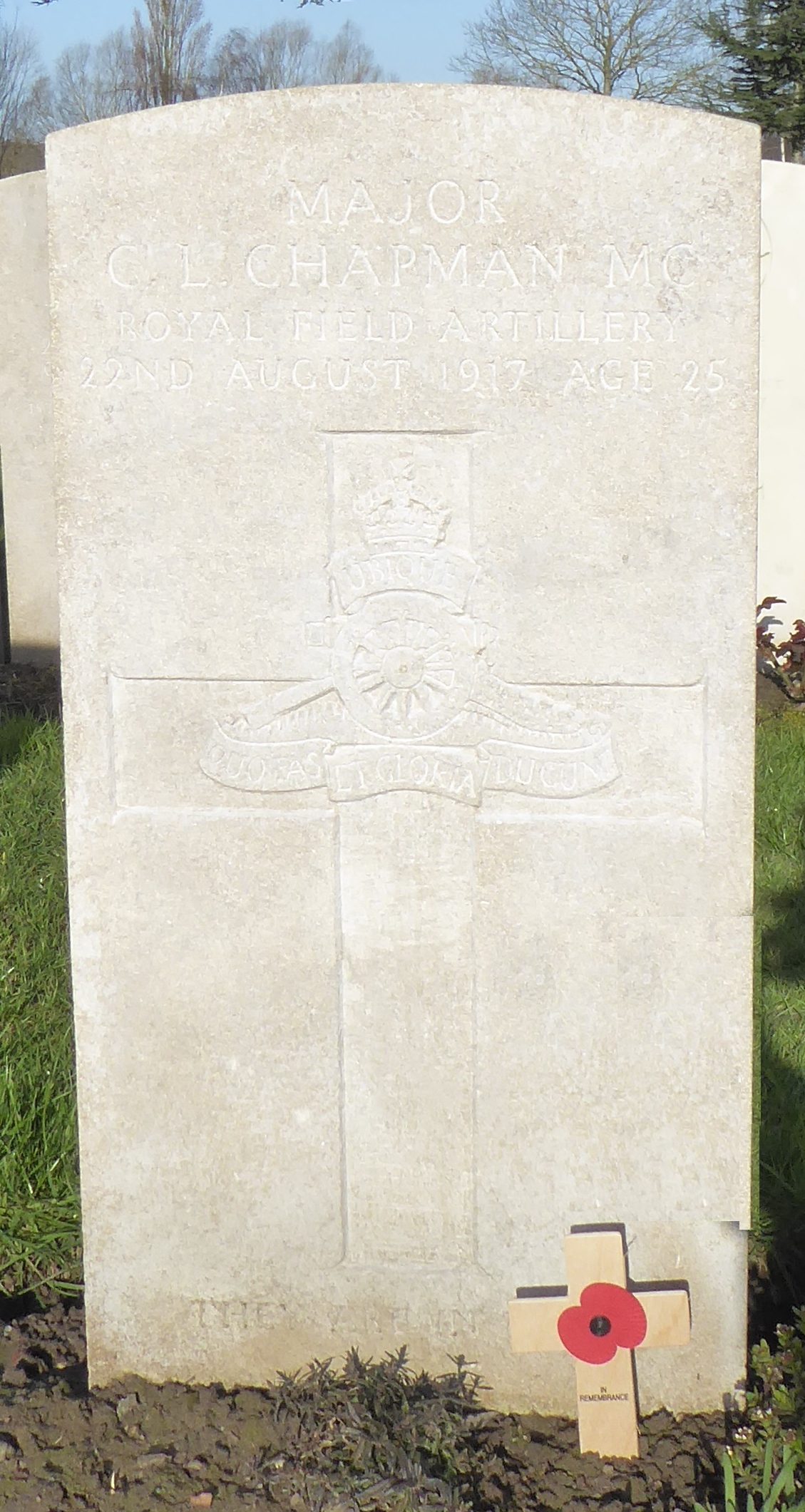
Major CL Chapman MC
4th Northumbrian Brigade RFA

------0------

NVAA Wreath


Saturday, 10 March 2018

Lys - Choques Military Cemetery


Choques Military Cemetery

The Choques Military Cemetery contains a single row of graves from D Battery 251 Brigade, formerly 5th Durham Battery, 4th Northumbrian (County of Durham) Howitzer Brigade from Hebburn. The men's names are recorded as killed in action on the Roll of Honour in the 3rd Durham Volunteer Artillery Centenary Book.
 On the evening 18th April 1918 the men of D/251 Battery found themselves in the village of Gonnenham, on the River Lys.

 Regimental archives record; 
Gronnenhem April 1918 

The morning brought sad news from our wagon lines.  The bombardment which had provided us with a lively interlude had visited our comrades with disastrous results. A shell struck the barn in which they were sleeping, bursting amongst the sleepers with deadly effect. Many of the survivors rushed for the open, to be met by a second shell, adding materially to the already heavy list of dead and wounded. 
The look of grim determination to be seen on the faces of our gunners indicate that there was one more account to settle with the enemy; and if, at the end, any portion of the debt remained unpaid, it was no fault of the officers or men of D/251.

 The men are buried together in a single row in Choques Military Cemetery.
Choques Military Cemetery
Men of D/251 Battery

NORTHUMBRIAN GUNNERS

D/Battery 251 Brigade Royal Field Artillery


Killed In Action Gronnenhem 18th April 1918 


  1. Hillbeck A Driver MM 2555
  2. Wilson F Driver 127301
  3. Allcott H Driver MM 4678
  4. Fewings RT Gunner 52505
  5. Harris AS Gunner 10235
  6. Hunt JAF Gunner 234324
  7. Bennet H Gunner 10315
  8. Jewell WS Driver 1288
  9. Maidment A Driver 10318
  10. Pearce EG Driver 82773
  11. Rich WG Driver 4546
  12. Richardson JH Driver 755887

Driver A Hillbeck MM
Driver F Wilson
Driver HB Allcott MM
Gunner RT Fewings
Gunner AS Harris
Gunner JAF Hunt
 

Gunner H Bennett


Gunner WS Jewell
 
Gunner AJ Maidment
Driver EG Pearce

 
Gunner WG Pearce

Killed In Action 25th April 1918 

Driver JH Richardson


C/Battery 251 Brigade Royal Field Artillery

Lieutenant C St J Nevill
 

Victoria Cross

Second Lieutenant Alexander Buller Turner VC
1st Bn. Royal Berkshire Regiment
Died of wounds 1st October 1915, aged 22.
 
2/Lt AB Turner VC
 
 
 "For most conspicuous bravery on 28th Sept., 1915, at "Fosse 8," near Vermelles. When the regimental bombers could make no headway in Slag Alley, Second Lieutenant Turner volunteered to lead a new bombing attack. He pressed down the communication trench practically alone, throwing bombs incessantly with such dash and determination that he drove back the Germans about 150 yards without a check. His action enabled the reserves to advance with very little loss, and subsequently covered the flank of his regiment in its retirement, thus probably averting a loss of some hundreds of men. This most gallant Officer has since died of wounds received in this action." 

Saturday, 8 May 2010

Firepower - May 2010 - Northumbrian Field Guns

Field Guns at Firepower used by Nothumbrian Gunner units

BLC 15 Pounder
Originally issued to Territorial Force (TF)Royal Field Artillery units in 1908. The TF RFA Brigades deployed with this gun to the Western Front in April 1915. It was replaced between October 1915 and January 1916.

1st Northumbrian Brigade RFA (TF)
2nd Northumbrian Brigade RFA (TF)
3rd Northumbrian Brigade RFA (TF)

Ordnance QF 18 Pounder
This was the standard Field Gun for the Royal Field Artillery in WW1. All Regular Brigades used this gun throughout the war, TF units receiving it between October 1915 to January 1916. All new Army unites fired the 18 pounder.

1st Northumbrian Brigade RFA (TF)- 250 Brigade RFA
2nd Northumbrian Brigade RFA (TF)- 251 Brigade RFA
3rd Northumbrian Brigade RFA (TF) -252 Brigade RFA
315 Brigade RFA / 316 Brigade RFA / 317 Brigade RFA
160 (Weardside) Brigade RFA

4.5 inch Howitzer.
The Territorial Force gunners used the 5" Howitzer from 1908 to 1915 when it was replaced with the 4.5 inch Howitzer.The 4,5 inch Howitzer was the standard Regular Army gun.

4th Northumbrian (County of Durham) Howitzer Brigade RFA (TF)
D/250 Battery / D/252 Battery / D/61 Battery

25 Pounder
Standard gun for Field Regiments in WW2. The Territorial Gunners re-equipped with this gun during WW2.

72nd (Northumbrian) Field Regiment TA (TA)
74th (Northumbrian) Field Regiment TA (TA)
124th (Northumbrian) Field Regiment TA (TA)

2 Pounder Anti/Tank Gun
The Northumberland Hussars re-rolled as anti-tank gunners in September 1939 on mobilisation, 125 Regiment converting in December 1939.

102 (Northumberland Hussars) ATk Regiment RHA (TA)
125th (Northumbrian) Anti-Tank Regiment RA (TA)

5.5 inch Gun
The 5.5in was the first gun of 101 Regiment, being used from the Regiment's formation in 1967 till 1980.

101 (Medium) Regiment RA (V)

105mm Light Gun
The 105mm Light Gun was used by 101 Regiment between 1980 and 1992. The Regiment supported 15 Infantry Brigade as part of the 2nd Divisions rear area defence in Germany during the Cold War.

101 (Field) Regiment RA (V)

FH70
The FH 70 was used by 101 Regiment from 1992 till 1997, when the Regiment converted to MLRS. The Regiment was rolled as a General Support Regiment in the 1st Armoured Division

101 Regiment RA (V)

Monday, 3 May 2010

Ypres 2010 - Passchendaele

The village of Passchendaele was finaly taken by the the Canadians 6th November 1917.

The British casulties are listed in the Official History of the Great War as 238,313..

One Casulaty for every 27 yards advanced.


Passchendaele Church


In support of the main Canadian attack on Passchendaele, the British launched attacks to protect the left flank. This included attacks by the 50th Division supported by 250 & 251 Brigades (1st Line Northumbrian Artillery), and 63rd (Royal Naval) Division supported by 223 and 318 Brigades (the latter Brigade originating from 2nd Line Northumbrian Artillery).