Blog Search


Showing posts with label Op Ducy. Show all posts

Wednesday, 20 August 2014

Op Ducy - Fontenay-le-Pesnel

A kilometre north of the Rauray Battlefield lies the 49th (West Riding) Division Memorial. Nearby is the Fontenay Le Pensel War Cemetery which contains the graves of 8 soldiers of 1st Battalion Tyneside Scottish (Black Watch).

49 West Riding Division Memorial
Fontenay Le Pesnel

49 West Riding Division Memorial
Fontenay Le Pesnel

49 West Riding Division Memorial
Fontenay Le Pesnel


Fontenay Le Pesnel
CWGC Cemetery

Fontenay Le Pesnel
CWGC Cemetery

Fontenay Le Pesnel
CWGC Cemetery

Fontenay Le Pesnel
CWGC Cemetery
Private JA Robertson 1st Battalion Tyneside Scottish (Black Watch)

 
1st Battalion Tyneside Scottish (Black Watch)
RankInitialsSurnameDiedAgedService No.Grave Ref.
L/CplG MBROOK28/06/194419'14415091'III. C. 7.
L/CplGGOODWIN28/06/194424'4460943'III. C. 10.
PvtJHARRIS29/06/1944'4455575'III. B. 10.
L/CplEHARRISON28/06/194429'3061770'III. C. 9.
L/SjtL WJOHNSTON28/06/194428'3061778'III. A. 3.
PvtJO'HAGAN01/07/194428'4461062'IV. D. 3.
PvtJ AROBERTSON02/07/194417'14430216'IV. D. 18.
CplJ GSIMPSON01/07/194429'407007'IV. C. 20.


Op Ducy - Battle of Rauray

On the afternoon 30th June 1944, the Commanding Officer of 1st Battalion Tyneside Scottish (Black Watch) held at O Group at 14:00. The Battalions mission was to defend the area around the village of RAURAY.

The main threat was counter attack by armour from the 2nd SS Das Reich and the 9th SS Panzer Divisions. The defence plan was based upon establishing effective anti armour killing zones for the guns from the anti-tank platoon, and basing the company positions around the gun emplacements.

The Battalion occupied a rise on the Rauray Spur. To its front was the Village of QUEUDEVILLE. Left front was a five cornered field, surrounded by the hedgerows of the bocage. To the north of the Battalion area was a farm, rear left, and the village of RAURAY, with the village of BRETTEVILLETTE to the right.


Rauray Battlefield panorama
Looking towards QUEUDVILLE - moving through 5 Cornered Field 
North to farm and RAURAY then towards BRETTEVILLETE
 
Looking South to QUEUDVILLE over the RAURAY SPUR

Five cornered field

Looking South - RAURAY left / farm right

Looking West to BRETTEVILLETTE

The most effective killing zones for the anti tank guns were to the front of A company, who were located in the five cornered field, and B Company who overlooked the Rauray Spur. Let of A Company was the Corps boundary and 6th KOSB.

The anti tank platoon were equipped with six 6 pounder guns firing sabot ammunition.

C Company were to the right of B Company, D Company rear, Battalion HQ in the famr buildings near Rauray. the 11th DLI were on the right flank, and to the rear 2nd Kensington's. In support were tanks from the 24th lancers and the Sherwood Rangers Yeomanary.


Rauray Battlefield
At 06:00 1st July 1944 the Germans attacked, infiltrating into the C Company position and forcing them back, isolating A and B Companies. The anti tank guns engaged the German tanks, destroying 3. At 11:00 C Squadron 24th Lancers counter attacked with D Company 1TS, D Company reinforcing B Company.

The Germans then launched a second attack, this time forcing A Company back, however, B Company reinforced by D Company continued to hold on the edge of the Rauray Spur. Two more attacks were held by the combined B and D Company, who brought down concentrated artillery fire, including naval gunfire support.

By 17:00, the Panzers were broken and the German attack had failed.

The anti tank gunners of 1TS had destroyed 10 tanks, the 24th Lancers 9, and artillery fire accounted for another 10 or 12.

1st Battalion Tyneside Scottish (Black Watch) earned 1 Military Cross, 3 Military Medals, and awarded the Battle Honour DEFENCE OF RAURAY.

The Battalion sustained over 200 casualties, 25% of it's strength.

Piper on the Rauray Spur

Remembering the losses of 1st Battalion Tyneside Scottish


Op Ducy - Tyneside Scottish Gold Beach

Around midday 12th June 1944 the main body of the 1st Battalion Tyneside Scottish (Black Watch) arrived offshore of Gold Beach. The advanced party were already ashore, having landed 12 hours earlier.  By 15:00 the men were disembarking and moving from  the beach to their assembly area at ESQUAY SUR SEULLES.

Gold Beach

Gold Beach

Gold Beach TS arriving on the beach

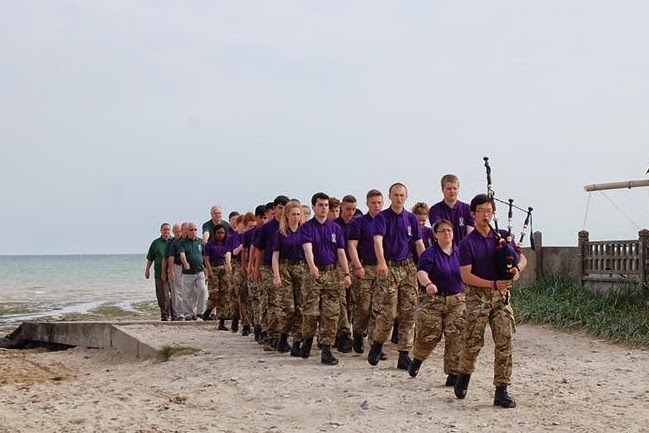
Gold Beach TS marching off


Gold Beach TS piped off the beach

Op Ducy - Arromanches

In order to exploit beyond the Normandy Beachhead it was essential that port facilities were available for bulky cargo, vehicles and supplies in order to sustain operations.

In August 1942 a raid on Dieppe had failed, and it became obvious that trying to take heavily defended ports was not viable. For the Normandy operation it was therefore decided to create a port made up of pre-fabricated components.

The port would consist of concrete caissons sunk offshore to create the port infrastructure, connected to the shore by floating runways. Old ships would be sunk as block ships to provide breakwaters. Two harbours would be constructed , one off Omaha Beach and one off Gold Beach.


Mulberry Harbour Concept

The harbours were constructed in multiple locations around the United Kingdom and towed across the channel into position. On 9th June 1944 (D plus 3), both harbours were in position.


Mulberry caissons being towed into position


Mulberry Harbour

Mulberry Harbour roadway

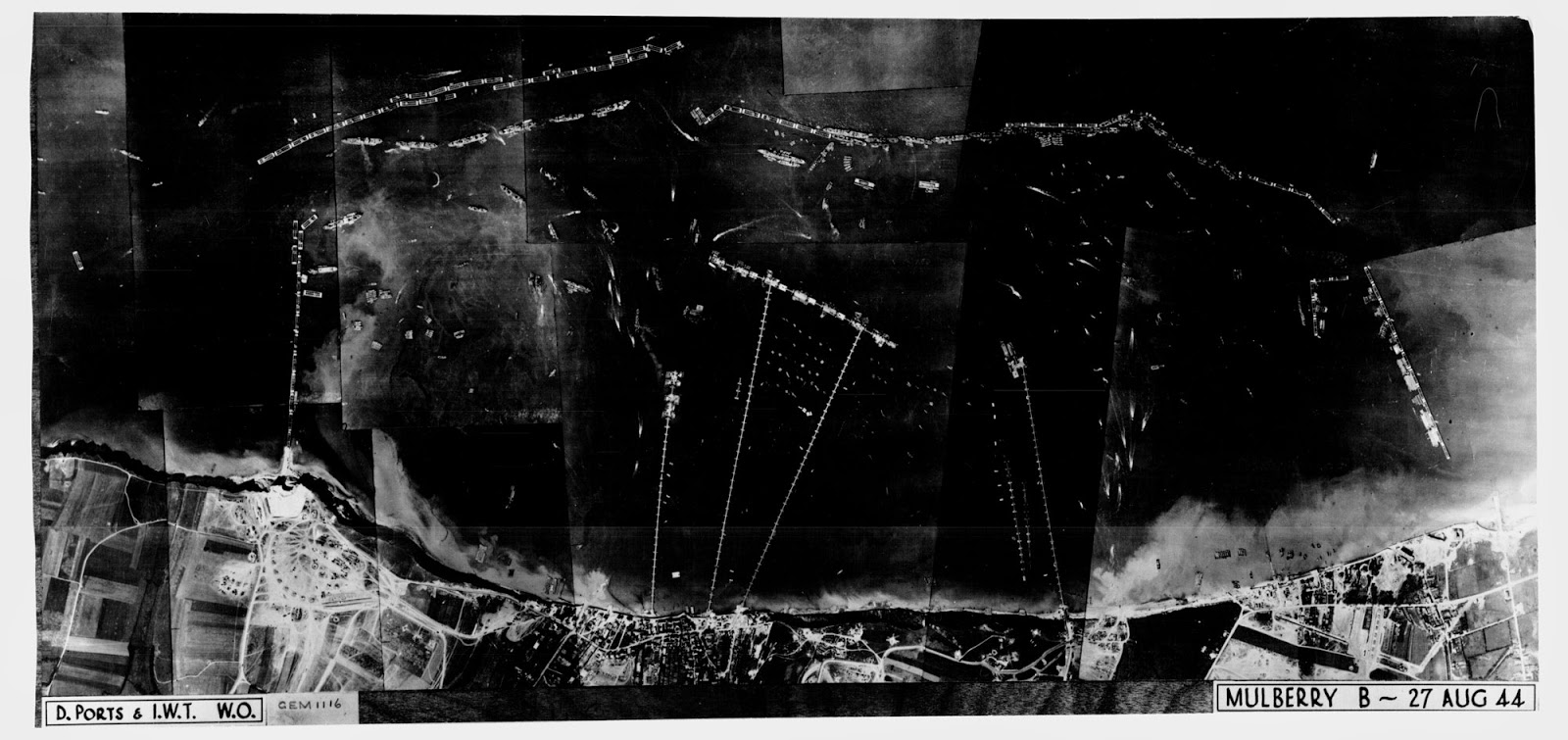
The Royal Engineers constructed the harbour at Arromanches with 33 jetties and 10 miles (15 km) of roadway, and it was named PORT WINSTON. 

Mulberry B harbour - Arromanches


Arromanches Map

Arromanches Panorama - Port Winston

Arromanches Mulberry Harbour remains

Arromanches

Arromanches Roadway remains

Op Ducy - Port En Besin

On the 6th June 1944 the 47th Royal Marine Commando was tasked with the capture of the small harbour of PORT EN BESSIN. The harbour was located 9 miles (12 km) to the west of GOLD BEACH. The fishing port was an important objective as it was to be the Normandy terminus for PLUTO (Pipe Line Under The Ocean), the mechanism by which fuel oil would be moved from the UK to France.

Port En Bessin location

Port En Bessin 1944
EAST                                                                            WEST

Port En Bessin 2014
EAST                                                                             WEST
 
The fishing port lies in a hollow with high sides rising up to 200 feet (60 metres),which were know as the Western and Eastern features.
 
Defending PORT EN BESSIN were elements of the German 352nd Infantry Division who held the high ground defended by concrete bunkers, wire entanglement's and mines. To the south concrete entrenchments covered the Bayeux Road.


Panorama from Eastern feature - moving through west & south 

Port En Bessin - Western feature
 
Port En Bessin - Eastern feature

The plan was 47 Commando would land on GOLD BEACH,  move inland, infiltrate through enemy lines and attack the village from the rear.


Port En Bessin 
WEST                                                             EAST


The operation began at 05:00 6th June 1944 when 420 men of 47 Commando with 420 men loading into landing craft 8 miles (13 km) off the Normandy coast. The German coastal guns opened fire on the craft as they approached the beach sinking one craft, another four were sunk when they hit mines attached to underwater obstacles. During the landing much of the units radio equipment was lost.

Around 300 men mustered on Gold Beach. Having borrowed radio equipment from the 231st Infantry Brigade they set off across country. The force managed to avoid contact until they were engaged at La  Rosière. The Commandos overcame the Germans, taking weapons and equipment to replace  the losses during the landings. By nightfall they reached Point 72 at Escures, 1.5 miles (2.4 km) from the port, where they dug in, ready to attack next morning.

The attack began by charging and overcoming the defensive position at the south of the village.

One troop then attacked the western feature. The feature was mined, rifle and machine gun fire was heavy, and the defenders were able to roll grenades down the hill. Unknown to the Marines, two Flak ships had been moved into the harbour, and they were able to bring fire onto the advancing troops, forcing them to withdraw.

The situation worsened when a German counter attack captured the Commandos rear HQ and cut off the troops in Escures.

The Marines began to clear the harbour area, but the Western and Eastern features were stubbornly defended by the Germans


Port En Bessin - Harbour
Captain Cousins found an unobserved path and was able to capture a concrete bunker. The Commandos then began to fight their way up the Eastern feature, concrete entrenchments, mines nd barbed wire. Through the night German positions were captured one by one and by dawn the Eastern feature as in the possession of 47 Commando. The positions near Escures were recaptured. At 04:00 8th June, the German garrison commander and 300 men surrendered.

Of the 420 Commandos who embarked, 116 were killed or drowned, and 40 wounded.


Port En Bessin Memorial
 

D-Day - Port en Bessin

Battle of Port En Bessin

Battle for Port En Bessin - People's War

D-Day: Heroic battle in Port-en-Bessin

Op Ducy - Ver Sur Mer

50th Divisional Artillery Memorial Ver sur Mer

D-Day - Royal Artillery Run In Shoot


50th Northumbrian Division
Divisional Artillery Memorial
Ver Sur Mer


Sexton Self Propelled Gun
Ver Sur Mer


Op Ducy - Juno Beach Centre

D-DAY - Juno Beach


 Juno Beach Centre


Juno Beach Visitors Centre

Juno Beach Visitors Centre


Op Ducy - Merville Battery


The German MERVILLE BATTERY is located 2 miles SE of the port of OUISTREHAM covering the mouth of the RIVER ORNE. Crucially for the planed landings on D Day it was situated 5 miles East of SWORD QUEEN BEACH, and it was assessed that the battery could cause serious problems for the troops landing on the beach.

Merville Battery Threat


The battery consisted of 4 concrete casemates, the type used normally housing 150mm guns, and this was what concerned the D-Day planners, consequently it was deemed necessary that the battery be destroyed prior to the main beach landings.

The battery was heavily bombed by the RAf on 16th May 1944, but little damage was inflicted, though the Battery Commander was killed as he visited his mistress.

A ground assault was therefore planed.

The defences for the battery were formidable:
  • 20mm anti-aircraft guns
  • 15 machine gun positions
  • Wire obstacles in an area 640 by 460 m surrounded by two barbed wire obstacles 15 4.6 m thick by 1.5 m high.
  • 100 m deep  minefield
  • Anti-tank ditch covering any approach from the nearby coast.
  • Areas to the East of the battery were flooded as part of a wider defence plan
Merville Battery June 1944

 
As part of the overall plan to secure the left flank of the D-Day landings, 9th Battalion Parachute Regiment, supported by Royal Engineers in Horsa Gliders, was tasked with the destruction of the battery. The Pathfinders would drop just after midnight to secure and mark the dropping and air landing zones. Main body would arrive 13:00, and the operation needed to be complete by 05:00 when a naval bombardment from HMS Arethusa would commence. Prior to the ground assault, RAF Lancaster Bombers would bomb the battery.

The Pathfinders drop was successful, however, their radio beacons had been damaged, and the smoke and debris from the RAF bombing, which was off target, obscured th landing lights.

The main drop and air landings were scattered as the DZ / LZ were not marked. Only 150 men out of a battalion of 800 arrived at the assembly point. There were no engineers and no infantry support weapons (anti tank guns) or jeeps. 

A reconnaissance party had managed to reach the battery, mark 4 routes through the minefield  and  cut a route through the barbed wire.

Merville Battery Assault

The reduced battalion managed to penetrate into the Battery and neutralised the gun by throwing fragmentation and phosphorous grenades through the gun apertures.


Merville Battery Casemate

The German garrison resisted and only 75 paratroopers withdrew from the battery shortly before 05:00.

The guns were only neutralised. Two guns were in action later in the day, though it transpired that the guns were only 100mm aged Czech WW1 guns.

The battery would not be captured till 17th August 1944.


Merville Battery Plan


Merville Battery Dakota

Merville Battery

On guard