Blog Search


Wednesday, 15 February 2023

London - Fire Fighters Memorial

 The National Firefighters Memorial is located to the south of St Paul's Cathedral in London. 

It was originally commissioned to remember the firefighters who lost thier lives during the Blitz on London in World War Two. 

Firefighters Memorial St Pauls

The German Luftwaffe began their air attacks on London on the 7th September 1940, and continued day and night for 56 out of the next 57 days.

 Heinkel He 111 River Thames London 7 September 1941

After defeat in the Battle of Britain and due to heavy losses during daylight raids, the Luftwaffe abandoned daylight raids, attacking only at night.

London Blitz Night Raid

The London Fire Brigade struggled gallantly to deal with the fires and the rescue of people during the air raids and in the aftermath. 

London Fire Brigade Firefighting

London Fire Brigade Rescue

On the night of the 29-30 December 136 bombers attacked London dropping around 100,000 bombs, mainly incendiary devices, targeting the City of London. The resulting fires became the Second Great Fire of London.

London Blitz Second Great Fire of London

London Blitz Second Great Fire of London
Ave Maria Lane

During the raid 28 incendiary bombs fell on St Paul's Cathedral. Prime Minister Winston Churchill ordered that  "St Paul's must be saved at all costs". In the morning after the raid, St Paul's remained as a defiant image to the destruction around it. 

St Pauls Cathedral December 30th 1941

St Pauls Cathedral February 15th 2023

The Blitz officially ended 11th May 1941. With the Luftwaffe not achieving strategic objectives of damaging the war economy and demoralising the British, resources were re-focussed on the forthcoming German invasion of Russia. 


Keep Calm and Carry On

Attacks on London would resume in 1944 when the V-Vengeance Flying Bombs and Rockets targeted the metropolis. During the Second World war from 1939 to 1945, 363 male members of the London Fire Service lost their lives. They are commemorated in the original memorial. The memorial later extended to record all 1,027 men and women of the Fire Services who lost their lives form 1939 to 1945. The memorial was then designated the National Firefighters memorial, recording not only those lost during WW2, bring the total roll of honour to 1,192 names.

While others are running away from danger, firefighters are running towards it. Tragically, some firefighters have paid the ultimate sacrifice keeping people safe.

Firefighters Memorial St Pauls Cathedral
Firefighters Memorial

Firefighters Memorial

London Firefighters WW2

Firefighters Memorial plaque

Firefighters Memorial Female Firefighters Commemoration

London - London Troops Memorial

The London Troops War Memorial located in front of the Royal Exchange in the City of London commemorates the men from the city who fought in World War One and Two. The monument records London units that fought in  World War One. It features two statues of WW1 soldiers. 

London Troops Memorial Royal Exchange

The front of the memorial features an inscription surmounted by the City of London coat of arms.  

London Troops Memorial


City of London arms

London Troops Memorial inscriptions

TO THE // IMMORTAL HONOUR // OF THE OFFICERS // NON-COMMISSIONED // OFFICERS AND MEN // OF LONDON // WHO SERVED THEIR // KING AND EMPIRE // IN THE GREAT WAR // 1914–1919 // THIS MEMORIAL IS // DEDICATED IN PROUD & // GRATEFUL RECOGNITION // BY THE CITY AND // COUNTY OF LONDON

THEIR NAME LIVETH FOR EVERMORE.

UNVEILED ON NOV 12TH 1920 BY // H.R.H. THE DUKE OF YORK // ON BEHALF OF // FIELD MARSHAL H.R.H. //THE DUKE OF CONNAUGHT // K.G., K.T., K.P.

An further description was added after the Second World War.

AND // ALBEIT MANY UNITS // NAMED HEREON // HAVE CHANGED IN // DESIGNATION AND ROLE // WE HONOUR AND // REMEMBER THE MEN // AND WOMEN WHO SERVED // IN ALL THE UNITS OF // THE CITY AND COUNTY // OF LONDON IN THE WAR OF // 1939–1945.

The two bronze bronze statues  are a Royal Fusilier infantry man, and a Gunner of the Royal Field Artillery.

Royal Fusilier

Royal Field Artillery Gunner

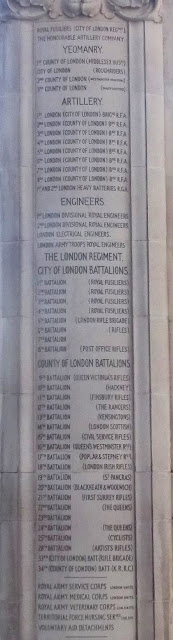
The rear of the memorial surmounted by the County of  London coat of arms records the units of the London Troops. The units include Royal Fusiliers (City of London Regiment) which consisted of 7 Regular and 40 Service battalions. The Honourable Artillery Company that that mobilised two  infantry battalions and five artillery batteries for active service. It records the 1st to 8th London (City of London) Brigade Royal Field Artillery and the 1st and 2nd London Heavy Batteries Royal Garrison Artillery.

London Troops Memorial unit listing

County of London arms

London Troops listing
 
London Troops Artillery


LONDON TROOPS

Royal Fusiliers (City of London Regiment), 

The Honourable Artillery Company. 

------------------------------

1st County of London Yeomanry (Middlesex Hussars)

City of London Yeomanry (Roughriders)

2nd County of London Yeomanry (Westminster Dragoons)

3rd County of London Yeomanry (Sharpshooters)


1st London (City of London) Brigade RFA

2nd  London (City of London) Brigade RFA

3rd  London (City of London) Brigade RFA

4th  London (City of London) Brigade RFA

5th  London (City of London) Brigade RFA

6th  London (City of London) Brigade RFA

7th  London (City of London) Brigade RFA

8th  London (City of London) Brigade RFA

1st London Heavy Battery RGA

2nd London Heavy Battery RGA


1st London Divisional Engineers

2nd London Divisional Engineers

London Electrical Engineers

London Army Troops Royal Engineers


1st Battalion (City of London) London Regiment (Royal Fusiliers)

2nd Battalion (City of London) London Regiment (Royal Fusiliers)

3rd Battalion (City of London) London Regiment (Royal Fusiliers)

4th Battalion (City of London) London Regiment (Royal Fusiliers)

5th Battalion (City of London) London Regiment (London Rifle Brigade)

6th Battalion (City of London) London Regiment (Rifles)

7th Battalion (City of London) London Regiment

8th Battalion (City of London) London Regiment (Post Office Rifles)


9th (County of London) Battalion London Regiment (Queen Victoria Rifles)

10th (County of London) Battalion London Regiment (Hackney)

11th (County of London) Battalion London Regiment (Finsbury Rifles)

12th (County of London) Battalion London Regiment (The Rangers)

13th (County of London) Battalion London Regiment (Kensingtons)

14th (County of London) Battalion London Regiment (London Scottish)

15th (County of London) Battalion London Regiment (Civil Service Rifles)

16th (County of London) Battalion London Regiment (Queens Westminster Rifles)

17th (County of London) Battalion London Regiment (Popular & Stepney Rifles)

18th (County of London) Battalion London Regiment (London Irish Rifles)

19th (County of London) Battalion London Regiment (St Pancras)

20th (County of London) Battalion London Regiment (Blackheath & Woolwhich)

21st (County of London)  Battalion London Regiment (First Surrey Rifles)

22nd (County of London) Battalion London Regiment (The Queens)

23rd (County of London) Battalion London Regiment

25th (County of London) Battalion London Regiment (The Queens)

26th (County of London) Battalion London Regiment (Cyclists)

27th (County of London)Battalion London Regiment (Artist Rifles)

33rd (City of London) Battalion London Regiment (Rifle Brigade)

34th (City of London) Battalion London Regiment (K.R.C.C.)

------------------------------

Royal Army Service Corps London units

Royal Army Medical Corps London units

Royal Army Veterinary Corps London units

Territorial Force Nursing Service London units

Voluntary Aid Detachments


London - Great Fire of London

 Short after midnight on the 2nd September 1666, a fire started in Pudding Lane in the City of London. The fire spread throughout the city  and lasted till Thursday the 6th September. A monument to the Great Fire of London was erected near the starting point in 1677.

Monument to Great Fire of London

Monument to Great Fire of London

London in 1666 had expanded beyond the Roman city walls and in the main was unplanned tightly packed buildings that had developed as the result of growing to become the largest city in Britain. The centre of the city, as now, was the financial and commercial centre. 

London 1660s

The Great Fire of London was started in a bakery in Pudding Lane shortly after midnight on Sunday 2 September. 

Pudding Lane Bakery

Pudding Lane Bakery marker plaque

Pudding Lane February 2023

Great Fire of London

The fire rapidly due to the wooden buildings, many in poor repair, fuelling the fire and strong winds which turned the conflagration into a fire storm. The situation was not helped by the indecisiveness of the Lord Mayor, Sir Thomas Bloodworth, who delayed the order to create fire breaks by demolishing buildings until Sunday night. On the Monday the fire pushed north into the heart of the City.

Great Fire of London London City burns

On Tuesday the fire continued. It was hoped St Pauls Cathedral with it's thick stone walls and the wide empty surrounding plaza forming a natural firebreak would survive. It was undergoing repairs at the time and was surrounded by wooden scaffolding which caught fire on Tuesday night. The heat of the fire began to melt the lead roof, and the molten metal flowed into the crypt which was full of printers and book sellers stocks placed there for safety. The stock caught fire and the the effects of the fire turned St Pauls into a ruin. 

St Pauls Cathedral burns

The fire was contained in the north by the Roman city walls. To the west it had leapt the River Fleet and was threating toward Whitehall, whilst in the east it was approaching the Tower of London. On Wednesday the winds dropped and fire breaks created by troops stationed in the garrisoned Tower of London using gunpowder prevented further spreading. 

Great Fire of London

It is estimated that the fire destroyed 13,500 houses, 87 parish churches, 44 Company Halls, the Royal Exchange, the Custom House, St Paul's Cathedral, Bridewell Prison, the General Letter Office, and the three western city gates—Ludgate, Newgate, and Aldersgate.


London - City of London

 The City of London, known as the Square Mile, is a  city, ceremonial county and local government district within the London metropolis. The city is governed by the  City of London Corporation, and has it's own police force. The ceremonial head is the Lord Mayor of London. 


Within the City of London are many iconic landmarks including St Pauls Cathedral, Tower of London, Tower Bridge as well as institutions such as the Bank of England. 


City of London - old and new

Mansion House
Lord Mayor of London residence
Bank of England and Royal Exchange

Bank of England

Royal Exchange

Monument to Great Fire of London 1666

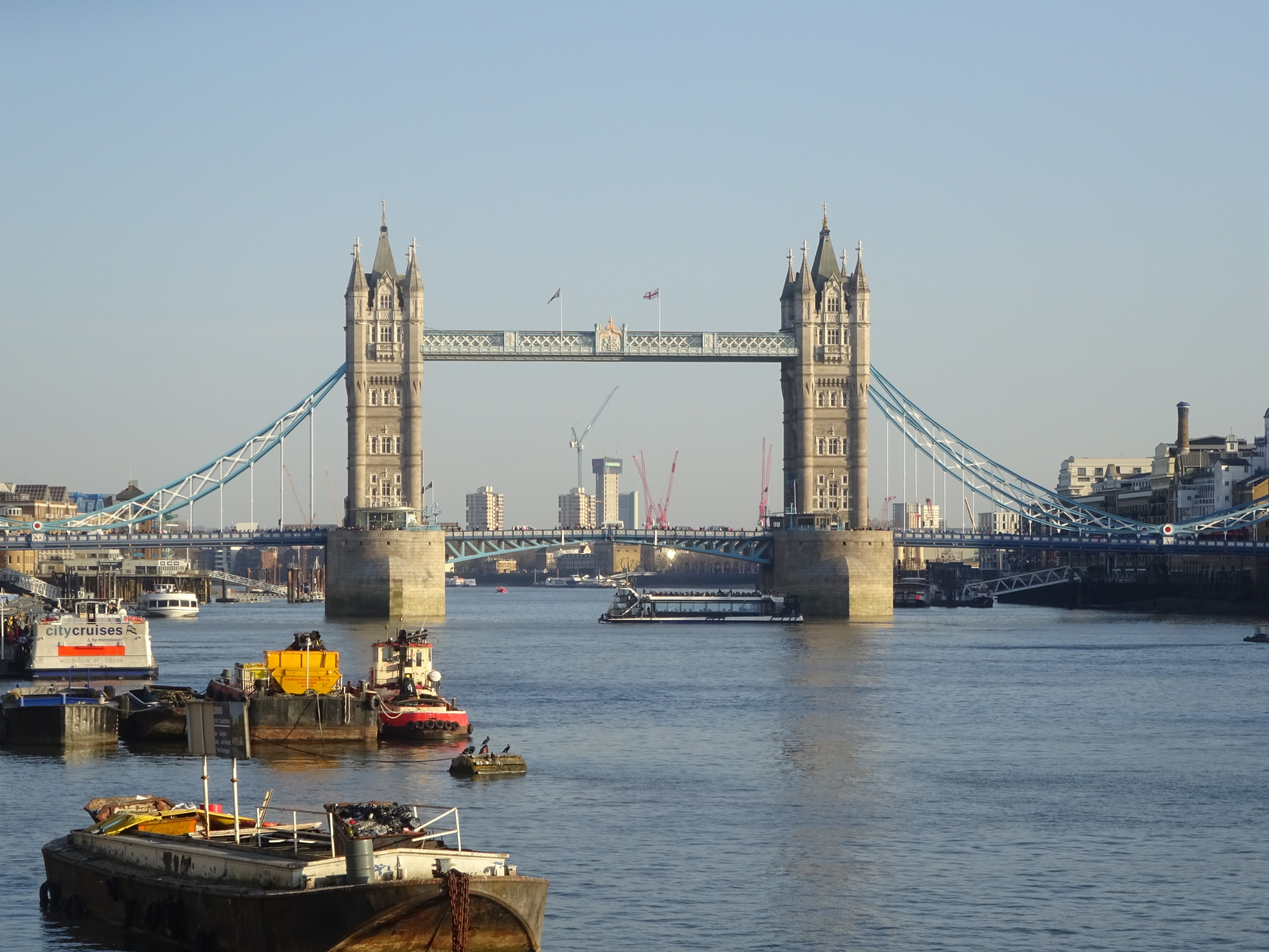
Tower Bridge and HMS Belfast

Tower Bridge

HMS Belfast

Tower Bridge and HMS Belfast IJ

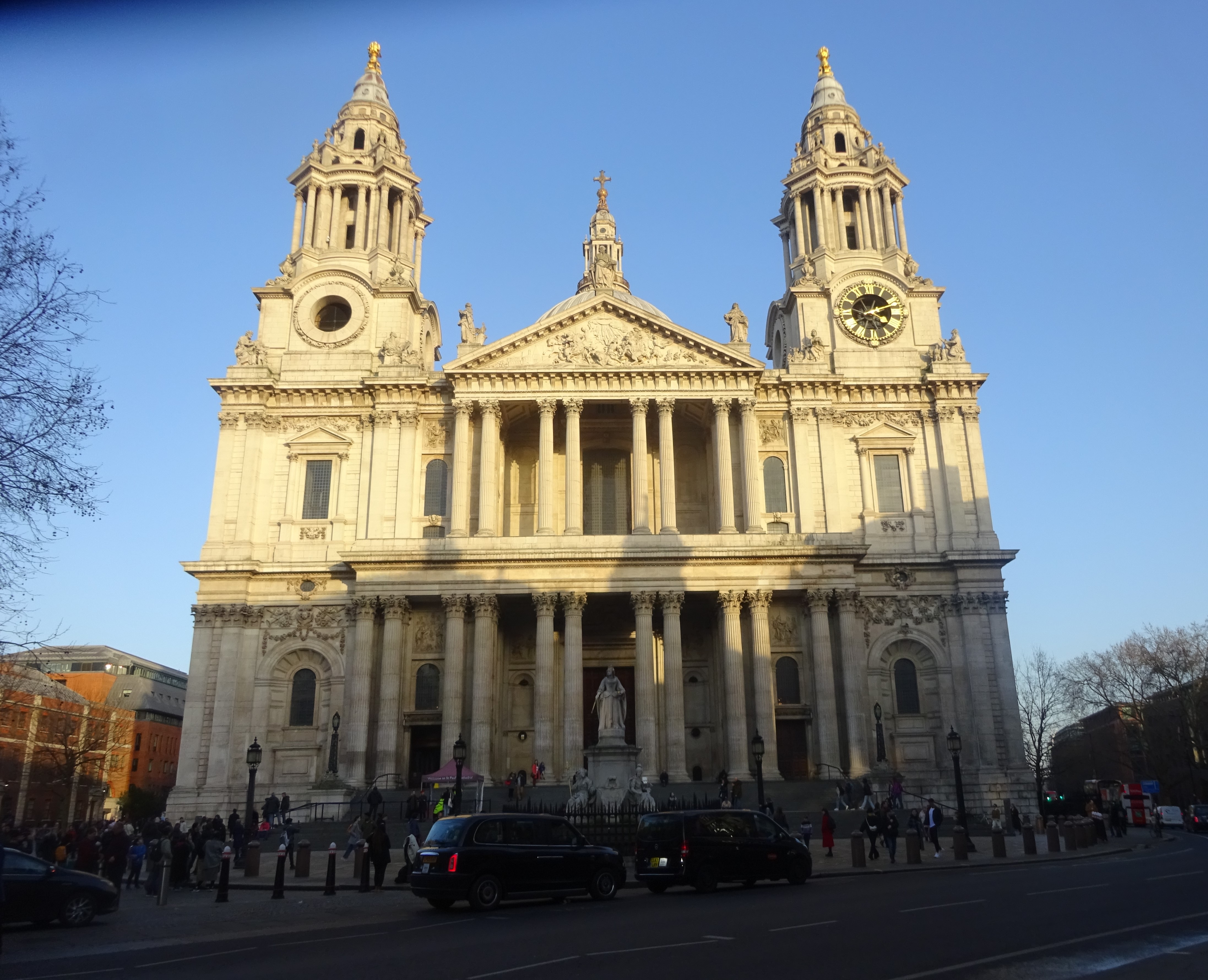
St Pauls Cathedral

St Pauls Cathedral Dome

St Pauls Cathedral entrance

St Pauls Cathedral IJ