Blog Search


Tuesday, 7 February 2023

Holy Island War Memorial

 The war memorial on Holy Island is located on a small hill on the south of the island overlooking the harbour. 

Holy Island War Memorial

It commemorates 8 men from World War One and 3 from World War Two. The memorial was unveiled by on 4 June 1922 by Major Morley Crossman DSO. 

The memorial cross was designed by  Sir Edwin Lutyens who designed the Cenotaph on Whitehall in London,  the Thiepval Memorial to the Missing, and the Stone of Remembrance which appears in all large Commonwealth War Graves Commission cemeteries. Lutyens connection to Holy Island pre dated World War One when he was the architect for the renovation of Holy Island Castle.

Holy Island War Memorial

------O------

The inscription commemorating those lost during World War One reads;

TO THE GLORY OF GOD

AND IN GRATEFUL MEMORY OF

OUR GLORIOUS DEAD

1914-1918

Holy Island War Memorial World War One

ROSSMAN William Ronald Morley

Second Lieutenant, 2nd Battalion, Kings Royal Rifle Corps

Killed in action 2nd November 1914

Commemorated on YPRES (MENIN GATE) MEMORIAL.


CROMARTY George Douglas

Private 30732, 2nd/4th Battalion, East Lancashire Regiment.

Killed in action 21st March 1918 

Commemorated on POZIERES MEMORIAL, Somme, France.


PATTERSON James B

Private 46763, 2nd Battalion, Durham Light Infantry

Killed in action 18th September 1918 in France & Flanders. Aged 18

Buried in CHAPELLE BRITISH CEMETERY, HOLNON, Aisne, France.


WILSON William

Private, Royal Dublin Fusiliers (RDF) 


TOUGH Joseph

Driver Gunner 69200 No. 4. Depot, Royal Garrison Artillery

Died 24th November 1918. Aged 25

Buried in BYKER AND HEATON CEMETERY, NEWCASTLE-UPON-TYNE, Northumberland.


SHELL Adam

Deck Hand 6708DA, H.M. Trawler "Ameer", Royal Naval Reserve

Died 18th March 1916. Aged 34. 

Commemorated on CHATHAM NAVAL MEMORIAL.


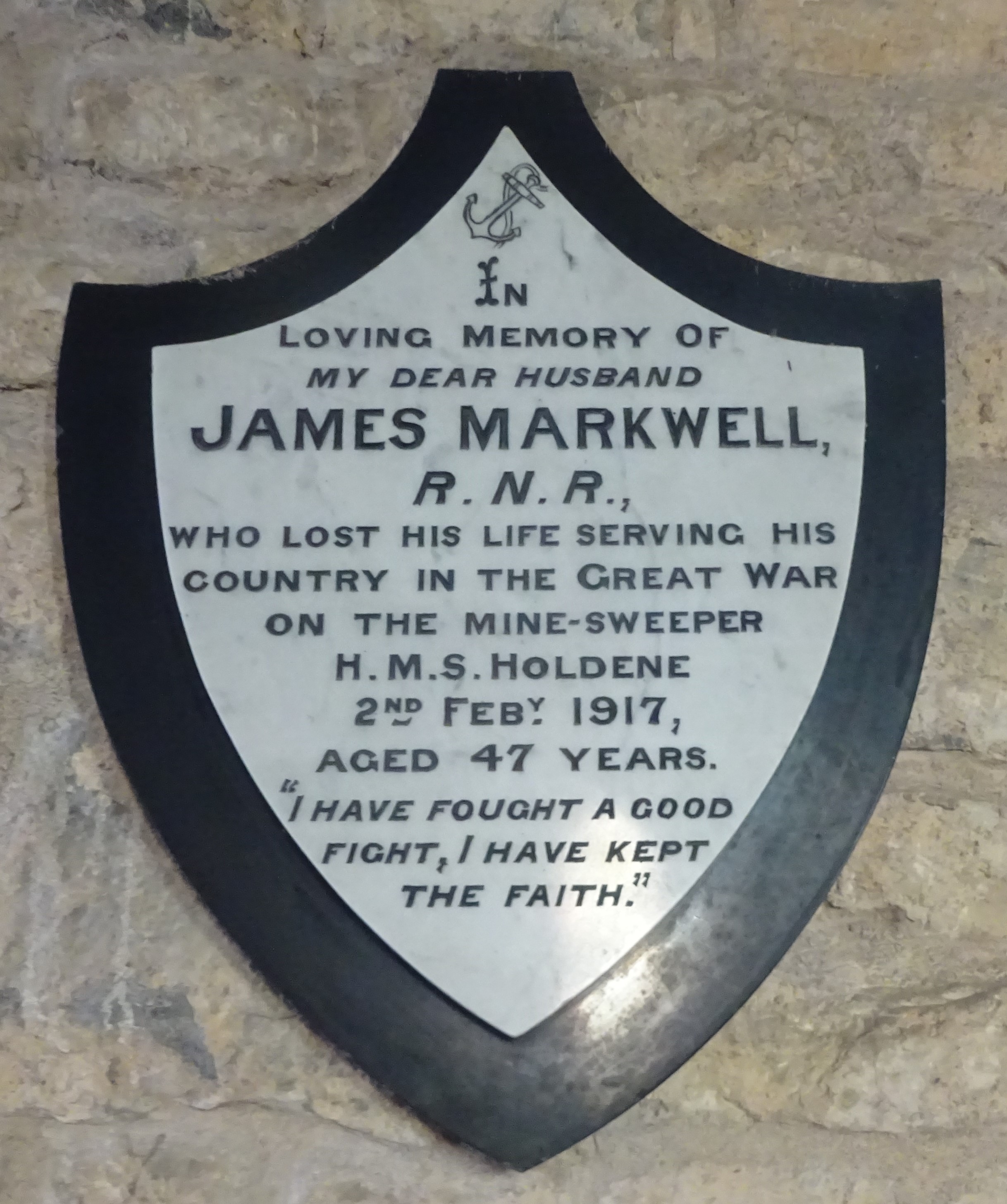
MARKWELL James

Deck Hand 6710DA, H.M. Trawler "Holdene", Royal Naval Reserve.

Died 2nd February 1917. Aged 46. 

Commemorated on CHATHAM NAVAL MEMORIAL, Kent.


MARKWELL Thomas

R.N.R.T.A.

------O------

The inscription commemorating those lost during World War Two reads;

TO THE GLORY OF GOD

AND IN GRATEFUL MEMORY OF

OUR GLORIOUS DEAD

1939-1945


HENDERSON Adam Shell

Seaman LT/JX 400013, H.M. Trawler Kingston Beryl, Royal Naval Patrol Service.

Died 25th December 1943. Aged 20

Commemorated on LOWESTOFT NAVAL MEMORIAL.


WALKER Thomas

Stoker 1st Class, H.M.S. Hood, Royal Navy

Died 24th May 1941. Aged 26

Commemorated on PORTSMOUTH NAVAL MEMORIAL.

------O-----

At the going down of the sun
We will remember them

------O------

In the St Mary's Church, three of those who lost thier lives during World War One have memorial plaques dedicated to them.

Holy Island St Mary's Church

Holy Island St Mary's Church
Private G.D. Cromarty


Holy Island St Mary's Church
Private JB Patterson

Holy Island St Mary's Church
J. Markwell

------O------

Commemorated on the Holy Island war memorial is Stoker 1st Class Thomas Walker. Thomas was born on 13th June 1914 in Holy Island, Northumberland to Thomas and Lily Walker. He was the husband of Agnes Walker. 

Stoker 1st Class Thomas Walker

Thomas was killed on 24th May 1941 serving on HMS Hood.

HMS Hood

In May 1941 the battle cruiser HMS Hood and the battleship Prince of Wales were ordered to intercept the German battleships Bismark and the heavy cruiser  Prinz Eugen  attempting to break out into the North Atlantic to attack Allied merchant shipping.

The British ships located the two German ships on May 23. Early the next morning the Hood and Prince of Wales went into battle opening the Battle of the Denmark Strait. After only 8 minutes HMS Hood was hit by shells from the Bismarck hit the boat deck, a huge jet of flame burst out from the vicinity of the mainmast, followed by a devastating magazine explosion. This explosion destroyed the aft part of the ship broke the back of Hood, and within three minutes the ship sank stern first.

Explosion of HMS Hood  seen from Prinz Eugen at 0600-0601

Only three survived men out of a ships compliment of 1,418 survived. Amongst those lost was Stoker 1st Class Thomas Walker.


Thomas Walker is commemorated on the Portsmouth Naval Memorial.

Portsmouth Naval Memorial


Holy Island


Holy Island Castle

The island of Holy Island, also known as Lindisfarne lies off the coast of Northumberland, 10 miles south of Berwick upon Tweed.

Holy Island Northumbrian Coast

Holy Island

IJ VM Holy Island

The island can be reached by a road causeway at low tide.

Road Causeway to Holy Island

View from Road Causeway to Holy Island at low tide

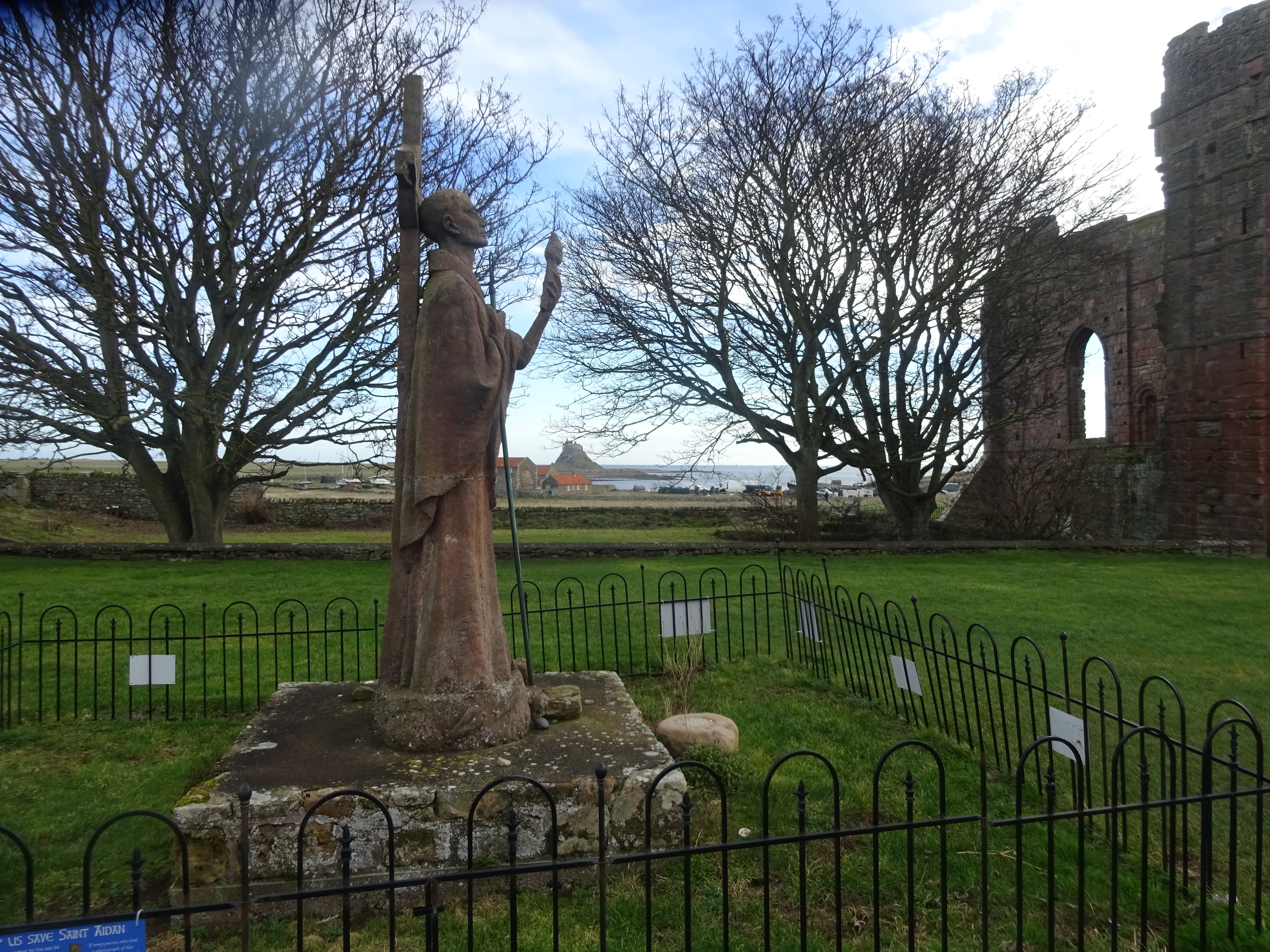
Lindisfarne became the centre of Christianity in the north when a monastery was founded in 634 by an Irish monk Aidan. He has been sent from Iona, an island in the Inner Hebrides,Scotland, at the request of the King of Northumbria, King Oswald. 

Lindisfarne Northumbria

Holy Island St Aidan

Lindisfarne Monastery

One of the monks who settled was Cuthbert who would be later canonised and become the patron saint of Northumbria. When he  retired in 676, he became an hermit on a small island nearby to the Lindisfarne Monastery. 

Holy Island - St Cuthbert's Island

Holy Island - St Cuthbert's Island

Cuthbert died in 687. He was first buried in Lindisfarne, later his body was moved by monks to Durham Cathedral. 


A set of manuscripts known as the the Lindisfarne Gospels were produced by a monk named Eadfrith, who became Bishop of Lindisfarne in 698,in honour of St. Cuthbert.

Lindisfarne Gospels

Lindisfarne Gospels

A priory was established during the 12th century, and became a major destination for pilgrims.

Lindisfarne Priory

Following the dissolution of the monasteries by Henry VIII between 1536 and 1541 the priory was left to go to ruin.

Holy Island Lindisfarne Priory Manor House Hotel

Holy Island Lindisfarne Priory

Holy Island Lindisfarne Priory

Holy Island Lindisfarne Priory

Holy Island Lindisfarne Priory

In 1542 Henry VIII ordered the fortification of Holy Island against Scottish invasion. By 1547 a fort was established on a high rock and equipped with guns. 

The castle was strategically vital during the Scottish Wars of the mid-1500s and later saw action in the English Civil Wars 1642 to 1651. The fortifications would be strength during a series of wars with the Dutch which ranged from 1652 to 1674. 

 The castle was purchased by Edward Hudson, the founder of Country Life magazine in 1901 who hired the architect Sir Edwin Lutyens to help with a renovation of the castle.

Holy Island Castle and Harbour

Holy Island Castle

Holy Island Castle IJ

Holy Island Castle VM

Holy Island Herring Girls

Holy Island Herring Girls


Holy Island VM and "Seal"

Holy Island Deer


Friday, 13 January 2023

Edinburgh - Accounting Museum

 The Museum on the Mound houses a collection relating to the history of the Royal Bank of Scotland, now part of the Lloyds Banking Group.

Museum on the Mound
Museum on the Mound IJ

The Bank of Scotland was founded in 1695 to support Scottish Business. At that point in time Scotland was an independent country, the Act of Union with England not being signed in 1704.

Bank of Scotland original ledgers and documents

The origins of Lloyds Bank lay with the formation of the Taylor and Lloyds Bank in Birmingham in 1765, by John Taylor and Sampson Lloyd. The association between the Taylor and Loyd family ended in 1852, and in 1865 became Lloyds Bank. It adopted the Black Horse logo in 1884.

Lloyds Bank history

The museum follows the development of the banking system and money from the early days of hand written ledgers through to modern computerised systems.

First calculator 1851 Tates Patent Arithmometer

Banking system development

Electronic Banking System

The Bank of Scotland issued it's first bank notes on its formation in 1695 , and continued to do so after the action of the Union in 1704. The practice of Scottish Banks issuing their banknotes continues today.

An exhibit shows what One Million Pounds in Scottish £20 bank notes looks like. 

One Million Pounds

One Million Pounds One Million Pounds VM