Blog Search


Friday, 1 July 2022

Tyneside Irish Somme Commemoration 2022

 The Tyneside Irish Brigade Memories Project aims to capture family memories of some of the 5,000 soldiers who fought in the Tyneside Irish Brigade of the Northumberland Fusiliers during the First World War.

On the 1st July 2022, their exhibition was shown at the Tyneside Irish Centre in Gallowgate, and a commemorative service was held to remember the men of the Tyneside Irish Brigade who were lost on the first day of the Battle of the Somme. 

Tyneside Irish Commemoration 1st July 2022

Padre leads the Commemoration


TI Somme Commmeoration
Piper Plays Minstrel Boy

The minstrel boy to the war is gone,
In the ranks of death you'll find him;
His fathers sword he has girded on,
And his wild harp slung behind him.
"Land of song!" said the warrior bard,
"Though all the world betrays thee,
One sword at least thy rights shall guard,
One faithful harp shall praise thee!"
The minstrel fell! But the foreman's chain
Could not bring that proud soul under;
The harp he loved ne'er spoke again
For he tore is chords asunder;
And said "no chains shall sully thee,
Thou soul of love and bravery!
Thy songs were made for the pure and free,
They shall never sound in slavery."

------0------

The origin of Tyneside Irish lay with Lord Kitchener's call to arms at the begining of the First World War and the formation of the Pal's Battalions. Originaly it was intended to raise a battalion of men of Irish descent to serve in the Northumberland Fusiliers. 

The number of men volunteering was such that four battalions were formed, the 24th to 27th Service Battalions Northumberland Fusiliers, 1st to 4th Battalions Tyneside Irish. 

They would form the 103rd (Tyneside Irish) Brigade, which together with their fellow compatriots from the North East the 102nd (Tyneside Scottish) Brigade and the 101st Brigade, constituted the 34th Division.

After training in the UK, the 34th Division depated for France in January 1916 destined for the Western Front to take part on the Battle of the Somme in the Summer. They would deploy in the area of La Boisselle in May 1916, ready for the British Army's assault on the Somme. 

Tyneside Irish Brigade 1st July 1916

Source: The Somme 1916 - Tyneside Irish Brigade Association

 On the first day on the Somme, the 34th Division attacked astride the Albert-Bapaume road at La Boisselle. The 103rd (Tyneside Irish) Brigade's task was to follow up the main attack by the 101st and 102nd (Tyneside Scottish) Brigades and advance on a line from Pozières to Contalmaison.

Advancing at the same time as the main attack, the Brigade started from the reserve trenches on the Tara-Usna Line. The four Battalions, marching in extended line (from left to right; the 2nd, 3rd, 1st and 4th), advanced down into Avoca Valley and then up the other side to the British front-line trench. 

From there they had to cross no man's land, pass through the German front-line and advance to their objectives. However, the main attack was an almost complete failure and the Tyneside Irish were utterly exposed to the machine guns of the German defences. 

The Brigade suffered heavy casualties even before its Battalions reached the British front-line. Opposite La Boisselle the Brigade was halted but on the right, elements of the 1st and 4th Battalions were able to advance up 'Sausage Valley' and pass through the German front-line. 

Two small parties met up behind the German support trench and pushed on towards their objective of Contalmaison. Their effort was in vain as they were eventually killed or captured.

The 1st battalion suffered 620 casualties on 1 July (18 officers and 602 other ranks), its commander, Lieutenant Colonel L.M. Howard, was among the dead. The 4th Battalion suffered 539 casualties (20 officers and 519 other ranks). While the commanders of the 2nd and 3rd Battalions were both wounded, as was the Brigade commander, Brigadier General N.J.G. Cameron.

The Brigade's losses on 1 July were so severe that on the 6th, it, along with the 102nd (Tyneside Scottish) Brigade, was transferred to the 37th Division, swapping with the 112th Brigade. The two Brigades returned to the 34th Division on 22 August.

The press reports of the first day of the Battle of the Somme outlined an optimistic view of events. 

Tyneside Irish La Boisselle 1st July 1916

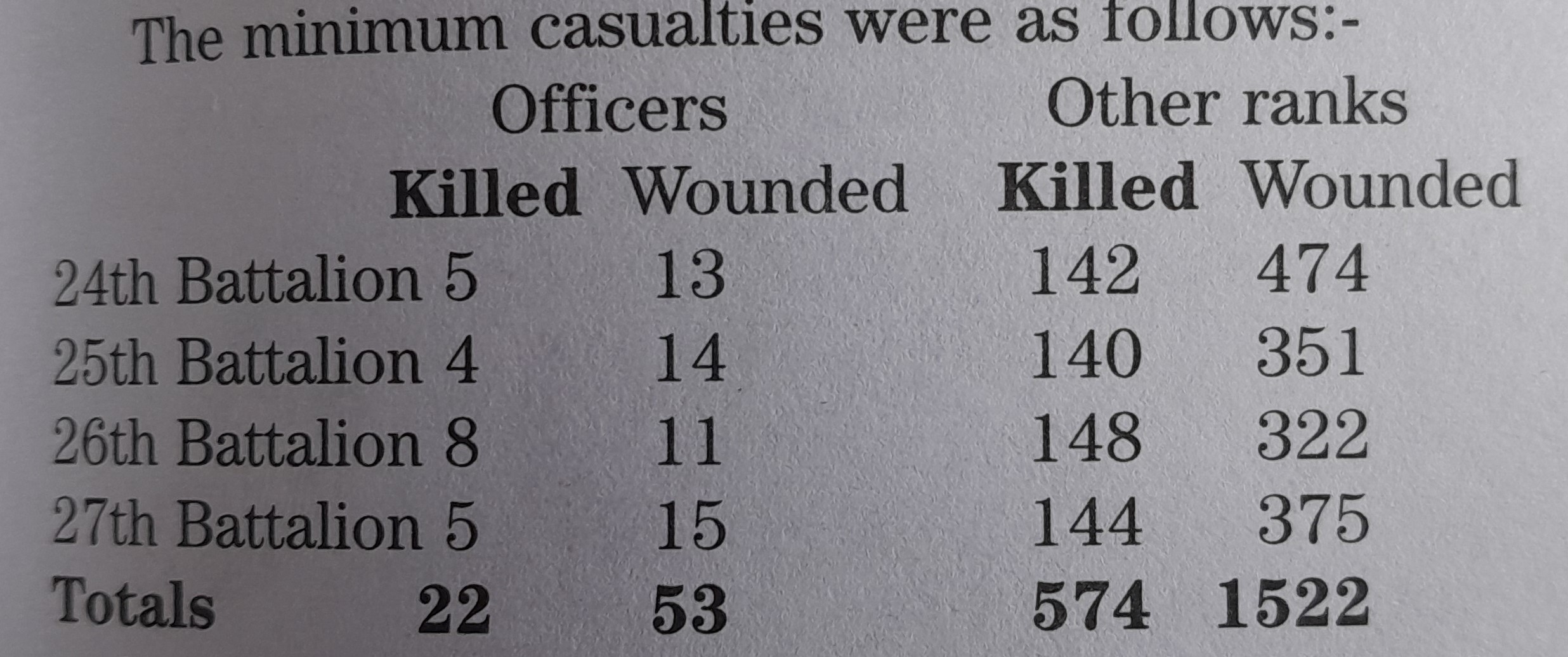
The casualty figures told a different story. The Tyneside Irish and Tyneside Scottish had sustained some of the highest number of casualties on that fateful day, for little territorial gain. The effects on the families of the fallen around Tyneside, Durham and Northumerland would be devastating. 

Tyneside Irish Casualties 1st July 1916

Source John Sheen, author                                                                                                                 Tyneside Irish 24th, 25th, 26th & 27th (Service) Battalions of Northumbeland Fusiliers

------0------

Tyneside Irish Uniform

Tyneside Irish Uniform
Tyneside Irish Collar Badges
Northumberland Fusilier Cap Badge

Tyneside Irish Uniform
1st Battalion Tyneside Irish Shouder Patch
24th Battalion Northumberland Fusiliers

------0------

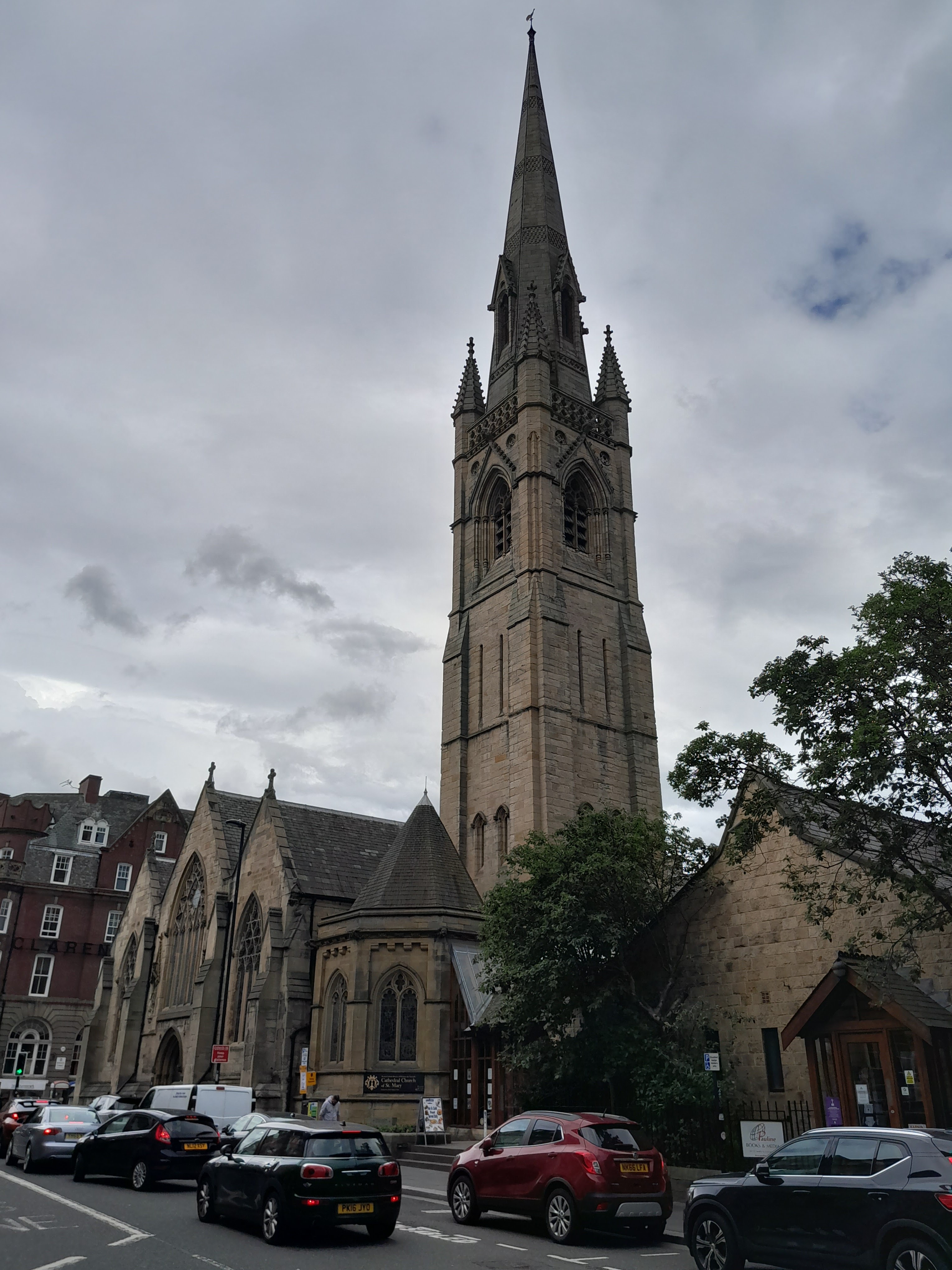
The Colour of the 27th Battalion Northumberland Fusilers, 4th Battalion Tyneside Irish can be found in St Mary's Cathedral, Newcastle.

St Mary's Cathedral Newcastle

27th Battalion Northumberland Fusilers
4th Battalion Tyneside Irish Colour


Friday, 3 June 2022

Queens Platinum Jubilee


Queens Platinum Jubilee Gun Salute Wallsend
101 (Northumbrian) Regiment Royal Artillery

Queens Platinum Jubilee
Newcastle Central Station

------o------


Sunday, 22 May 2022

Beamish - 68th Durham Regiment of Foot


The 68th Regiment of Foot (Light Infantry) was an infantry regiment of the British Army, raised in 1758. There first Colonel was John Lambton from Durham. 


In August 1782, it was decided to attach counties to regiments to aid recruitment, and the 68th was allotted to County Durham, becoming the 68th (Durham) Regiment of Foot. Under the Childers Reforms it amalgamated with the 106th Bombay Light Infantry to form the Durham Light Infantry in 1881.

They served in the Seven Years War (1756 to 1763) as Britian and France fougt for global pre-eminene. They fought in France and the West Indies, and spent some time stationed in the North East.


During the Peninsular War (1808 to 1813) against Napoleon, they fought at Salamanca, Vitoria, in the Pyrenees, crossing into France. In France they engaged in the Battle's of Nivelle and Orthez, and aftered the fighting was over they entered Bordeux in March 1814.


The 68th Foot were awarded their first battle honour Peninsular. They would not active service again for 40 years when they were involved in the Crimean War.  

------o------
BEAMISH
The Old 68th Durham Light Infantry Society and Display Team

The Old 68th Durham Light Infantry Society and Display Team have set up camp at Pockerley Old Hall this weekend! Watch drill displays, see musket-firing demonstrations and find out about life in the army in the 1800s. pic.twitter.com/VKcHQg3DCk
— Beamish Museum (@Beamish_Museum) May 21, 2022

Detachment 68th (Durham) Regiment of Foot

Detachment 68th (Durham) Regiment of Foot
Sergeant 

Soldier

Encampment

Mess Tent

Thursday, 19 May 2022

Amble - RAF Pinnace Memorial

IJ Warkworth Harbour Amble

On the 29 September 1969, RAF Search and Rescue craft Pinnace 1386 overturned while approaching Amble harbour in severe weather.

RAF Pinnace 1386

Approach to Amble Harbour looking towards Coquet Island

Amble lifeboats, together with HM Coastguard and the Search and Rescue squadron from RAF Acklington, spent hours attempting to rescue the crew of the stricken vessel. Local divers also joined in to help free the men. One crew member survived after Royal Navy divers managed to create a hole in the upturned hull, from which he managed to escape.

The crew members who died were Flt Lt Bell (Skipper), Cpl Ivil (Wireless Operator) and SAC Denson (Wireless Operator). They were the only three RAF Marine Branch servicemen to die while on active sea duty in the post war era. The survivor was Sgt Robert Moore BEM (Marine Engine Fitter).

A memorial located at the entrance to Warkworth Harbour, Amble, to RAF Pinnace was unvieled on 3rd June 2018.

Memorial to crew of RAF Pinnace 1386 - The Ambler

RAF Pinnace Memorial Warkworth Harbour, Amble

RAF Pinnace Memorial


Friday, 13 May 2022

Newcastle - Crown Posada Ships

The Crown Posada near the Quayside in Newcastle is an iconic pub. It was built in 1880 and was orgininally called 'The Crown'. It became the 'Crown Posada' in 1897. Posada is the Spanish word for 'resting place' and there are various stories as to why it was added to the pubs name. 

Crown Posada Newcastle

'The Crown' Newcastle

'Posada' - Resting Place

Crown Posada Newcastle

It may have been added to welcome the many Spanish sailors who docked their ships on the quayside when it was a place that cargos were unloaded. 

Newcastle Quayside 1897

It is also said the pub was bought by by a Spanish sea captain for his mistress on Tyneside.


Crown Posada IJ and VM

Crown Posada Newcastle

The pub has two stained glass windows, one depicting a Tudor Gentlemen drinking, the other a lady pouring beverages. 

Crown Posada Newcastle
Tudor Gentleman Drinking

Crown Posada Newcastle
Serving Lady

Another feature is the in pub entertainment, a 1950's record player and vinyl records.

Crown Posada Newcastle
1950's Record Player and Vinyl Records

The Crown Posada was a favoured location for a 'run ashore' for Royal Navy sailors from ships  visting the River Tyne.  To mark their visitt some left their sailors caps bearing the names of their ships.

Crown Posada Newcastle
Royal Navy Ships

HMS Appolo - Leander Class Frigate

HMS Appollo

HMS Lincoln - Salisbury Class Frigate

HMS Lincoln

HMS Blake -Tiger Class Cruiser

HMS Blake

Crown Posada Newcastle
Royal Navy Ships

HM Submarines  
HMS Onslaught an Oberon Class Submarine was one vessel that visited the Tyne.

HMS Onslaught

HMS Antrim - County Class Destroyer

HMS Antrim