Blog Search


Friday, 11 March 2022

Portsmouth 2022 - HMS Warrior


HMS Warrior IJ

HMS Warrior was Britain's first ironclad war ship being commissioned on 1st August 1861. 

HMS Warrior

The ship gave it's name to the Warrior Class warships which were built in response to the French Navy's launching of the first ironclad warship Gloire.

Warrior Class warships
HMS Warrior and HMS Black Prince

HMS Warrior was a steam powered with a full set of sails. It had a single gun deck mounting 19 guns on each side. A fore and aft chaser gun completed the armament of 40 guns.


HMS Warrior Portsmouth

The armament of 40 guns consisted of:
26 × Smoothbore muzzle-loading (SBML) 68-pdr (206 mm) guns
10 × Rifled breechloading (RBL) 110-pdr (178 mm) guns
4 × Rifled breechloading (RBL) 40-pdr (121 mm) guns

HMS Warrior 110 pounder RBL IJ

HMS Warrior RBL 110 pounder

HMS Warrior Gun Deck

HMS Warrior RBL 40 pounder

HMS Warrior opening the breech  TW IJ


HMS Warrior Crew Station on Gun Deck

HMS Warrior Rum Ration

HMS Warrior Officers War Room

HMS Warrior Officers Dining Room
HMS Warrior Officers Cabin

HMS Warrior conducted a publicity tour of Great Britain in 1863.

HMS Warrior departing Portsmouth

HMS Warrior practice firing

HMS Warrior was then employed on active working as part of the Channel Squadron. Ten years later she was made obsolete as warship as sail came to an end and transition to the steel armour plated ships. 

Portsmouth 2022 - HMS Victory

HMS Victory Portsmouth

 HMS Victory, preserved at the Portsmouth Historic Dockyard, is known for her part in the Battle of Trafalgar as Nelson's Flagship.

HMS Victory was built at Chatham Naval Dockyard where the keel was laid down on 27th July 1759. Around 6,000 trees, 90% of which were oak, were used in the construction, and the vessel was launched on 17th May 1765. Following the end of the Seven Years War (1756-1763), there was no active requirement for the ship. She was moored in the Medway, and fitted out gradually over a period of four years. Sea trials being conducted in 1769, after which she returned to anchor in the Medway. 

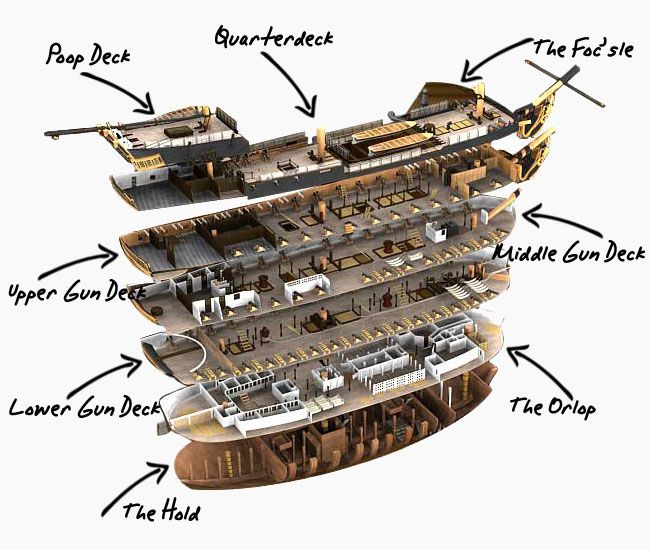
HMS Victory was a 104 gun first rate ship of the line, with three gun decks.


HMS Victory Deck

HMS Victory Ships Bell

HMS Victory Ships Wheel

HMS Victory


HMS Victory Deck Gun
HMS Victory Upper Gun Deck

HMS Victory Middle Gun Deck

HMS Victory Lower Gun Deck

It was not until 1778 that HMS Victory was commissioned after France joined the American War of Independence.

HMS Victory under sail

HMS Victory's first action during the American War of Independence was against the French at the First Battle of Ushant (Bay of Biscay) on 27th July 1778. The battle ended with an indecisive outcome. British victory was however secured on 12th December 1781. 

First Battle of Ushant

On 16th June 1779 Spain had entered the American War of Independence on the side of France. The Spanish used the opportunity to lay siege to Gibraltar. In October 1782. HMS Victory was part of a convoy protecting ships resupplying besieged Gibraltar. An indecisive battle took place of Cape Spartel against French and Spanish ships which allowed the supply ships to successfully reach Gibraltar and return to England. The Great Siege of Gibraltar ended in 1783 when peace talks began.

Relief of Gibraltar 1782

Britain and Spain were once again at war in 1797, and HMS Victory was back in action. The Royal Navy blockaded Spanish ports. At the beginning of the conflict, British were victorious over the Spanish Navy at the Battle of Cape St Vincent on 14th February 1797.

Battle of St Vincent 1797

On her return to England, HMS Victory was found to be unseaworthy and was declared unfit for active service in 1798. Destined to be converted for non-combatant use, her future as a ship of line line was saved with the loss of HMS Impregnable a year later. It was decided to re-condition HMS Victory, work commencing in 1800, and completed three years later. 

On the 18th May 1803, Vice-Admirable Lord Nelson hoisted his flag on HMS Victory from where he would command a British Fleet as Britain went to war against Napoleonic France.

Nelson and HMS Victory

HMS Victory Day Cabin

HMS Victory Nelsons Day Cabin

HMS Victory writing desk

HMS Victory Nelsons day room

HMS Victory Nelsons Sleeping Quarters

The decisive naval engagement against the French took place on the 21st October 1805 off Cape Trafalgar. It was Nelson's innovative tactics that defeated the French Navy.

Battle of Trafalgar

Battle of Trafalgar

Battle of Trafalgar HMS Victory in action

Vice-Admirable Lord Nelson would not see the victory his tactics brought about. 

Dr. William Beatty Victory's physician recounted..

About fifteen minutes past one o'clock, which was in the heat of the engagement, he was walking the middle of the quarter-deck with Captain Hardy, and in the act of turning near the hatchway with his face towards the stern of the Victory, when the fatal ball was fired from the enemy's mizzen-top.

The ball struck the epaulette on his left shoulder, and penetrated his chest. He fell with his face on the deck. Captain Hardy, who was on his right (the side furthest from the enemy) and advanced some steps before his lordship, on turning round, saw the Sergeant Major of Marines with two seamen raising him from the deck; where he had fallen on the same spot on which, a little before, his secretary had breathed his last, with whose blood his lordship's clothes were much soiled. 

Battle of Trafalgar Nelson lies wounded

HMS Victory - spot where Nelson fell

Captain Hardy expressed a hope that he was not severely wounded; to which the gallant Chief replied: 'They have done for me at last, Hardy.' - 'I hope not,' answered Captain Hardy. 'Yes,' replied his lordship; 'my backbone is shot through.'

Captain Hardy ordered the seamen to carry the Admiral to the cockpit.

It was there that Admiral Lord Nelson died. 

Battle of Trafalgar Nelson's death

HMS Victory Nelson's resting place


Portsmouth 2022 - Mary Rose

 When Henry VIII came to the throne in 1509 he inherited a navy of six ships. He adopted an aggressive foreign policy wanting to challenge France and Spain.  To protect newly developing trade routes and vital English Channel links, he began to build a fleet of ships. 

Construction of Mary Rose began on 29 January 1510 in Portsmouth, being launched in July 1511. The ship was towed to London and fitted with rigging and decking, and supplied with armaments. 

Mary Rose

The design featured a new innovation, gun ports This provided the capability of a  multi-gun deck increasing firepower dramatically in comparison to other ships. 

Onboard the Mary Rose gundeck

The Mary Rose first saw action on 10th August 1512 at the Battle of Mathieu when it engaged the French ship Grand Louise, shooting out her mainmasts. It was the first naval battle between ships with gun ports engaging each other at range with no attempt at boarding. 

Battle of Mathieu 1512

In 1513, the Mary Rose conveyed troops to the north of England where they would disembark and engage the Scottish troops at the Battle of Flodden. War with France ended in 1514, however conflict broke out again from 1522 to 1526, though there was little naval action. 

In 1534, Henry VIII broke away from the authority of the Roman Catholic Church in Rome and established himself as the head of the Church of England. The Pope demanded that Catholic monarchs of France and Spain remove Henry from power. 

Fearful of invasion, Henry mobilised his fleet. The Mary Rose underwent a refit with extra gun ports being added and the sides strengthen to accommodate the  weight of the extra guns. 

In 1543, Henry was once again at war with France. An expedition to France was in the main a failure, however Boulogne was captured in 1544. In retaliation, the French sought to capture Portsmouth.

In July 1545, 200 French ships set sail across the channel. They entered the Solent on 19th July 1545. Henry's navy engaged the French ships in the Battle of the Solent, the king watching the battle unfold from Southsea Castle.

Battle of Solent 1545
Southsea Castle

Battle of Solent 1545

The Mary Rose engaged the French ships firing her starboard guns, then turned to come around in order to fire her port guns. As the Mary Rose turned she listed over and sunk. Of her crew of 500, 35 men survived.

Sinking of the Mary Rose 1545

WHY THE MARY ROSE SANK


The wreck of the Mary Rose was recovered in 1971. The hulk and artefacts are displayed in a museum in Portsmouth Harbour. 

Mary Rose hulk

Mary Rose hulk

Mary Rose breach loading gun

Mary Rose wrought iron cannon

Mary Rose cast iron cannon

Mary Rose iron and bronze cannon

Mary Rose Master Gunners chest

Mary Rose cannon