Saturday, 15 September 2018

Op Lille - Canonniers Sedentaires de Lille Museum

The Lille Artillery Museum records the history of the Canonniers Sédentaires de Lille.

 
Canonniers Sédentaires de Lille Museum


Canonniers Sédentaires de Lille
 
Canonniers Sédentaires de Lille Museum
Tyneside Scottish Branch RAA
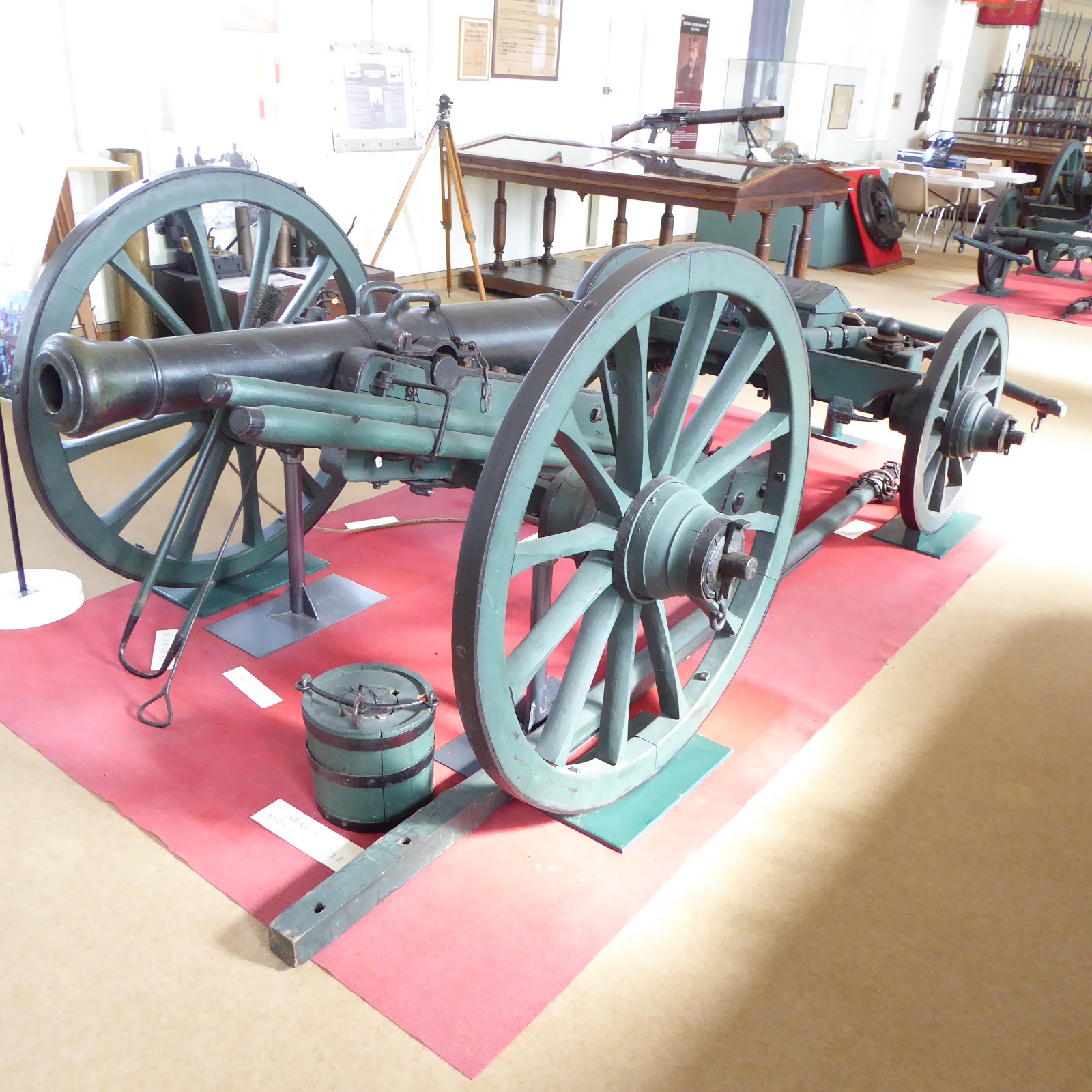
The museum contains two 4-pounder Gribaeuval cannons presented to the Canonniers  de Lille by Napoleon Bonaparte.
 
4-pounder Gribaeuval cannon

The système Gribeauval artillery system introduced by Lieutenant General Jean Baptiste Vaquette de Gribeauval during the 18th century. The method for the casting of gun barrels prior to the Gribeauval system was pouring molten metal around a clay core which was removed to leave the guns bore. This produced imperfections in the barrel preventing a tight fit of cannon balls resulting in loss of explosive power.
 
The Gribeauval system cast the barrel as a solid block. The bore was then drilled out allowing in a consistent and accurate bore. This resulted in increased accuracy and lighter artillery barrels for the same range as previous guns.
 
The 4-pounder Gribaeuval cannons were introduced in 1765 and used during the American Revolutionary Wars (1775-1783), French Revolutionary Wars (1792-1802), and the Napoleonic Wars (1803-1815).


4-pounder Gribaeuval cannon

4-pounder Gribaeuval cannon

4-pounder Gribaeuval cannon limbered for movement

4-pounder Gribaeuval cannon ammunition

4-pounder Gribaeuval cannons
 

Op Lille - Lille Citadel

The Citadel of Lille is located to the west of the city at the junction of the rivers Deûle and Bucquet. It was built between 1667 and 1670.

 Lille was part of Spain until 1667 when it was captured by the French. Louis XIV immediately ordered the construction of the citadel to defend the newly acquired city. It was one of 47 fortresses built during his reign.

Citadel de Lille

The citadel used the junction of the two rivers and swamp land to provide natural defences. A system of locks and water gates allowed land around the citadel to be flooded. if required. The pentagonal star shape allowed mutual support and enfilading fire to all approaches. The defences consisted of a series of canals, moats, bastions and ramparts.

Citadel de Lille and City

Citadel de Lille

Citadel de Lille - Canal Moat


Citadel de Lille - Outer Wall Fortification

Citadel de Lille - Entrance though outer wall

Citadel de Lille - Entrance to main citadel
 
Citadel de Lille - Entrance

The Citadel is still a functioning military installation. It is the Headquarters of the French Army Rapid Reaction Corps.


HQ Rapid Reaction Corps France


Saturday, 28 July 2018

Alnwick Castle Beating of Retreat

Northumbria Army Cadet Force
Beating of Retreat
Alnwick Castle


Casino Band and Band 5 RRF


VM                                    CG                             Paul


Casino Band and Band 5 RRF
 
Casino Band and Band 5 RRF


Post Horn Gallop


Casino Band  and Band 5 RRF


Saturday, 23 June 2018

Edinburgh - Wojtek


In 1941 the Polish Armed Forces in the East was formed in the Soviet Union. This consisted of soldiers loyal to the Polish Government in exile. After the German Invasion of the Soviet Union, the formation was evacuated to Persia (Iran) under the control of the Western Allies and designated the Polish II Corps.
Whilst en route to Tehran a group of soldiers purchased an orphan bear cub. The cub lived with the soldiers whilst they were in a refugee camp.


In August he was adopted by the 2nd Transport Company, later 22nd Artillery Supply Company and given the name Wojtek. The name us derived from Polish for “Happy Warrior”.
To obtain rations Wojtek. was enlisted into the Polish Army. Wotjek settled into Army life playing with the soldiers, enjoying the occasional beer and eating cigarettes.
The Polish Army moved from Iran, through Syria and Egypt to join the British Eight Army for the Italian Campaign.


It was at the Battle of Monte Cassino that Wojtek came to prominence. During the Battle he helped move 100 pound crates of 25 pounder shells.


 In recognition of Wojtek’s contribution, the official emblem of the 22nd  Artillery Supply Company became a bear carrying an artillery shell.


The Polish Army would fight their way north through Italy. When the unit moved Wojek would travel in the cab of a waggon.


At the end of the war, Wojtek. and the rest of the 22nd Artillery Supply Company were transported to the UK where they were stationed at Hutton, 8km (5 miles west of Berwick upon Tweed). On demobilisation Wojtek was given to Edinburgh Zoo. 


Wojtek passed away in December 1963 aged 21.


In 2015 a bronze statue of Wojtek. with a Polish Soldier was unveiled in Princess Street Edinburgh. A relief structure chronicles Wojtek's journey from Iran, through the war, to Edinburgh.

Polish Soldier and Wojtek
Polish Soldier Wojtek  and Sculpture telling the bears story
Wojtek Sculpture
Wojtek Polish Memorial


Saturday, 5 May 2018

Army v Navy 2018


Royal Oak
Pre Match Drinks
Twickenham

Twickenham

Army V Navy 2018 
Army V Navy 2018
In the picture somewhere !
Army V Navy 2018
Army Try

ARMY 22    NAVY 14 


Army V Navy 2018
Army - Babcock Trophy Winners
Army V Navy 2018


Friday, 4 May 2018

London - Whitehall MOD

Whitehall MOD
Iraq / Afghanistan Memorial
Whitehall MOD
Iraq / Afghanistan Memorial


Whitehall MOD
Korean War Memorial

Whitehall MOD
Field Marshall Slim

Whitehall MOD
Field Marshall Montgomery
 
 
Whitehall MOD
Field Marshall Alanbrooke