Battlefield tour to the area of the Battle of Cambrai 1917.
 |
| Battle of Cambrai 1917 - mass tank attack |
Tanks were first used on the Somme during the Battle of Flers-Courcellete in September 1915. They had subsequently been used during the Battle of Arras in April 1917, the Battle of Messines June 1917 and during the Third Battle of Ypres July to November 1917.
The tanks had been used in small numbers to support the infantry to secure key strongpoints. This had limited success, particularly in the mud of the Flanders battlefield during 3rd Ypres when the tanks ground to halt as they bogged in the quagmire.

The newly formed Tank Corps were keen to show the capability of their tanks. They had proposed a raid in the Cambrai sector, however the idea had been rejected at the time due to the need for resources for 3rd Ypres.
In October 1917 it had become obvious that the Flanders offensive would not achieve a breakthrough. Field Marshall Haig was keen to have a successful conclusion to 1917 so he now sanctioned the operation in the Cambrai - Op GY.
The Cambrai battlefield is dominated by Bourlon Wood on the left and extends on the right to the Gonnelieu and Bonavis Ridges. The sector was relatively unscathed by three years of war, and the ground today is similar to today.
 |
| View across the Battlefield to Bourlon Wood |
The Canal St Quentin ran between the main German defensive lines and running across the battlefield was the Flesquiers Ridge.
 |
| St Quentin Canal |
 |
| View to Flesquieres Ridge |
 |
| Cambrai Battlefield |
The German forces were ensconced on the Siegfried-Stellung, prepared defences in depth, which the British termed the Hindenberg Line. After heavy losses at Verdun and on the Somme during 1916, the Germans looked to shorten their line to reduce the number of troops required. Construction of the Siegfried-Stellung commenced in September 1916. It would consist of an outpost line, then three defensive lines. Fields of barbed wire up to 100 yards (91metres deep) were covered by machine gun fire.
 |
| Hindenberg Line Cambrai |
 |
| Hindenberg Line Cambrai - Barbed wire defences |
On 6th March the German Army commenced Operation Alberich, the withdrawal to the Siegfried Stellung. They laid waste to the area they left behind, destroying infrastructure, leaving booby traps and obstacles to cause disruption. After two weeks the German forces were firm on their new defensive lines.
 |
| Operation Alberich - withdrawal to the Hindenberg Line |
 |
| Hindenberg Line positions Cambrai |
Operation GY would be conducted by the British Third Army supported by 476 tanks from the Tank Corps. Third Army's intent was to break through the enemy defensive system by coup de main (surprise), seize crossing points on the St Quentin Canal, to allow the Cavalry Corps to invest Cambrai and exploit in depth. Key Ground would be sized the protect the flanks, Bourlon Wood on the left and Gonnelieu / Bonavis Ridge on the right.
The assault would be conducted by two Corps. On the right III Corps (6 / 12 / 20 / 29 Divisions), with IV Corps (36 / 51 / 62) left.
 |
| Cambrai dispositions and assault plan |
Leading the attack would be the tanks. They would breach the wire defences, then support the infantry to clear infantry the enemy trenches. Special wire pulling tanks would clear paths for the cavalry and guns to follow on.

 |
| Cambrai - Tank Battalion deployment |
There would be no preliminary bombardment. Surprise would be maintained by no pre registration of targets. Advances in survey, calibration and meteor meant that a method of 'silent registration' could be adopted and the guns could fire from map data. There would be 1,003 guns firing across a frontage of 10,000 yards (9,150 metres). The guns would fire a lifting barrage in order that the ground would not be damaged to enable easier passage for the tanks. Smoke would be used to screen the attackers and counter battery groups would target the German artillery.
 |
| Cambrai - IV Corps Fire Plan |
The attack would be supported by the Royal Flying Corps. They would bomb targets in depth, provide air observation for artillery and strafe targets along the German lines of defence.
 |
| Cambrai - Royal Flying Corps Scheme of employment |
The tanks were brought to railheads at Bertinourt, Ruyaulcourt (1st Tank Brigade), Ytres, Sorrel (2nd Tank Brigade), and Heudicourt (3rd Tank Brigade).
 |
| Cambrai - Tank transport trains |
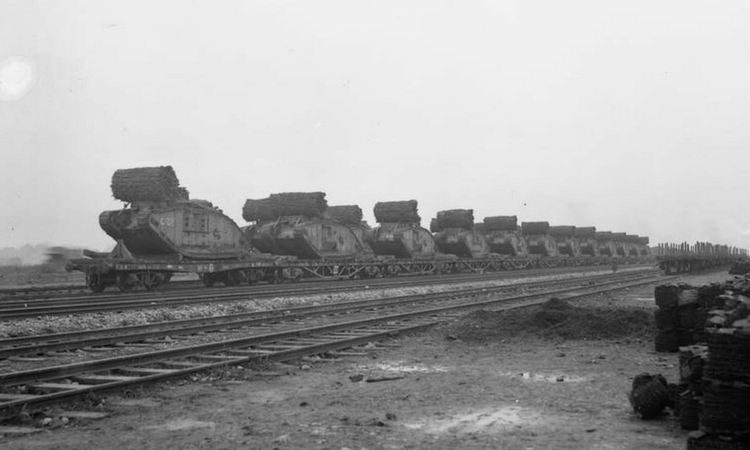 |
| Cambrai - Tanks transported to rail heads |
 |
| Cambrai - tanks offloading at railheads |
From 7th November 1917 onwards, the tanks moved into hides behind the front line in Havrincourt Wood, Dessart Wood, Villers Plouich, Villers Guislain and Gouzeaucourt.
 |
| Gouzeaucourt Military Cemetery |
Attached to the tanks were fascines, large bundles of wood four feet six inches in diameter and ten feet wide which would dropped into trenches which had been widened on the Hindenberg Line, allowing tanks to passage across the obstacles.
 |
| Mark IV tank with fascine |
The tanks would work in sections of three, one up two back. The lead tank would breach the wire, move along the trench perimeter firing into it to supress the enemy, turn back on its self continuing suppressive fire, before turning towards the trench, dropping its fascine, and crossing over. The two following tanks would follow on over successive lines of trenches in a similar manner.
 |
| Cambrai - Tank Tactics |
Following behind would be wire pulling tanks to clear a barbed wire to allow passage of cavalry and guns.
 |
| Cambrai - Wire Pulling Tanks |
Leading the operation from the front was Brigadier Hugh Elles, Commander of the Tank Corps. Boarding the tank Hilda, he attached a flag, the colours of which (brown/red/green) symbolised the struggle of the newly formed Tanks Corps;
Through the mud and the blood to the green fields beyond
 |
| Cambrai - Brigadier Elles boards Hilda |
At 06:40 20th November 1917, 1,003 guns opened fire to start the Battle of Cambrai. The tanks advanced lead from the front by Brigadier Elles in Hilda.
 |
| Cambrai - Brigadier Elles leads the attack in Hilda |
 |
| Cambrai - Through the Mud, Blood to Green Fields Beyond |
 |
| Batttle of Cambrai |
BATTLE OF CAMBRAI
20th November - 6th November 1917
The Battle of Cambrai was launched on 20th November 1917. The use of silent registration meant the bombardment followed by the deployment of tanks achieved surprise. The tanks quickly broke through the German outpost lines and penetrated up to 5 miles (8km). The success was such that the church bells rang throughout Britain to celebrate.
Despite the gains the main objectives were not achieved. On the first day only a few crossing points over the St Quentin Canal had been secured and only a small bridgehead was established over the canal. Bourlon Wood had not been captured and the British advance had been checked by determined German Gunners trained in anti-tank tactics. Bourlon Wood would not be secured till 27th November.
The Germans counter attacked between the 30th November and 7th December. Bringing in reserves to strengthen their forces, they launched 7 Divisions against British lines forcing them back reversing previously won gains.

Battle of Cambrai 1917