Friday, 24 March 2017

Arras - Souchez General Barbot Memorial

General Barbot Monument
Souchez
In October 1914 the French 10th Army clashed with the German 6th Army around Arras. To the east of the City, at Feuchy, General Ernest Barbot commanding the 77th Division engaged in ferocious fighting. His Division was pushed back towards Arras, whilst on his left flank, the 70th Division had lost the vital ground of Vimy Ridge.


First Battle of Artois


Barbot's Division withdrew into Arras. Rallying his men to defend the city the General declared;

Whilst I am alive we do not retreat. So, Gentlemen of the Staff go to the men. Raise their hearts! Repeat everywhere: We stand fast, we will not let Arras go!

Barbot's men fought till they were exhausted, but they were instrumental in saving the city before being relieved by the 45th Division.

General Ernest Barbot
The 77th Division were moved to the front in front of Souchez. On 9th May 1915, the French launched an offensive to try to capture Vimy Ridge supported by the British to the North (Battles of Festubert and Aubers Ridge).

2nd Battle of Artois
 
During this battle, on 10th May,  General Barbot was mortally wounded. He is buried in a simple grave in the Cemetery of Notre Damme de Lorrette.

 
General Barbot Grave
Notre Damme De Lorrette
 
In 1937, a memorial to General Ernest Barbot and his division was inaugurated in Souchez. He was a soldiers general, his popularity was such that 100,000 Veterans attened the monuments unveiling.  Général Keller read the address:

Général Barbot was a man who knew how to natter with his men, to praise their courage and his ease of attitude, far from diminishing his prestige, created an atmosphere of that mutual affection which can be found in men who pursue the same goal and expose themselves to the same dangers.


Arras - Albain Saint Nazaire

Selfie
Ablain St Nazaire
On the start of World War One, Germany enacted the Schlieffen Plan sweeping through Belgium forcing French and British Forces to retreat to the River Marne. After failing to penetrate further, the German Army withdrew to the River Aisne where they started to dig in.

The movements of both sides had left on open flank from the River Aisne, 170 km to the Channel Coast. Each side now tried to out flank each other and meeting engagements occurred during the phase which was termed the Race to the Sea.


In late September 1914 the French 10th and German 6th Armies moved towards each other, both intended on securing the vital high ground around Arras, Notre Damme de Lorrette and Vimy Ridge. The First Battle of Artois ended with Vimy Ridge and part of Notre Damme de Lorrette under German Control.

Arras Sector January 1915
During the Battle, the French had destroyed the Church at Ablain St Nazaire to prevent it being used as an observation post by the Germans.


Ruins of Ablain St Nazaire Church
looking towards Notre Damme de Lorrette
The Church dated back to the 16th Century. It was built by a local nobleman, Charles de Bourbon, to give thanks for a miraculous healing of his daughter.

Ablain St Nazaire Church
pre World War One
After the War the Church was not re-built, the ruins being left as they are, in memory of the French soldiers who lost their lives defending, and then recapturing the village.

Ablain St Nazaire Church
16th C Church Ruins
Ablain St Nazaire Church
16th C Church Ruins

Arras - Arras

The City of Arras can trace it's history back to pre-historic times with evidence of human habitation in the Scarpe Basin. It became a centre for trade, particularly in wool and textiles and flourished in medieval times. The Cathedral was constructed between 1030 and 1396, the Grande Ville between 1463 and 1554.

Arras 1716

 During World War One Arras was the scene of four major confrontations. German Cavalry patrols had entered the City at the end of August 1914, though the incursion was temporary, French troops moving into the City. The first major engagement around the City took place between 1st and 4th October as the German Sixth Army sort to capture the City. The Germans were held and would never enter the City throughout WW1.

Arras was only about 10 km from the frontline throughout the War and was heavily damaged.

Arras under attack WW1
Hotel de Ville Arras
Pre WW1

Hotel de Ville Arras
Ruins WW1

Hotel de Ville Arras
2017
Arras Cathedral
pre WW1

Arras Cathedral
WW1 Ruins

Arras Cathedral
2017
 The Cathedral was rebuilt on those parts of the former building which were not destroyed. The scars of the fighting are sill visible on the parts of the original structure.

Arras Cathedral
Scars of War

Arras Cathedral
Francis of Assisi
Grande Place
pre WW1


Grande Place
WW1 Ruins
 
Grande Place
 2017
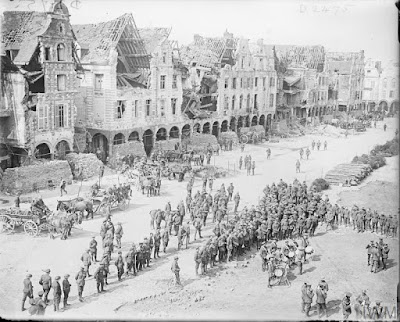
British Military Band Arras 30 Apr-17
Source: IWM Q6047
Russian Girl Band Arras 2017


Gare D' Arras
pre WW1
 
Gare D' Arras
WW1 Ruins
Gare D' Arras
2017
Arras Belfry
 
The Hotel De Ville dominates the Place De Heros.  The belfry provides views over the surrounding district.
 
Arras Hotel De Ville
 Belfry
 
Arras Hotel De Ville
 Belfry - At the top

Arras Hotel De Ville
View towards Notre Dame de Lorette / Vimy Ridge
 
Les Boves
 
Beneath Arras are a series of caves 'Les Boves'. These originated from the 10th century when they were excavated for building materials, in effect underground quarries. Many buildings around the Grand Place and  Place de Heros have cellars. Beneath the Hotel de Ville and extending under Arras are more man made caves. During World War One Les Boves were used to shelter troops from German bombardment.
 
Arras
Les Boves
Les Boves Grand Place
Arras
 
 
AROUND ARRAS


Place de Marshall Foche
Arras
Place de Marshall Foche
Arras War Memorial

Eglise Saint Jean Baptiste
Arras

Memorial to 56th (1st London Division)
Arras
French Resistance Memorial
Arras


ARRAS AT NIGHT
 
Grande Place
Arras
 
Hotel De Ville
Arras
 
Sellfie and Photo Bomb
Arras


Thursday, 23 March 2017

Arras - Battlefield Tour 2017

Arras
Hotel de Ville
The City of Arras is situated in the Artois Region of France, 220 km North of Paris, 100km from the English Channel Coast.

Artois Region of France

Lille lies 50km North East, with Ypres a further 50 km
Northern France and Belgium
Arras was the scene of major battles during WW1 as the French, Germans and|French fought to control the vital high ground that dominates the area. The key features that dominate the landscape being Notre Damme de Lorrette North of the City, with Vimy Ridge running North South to the River Scarpe.


Arras Ground
 
Panorama from Notre Damme de Lorrete towards Vimy Ridge
Panorama from Vimy Ridge over the Douai Plain

Panorama from Vimy Ridge towards Lens

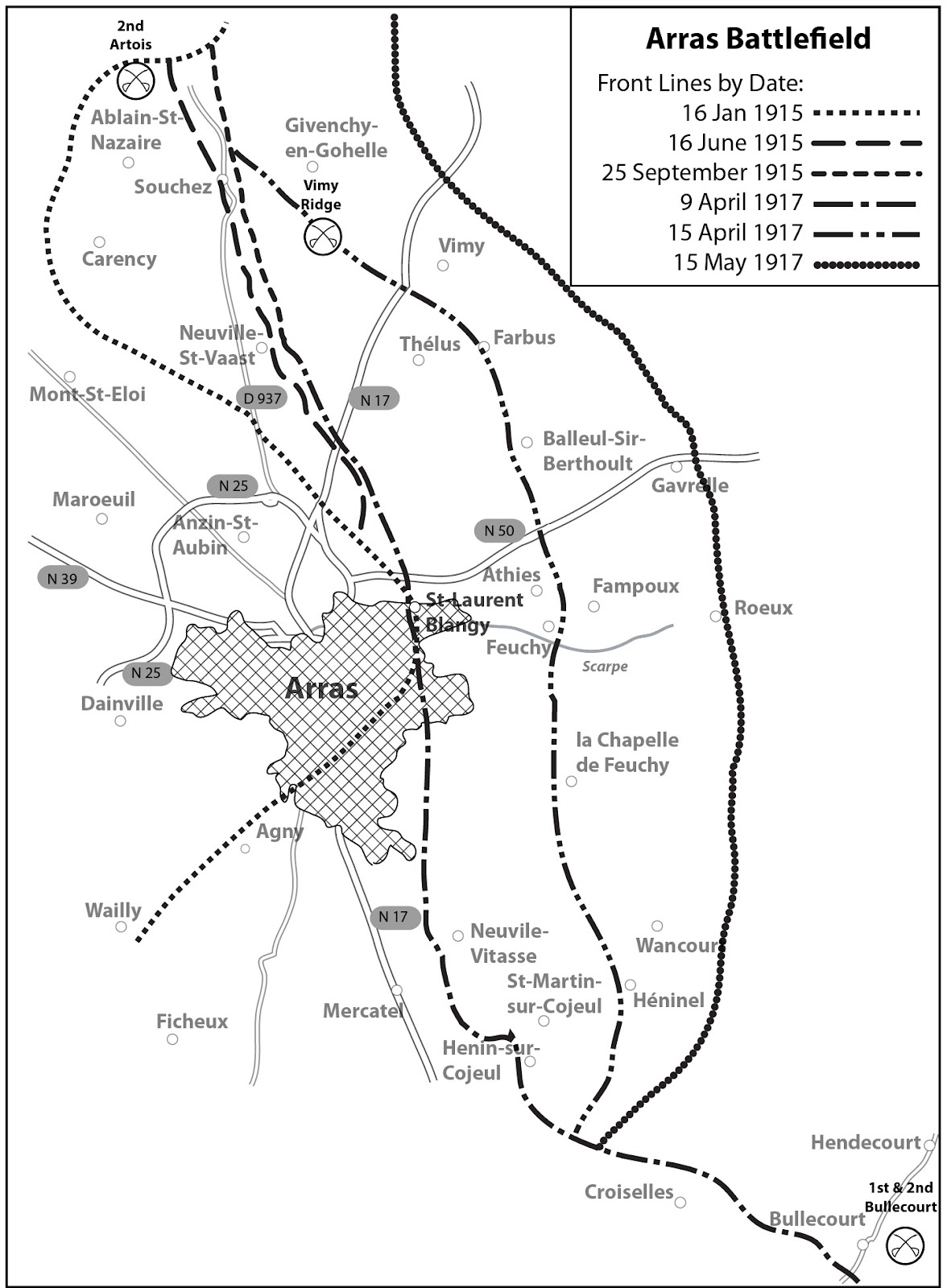
The first battles around Arras in the First World War occurred in September 1914 in the Phase known as the Race to the Sea. This left the Notre Damme de Lorrette partially in German hands, and Vimy Ridge under German control.  The French sought to regain the high ground launching attacks in May and September 1915 making some gains, but Vimy Ridge remained  as German territory.

In March 1916 the British 3rd Army relieved the French 10th Army and took over the Arras sector, extending the length of line held by the British to stretch form the River Somme to Dixmunde, North of Ypres.

In April 1917, a British / Canadian offensive captured Vimy Ridge.

Arras Battlefield 1914 - 1917
Source: www.frenchbattlefields.com

Arras Ground Brief