Tuesday, 24 February 2015

IWM London - Le Cateau VC's

Early in the morning of the 26th August 1914, the British II Corps were ordered to stand fast to the west of Le Cateau. The 37th Howitzer Battery RFA in support of the 5th Division deployed either side of a road in a covered position.

The weight of the German advance forced the BEF to withdraw, though their efforts were such that that a stopping blow forced the Germans to pause. This action allowed the BEF to commence a retreat which would ultimately stop on the River Marne.

During the battle, the 37th Howitzer Battery RFA had withdrawn 4 guns. Captain Douglas Reynolds found two horse teams when he retired to Remount, and decided to rescue the remaining two howitzers. He called for volunteers to assist him  and amongst them were Driver Job Drain and Driver Fred Luke.

Under heavy fire Captain Reynolds, Driver Drain and Driver Luke were able to rescue one of the guns. For their bravery Captain Reynolds, Driver Drain and Driver Luke were awarded the Victoria Cross.


The Victoria Crosses awarded to Drivers Darin and Luke are located in the Ashcroft Gallery in the Imperial War Museum London.

IWM Lord Ashcroft
Le Cateau VC's 

Driver Job Drain


London Gazette, 25th November 1914
Citation with Driver Drain: At Le Cateau on August 26th, 1914, as volunteers, these two drivers saved their guns from falling into the hands of the enemy, although it was at the time under heavy fire from hostile infantry, who were only 100 yards away.

IWM Lord Ashcroft Gallery
Drain VC

Driver Frederick Luke


London Gazette, 25th November 1914
Citation with Driver Luke: At Le Cateau on August 26th, 1914, as volunteers, these two drivers saved their guns from falling into the hands of the enemy, although it was at the time under heavy fire from hostile infantry, who were only 100 yards away.
 
IWM Lord Ashcroft Gallery
Luke VC


IWM London - Royal Artillery WW1

The Great War became dominated by Artillery.

In August 1914 the British Expeditionary Force deployed to France with 342 guns. The emphasis was on manoeuvre,  13 pounders and 18 pounders providing direct support to the infantry and the cavalry.

Imperial War Museum 13 pounder Gun

The first round fired on the Western Front was fired by E Battery RHA on 22nd August 1914


By the end of the war over 170 million rounds had been fired.

Imperial War Museum Artillery Shells

The transition to trench warfare called for heavy artillery and the expansion of the Royal Artillery.  By the end of the First World War there were 6,437 guns in France.

In 1914 the Royal Artillery fielded 3 Siege Batteries. In 1918 there were 400 Siege Batteries.

Imperial War Museum 9.2 inch Howitzer


IWM Visit - WW1 Galleries

Imperial War Museum London
The First World War Galleries
To commemorate the Centenary of the First World War the Imperial War Museum in London opened the WW1 Galleries. The exhibition chronicles the period from the pre war Britain and Empire through the conflict to the Armistice in 1918, and the aftermath. 
IWM London WW1 Galleries
French 75mm Quick Firing Gun

IWM London WW1 Galleries
Kitchener's iconic recruiting poster

IWM London WW1 Galleries
Kitchener Blues uniform

IWM London WW1 Galleries
American / British / French uniforms

IWM London WW1 Galleries
British SMLE Rifles

IWM London WW1 Galleries
British Weapons
Grenade rifle
SMLE rifle
Lewis gun
Mills bombs

IWM London WW1 Galleries
Vickers Machine Gun sowing interlocking fire

IWM London WW1 Galleries
Sopwith Camel
British Tank

IWM London WW1 Galleries
Financing the war

IWM London WW1 Galleries
Naval convoy model

Saturday, 21 February 2015

Imperial War Museum London

The Imperial War museum was founded in 1917 to record the military effort and sacrifices of the British Empire during the First World War. The museum was originally located in Crystal Palace and opened in 1920. It moved to South Kensington in 1924.  In 1936 the museum moved to the present location in Southwark , the buildings previously being the Bethlehem Royal Hospital. 

The museum and collections were subsequently expanded to record the Second World War and subsequent conflicts.

Imperial War Museum London

IWM London 15 inch Naval Guns
 In 1968 two 15-inch naval guns were mounted outside the museum. One had been on the HMS Ramillies and the other on both HMS Resolution and HMS Roberts. Both had been fired during World War two.

IWM London - Selfie

Friday, 13 February 2015

Beamish - WW1 Exhibits


Beamish Town printers - WW1 recruiting window

Beamish Town printers - WW1 recruiting window

Beamish Town printers - WW1 recruiting window

Beamish Town printers - South Shields tram

 Thomas Pascoe - Beamish Soldier


Thomas Pascoe
1st Field Ambulance
Royal Naval Division
Thomas Pascoe was born in 1881 and grew up at 8 Eden Terrace, Urpeth, a short distance from Beamish. He lived with his mother and step father Charles Blake.

Thomas worked as a miner and by 1911 he had married Elizabeth. had a daughter Mary (born in 1903)  and was living at 5 Wood Row, Beamish, he was a member of Beamish Methodist Church and the local St John's Ambulance.

He joined the 1st Field Ambulance Royal Naval Division in March 1915, serving in Gallipoli, Turkey and on the Western Front in France.

 
Royal Naval Division cards

Thomas Pascoe letters home
Thomas Pascoe died of wounds 4th January 1918. He is listed as serving in the Royal Marines Medical unit Royal Naval Division - service number Deal/3633(S).
Thomas is buried at ST. SEVER CEMETERY EXTENSION, ROUEN


Tuesday, 3 February 2015

March of the Tyneside Scottish - Alnwick Castle

Alnwick Castle
Alnwick Castle

Tyneside Scottish Alnwick Castle


***

March of the Tyneside Scottish - Alnwick

On the 30th January 1915 the 1st Tyneside Scottish (20th Battalion Northumberland Fusiliers) marched north from Morpeth via Felton en route to the new Army Camp built on the pastures to the north of Alnwick Castle.

At 4:30 pm the Battalion arrived on the outskirts of the town. When they reached Alnwick Station the Pipes and Drums struck up. The Tyneside Scots marched through the Bondgate and along the main street, the town turning out in force to welcome the soldiers to Alnwick.
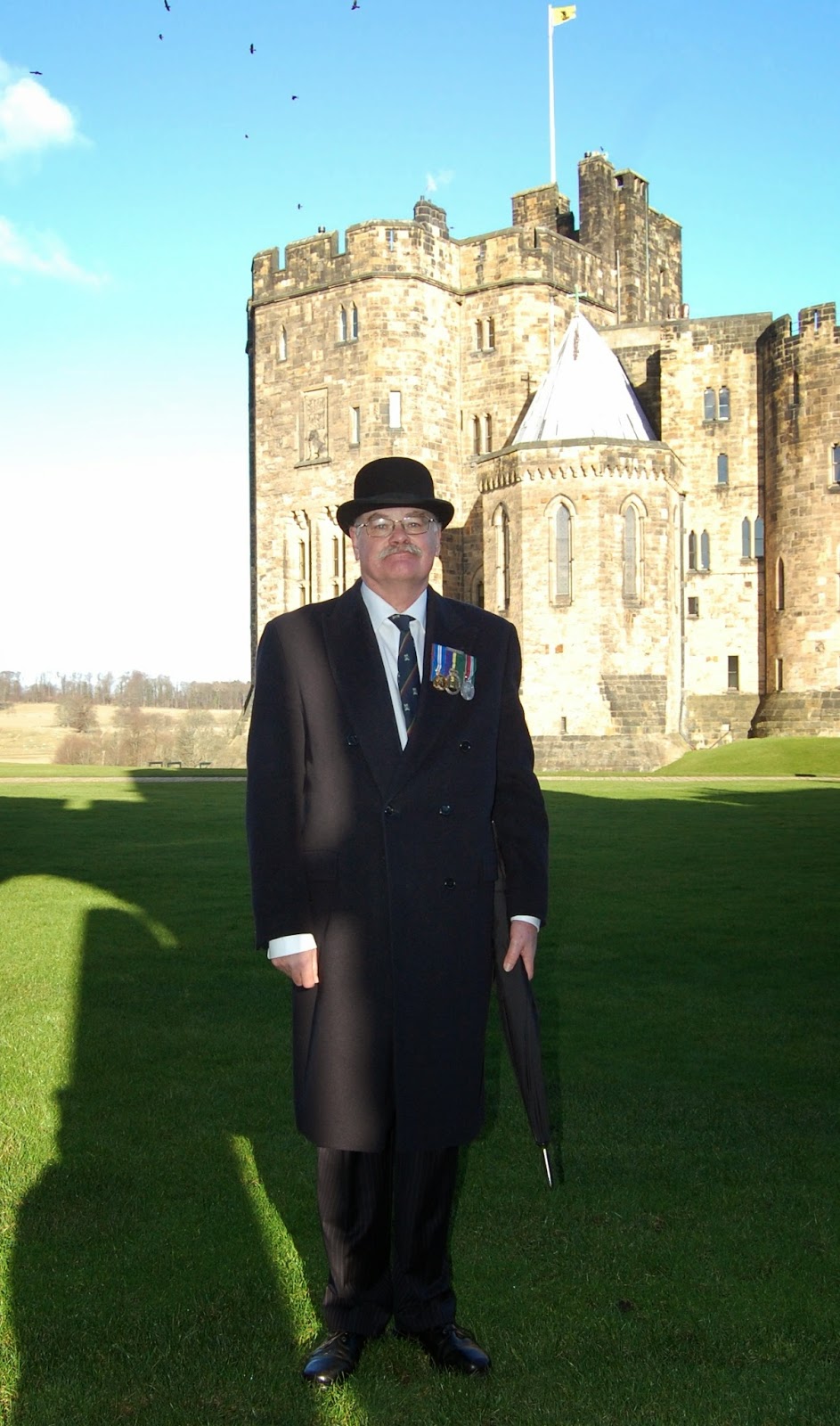
On Sunday 1st February 2015, 100 years later, the Tyneside Scottish once more marched through Bondgate into Alnwick. The Pipe band of Northumbria ACF led serving TS from 204 (Tyneside Scottish) Battery Royal Artillery, veterans from the Tyneside Scottish Branch RAA and the Tyneside Scottish detachments of Northumbria ACF down Bondgate, and into Alnwick Castle.

Tyneside Scottish approach Bondgate
Eyes right Alnwick War Memorial
Pipe band march through Bondgate
Marching through Alnwick

Tyneside Scottish approach Alnwick Castle
  
Tyneside Scottish march through Alnwick Castle

Tyneside Scottish march through Alnwick Castle


March of the Tyneside Scottish – Newcastle - Alnwick

In 1914, following the outbreak of the First World War men rushed to join the Colours. The influx  placed an immense strain on the accommodation available in barracks.

 The Tyneside Scottish like many of the Pals Battalions were forced to find accommodation in the local area. The Battalions were spread throughout Tyneside. Men were accommodated in Newcastle, Wallsend, Heaton, and Newburn.  Buildings were pressed into service as headquarters, quartermaster’s stores, billets and training locations.
 
 
 Whilst this met an initial need, the arrangements were not conducive to military training beyond basic skills. With support of the Duke of Northumberland, a new Army Camp was built on the pastures to the north of Alnwick Castle.


 In early 1915 the new camp was nearly ready and at the end of January 1915, the 1st Tyneside Scottish (20th Battalion Northumberland Fusiliers) departed from Newcastle to march to Alnwick. Prior to departure a civic reception, attended by the Lord Mayor was held.

On Saturday 31st January 2015, a service to commemorate the centenary of the March of the Tyneside Scottish to Alnwick was held in St Thomas the Martyr in Newcastle Haymarket. After the ceremony a wreath was laid at the Response memorial.


Tyneside Scottish March Commemoration
Wreath laying at the Response


MARCH OF THE TYNESIDE SCOTTISH


The route north would pass through Seaton Burn, Morpeth, Felton, then onto Alnwick. The first halt was at Seaton Burn where, following a rousing welcome by the inhabitants, the men were served a hot meal. Forty five minutes later, the men were on the move.


By late afternoon they reached Morpeth where they were welcomed by a vast crowd. The Battalion spent the night in billets, departing the following morning at 9:00 am lead by the Pipe band. By lunchtime they reached Felton.

“The visit of the 1st Battalion of Tyneside Scottish Fusiliers on their route march from Newcastle to Alnwick – that’s about 35 miles – was to the inhabitants of Felton an event of great interest. The village was bright with bunting and as the time grew near for their arrival, crowds gathered on the bridge and at various points of vantage. At about 11.15am the drums were heard followed by the strains of bagpipes and in a few minutes the head of the column was seen making the descent of the peth – the hill at the south side of Felton.”

After a meal on the recreation field, the Battalion left for Alnwick.