Blog Search


Friday, 13 February 2015

Beamish - WW1 Exhibits


Beamish Town printers - WW1 recruiting window

Beamish Town printers - WW1 recruiting window

Beamish Town printers - WW1 recruiting window

Beamish Town printers - South Shields tram

 Thomas Pascoe - Beamish Soldier


Thomas Pascoe
1st Field Ambulance
Royal Naval Division
Thomas Pascoe was born in 1881 and grew up at 8 Eden Terrace, Urpeth, a short distance from Beamish. He lived with his mother and step father Charles Blake.

Thomas worked as a miner and by 1911 he had married Elizabeth. had a daughter Mary (born in 1903)  and was living at 5 Wood Row, Beamish, he was a member of Beamish Methodist Church and the local St John's Ambulance.

He joined the 1st Field Ambulance Royal Naval Division in March 1915, serving in Gallipoli, Turkey and on the Western Front in France.

 
Royal Naval Division cards

Thomas Pascoe letters home
Thomas Pascoe died of wounds 4th January 1918. He is listed as serving in the Royal Marines Medical unit Royal Naval Division - service number Deal/3633(S).
Thomas is buried at ST. SEVER CEMETERY EXTENSION, ROUEN


Tuesday, 3 February 2015

March of the Tyneside Scottish - Alnwick Castle

Alnwick Castle
Alnwick Castle

Tyneside Scottish Alnwick Castle


***

March of the Tyneside Scottish - Alnwick

On the 30th January 1915 the 1st Tyneside Scottish (20th Battalion Northumberland Fusiliers) marched north from Morpeth via Felton en route to the new Army Camp built on the pastures to the north of Alnwick Castle.

At 4:30 pm the Battalion arrived on the outskirts of the town. When they reached Alnwick Station the Pipes and Drums struck up. The Tyneside Scots marched through the Bondgate and along the main street, the town turning out in force to welcome the soldiers to Alnwick.
On Sunday 1st February 2015, 100 years later, the Tyneside Scottish once more marched through Bondgate into Alnwick. The Pipe band of Northumbria ACF led serving TS from 204 (Tyneside Scottish) Battery Royal Artillery, veterans from the Tyneside Scottish Branch RAA and the Tyneside Scottish detachments of Northumbria ACF down Bondgate, and into Alnwick Castle.

Tyneside Scottish approach Bondgate
Eyes right Alnwick War Memorial
Pipe band march through Bondgate
Marching through Alnwick

Tyneside Scottish approach Alnwick Castle
  
Tyneside Scottish march through Alnwick Castle

Tyneside Scottish march through Alnwick Castle


March of the Tyneside Scottish – Newcastle - Alnwick

In 1914, following the outbreak of the First World War men rushed to join the Colours. The influx  placed an immense strain on the accommodation available in barracks.

 The Tyneside Scottish like many of the Pals Battalions were forced to find accommodation in the local area. The Battalions were spread throughout Tyneside. Men were accommodated in Newcastle, Wallsend, Heaton, and Newburn.  Buildings were pressed into service as headquarters, quartermaster’s stores, billets and training locations.
 
 
 Whilst this met an initial need, the arrangements were not conducive to military training beyond basic skills. With support of the Duke of Northumberland, a new Army Camp was built on the pastures to the north of Alnwick Castle.


 In early 1915 the new camp was nearly ready and at the end of January 1915, the 1st Tyneside Scottish (20th Battalion Northumberland Fusiliers) departed from Newcastle to march to Alnwick. Prior to departure a civic reception, attended by the Lord Mayor was held.

On Saturday 31st January 2015, a service to commemorate the centenary of the March of the Tyneside Scottish to Alnwick was held in St Thomas the Martyr in Newcastle Haymarket. After the ceremony a wreath was laid at the Response memorial.


Tyneside Scottish March Commemoration
Wreath laying at the Response


MARCH OF THE TYNESIDE SCOTTISH


The route north would pass through Seaton Burn, Morpeth, Felton, then onto Alnwick. The first halt was at Seaton Burn where, following a rousing welcome by the inhabitants, the men were served a hot meal. Forty five minutes later, the men were on the move.


By late afternoon they reached Morpeth where they were welcomed by a vast crowd. The Battalion spent the night in billets, departing the following morning at 9:00 am lead by the Pipe band. By lunchtime they reached Felton.

“The visit of the 1st Battalion of Tyneside Scottish Fusiliers on their route march from Newcastle to Alnwick – that’s about 35 miles – was to the inhabitants of Felton an event of great interest. The village was bright with bunting and as the time grew near for their arrival, crowds gathered on the bridge and at various points of vantage. At about 11.15am the drums were heard followed by the strains of bagpipes and in a few minutes the head of the column was seen making the descent of the peth – the hill at the south side of Felton.”

After a meal on the recreation field, the Battalion left for Alnwick.

Saturday, 20 December 2014

Edinburgh - Greyfriars Bobby and One O Clock Gun

Greyfriars Bobby belonged to John Gray who was employed as a watchman with Edinburgh City Police. When John Gray died in 1858, Bobby remained faithful and could be found everyday at his masters grave in Greyfriars Church Yard.  Initially people tried to get rid of the dog, however his loyalty was recognised and the locals began to feed him, and a shelter was set up for him.

Willliam IV Bridge and Greyfriars Kirk
In 1867 Sir William Chambers, the Lord Provost of Edinburgh paid for Bobby's licence, and gave the dog a collar. Among those who befriended Bobby was Colour Sergeant Donald Mcnab Scott  of the Royal Engineers.

C/Sgt Donald McNab Scott
Royal Engineers

Colour Sergeant Donald Scott  served as a surveyor with 14 Company RE mapping Scotland and the north of England for the Ordnance Survey Department, based at the  Ordnance Survey Office Melbourne Place.  While lodging at Candlemaker Row he became friendly with Bobby.It is said he trained the loyal Skye terrier to leave Greyfriars Kirkyard and go to Traill's restaurant on Candlemaker's Row for his lunch when the daily One o'clock Gun sounded.

 
Bobby died in 1872 and was buried not far from his master just inside the gate of Greyfriars Kirkyard, not far from John Gray's grave. A year later, Lady Burdett-Coutts had a statue and fountain erected at the southern end of George IV Bridge to commemorate him.


Greyfriars Bobby Public House
Candle Maker Row Edinburgh
Greyfriars Bobby Statue

Greyfriars Bobby Memorial

Greyfriars Bobby Story


Edinburgh - One O Clock Gun Edinburgh Castle


The One O Clock Gun is fired from The Mills Battery in Edinburgh Castle everyday at 13:00

One O Clock Gun Edinburgh Castle
 
One O Clock Gun - FIRE - Edinburgh Castle

Master Gunner Edinburgh Castle

Edinburgh - One O Clock Gun Exhibition Edinburh Castle

The chronometer was the primary mechanism for measuring longitude and relied on ships instruments being set accurately. The problem of measuring longitude was solved by John  Harrison who developed clocks and watches to measure time accurately on board ship, and was successfully trailed by Captain James Cook in 1776.

To set their chronometers, ships captains would need to leave their ships and set the time by refrence to master clocks maintained for that purpose in ports.The One O Clock time signal was instituted to allow ships captains to set their chronometers without leaving their ships.One O clock was selected as the time for the signal as it allowed readings to be taken at mid day.


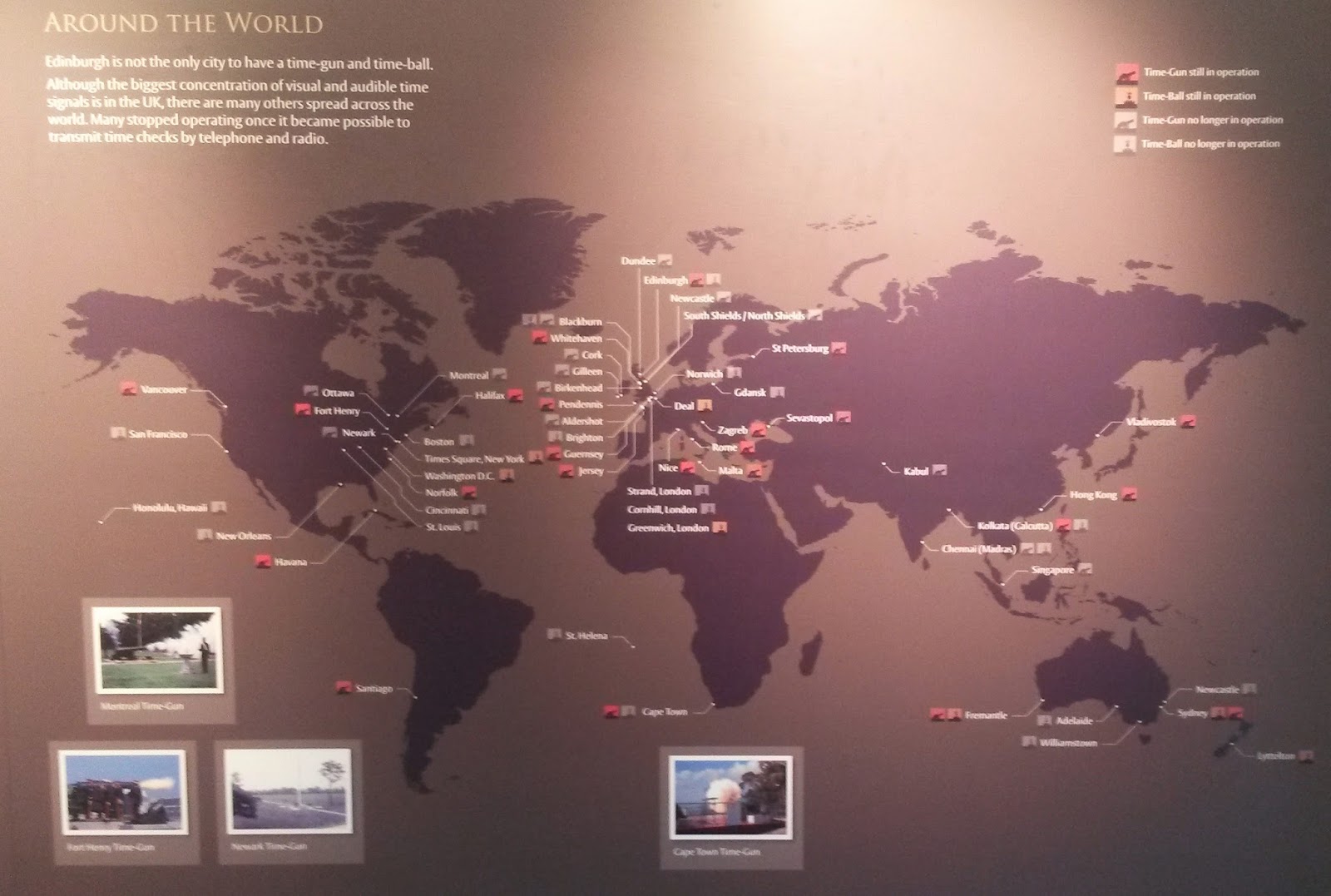
The first time signal was instituted at Portsmouth in 1829  and consisted of a ball dropped from a mast. In 1833, a time ball was set up at the Greenwich Observatory. The East India Company decided to set time balls up along their trade routes, leading to the mechanism being adopted around the world. A further development was the introduction of guns being fired to signal the time.


The time ball in Edinburgh was set up on the Nelson Memorial on Carlton Hill in 1853. An electric signal from the adjacent observatory triggered the ball being dropped. Unfortunately the signal was difficult to spot in foggy weather. In 1858 it was therefore proposed that a gun be fired on Carlton Hill to signal one o clock. There was concern the gun firing would disturb the instruments, so it was decided to fire the gun from Edinburgh Castle. A 4,000 feet (1,220 metres) wire connected the time ball on Cartlon Hill to the gun on the Half Moon Battery.

The first firing occurred 7th June 1861.


Half Moon 2
One O Clock Gun fired from Half Moon Battery
Although the gun would fire at precisely One O Clock, the sound would take a number of seconds to travel, consequently to set time accurately it would be necessary to know the exact time the noise of the firing was heard. This lead to the publishing of Sound Maps for Edinburgh.


In 1863 the observatory was connected to time guns in Newcastle and South Shields.

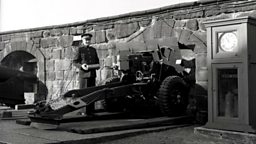
The first One O Clock Gun was a 12 pounder muzzle loader, which was replaced by a 18 pounder muzzle loader in September 1861. In 1913 a 32 pounder Dwarf Gun was used, which would be replaced in July 1923 by an 18 pounder QF Gun. In 1952 a 25 pounder became the One O Clock Gun.


The location for firing moved to the Mills Mount Battery overlooking Princess Street in 1971.

One O Clock Gun 25 pounder

 In November 2001 the 25 pounder was replaced by a 105mm Light Gun.

One O Clock Gun - 105mm Light Gun

Edinburgh Castle One O Clock Gun Exhibition

Edinburgh Castle One O Clock Guns
Model Exhibition


Friday, 19 December 2014

Edinburgh - Field Marshall Haig Statue Edinburgh Castle

Situated in the Edinburg Castle's Hospital Square occupied by the Scottish National War Museum is a bronze statue of Field Marshall Douglas Haig, the controversial commander of the British Expeditionary Force from 1915 to the end of the war.

Haig was born in Charlotte Square, Edinburgh in June 1861, his father heading the family business of Haig Whisky.

Field Marshall Haig on a charger
Statue - Field Marshall Haig on a charger

The statue was presented to the City of Edinburgh by Sir Dhunjibhoy Bomanji of Bombay "in admiration of the services rendered to the British Empire by the Field Marshal.” and was unveiled in 1923.  It was initially located on the Esplanade, where, during the period of the Edinburg Tattoo it was enveloped by seating.


Earl Haig Statue, Edinburgh Castle Esplanade. (Colin Smith) / CC BY-SA 2.0
The statue was relocated to outside the Scottish National War Museum and re-dedicated in March 2011.

FM Haig statue Edinburgh Castle Hospital Square 

FM Haig statue Edinburgh Castle


Field Marrshal Douglas Haig