Friday, 29 April 2011

Somme - Elswick Battery Position

The 3rd Northumberland Battery (known as the Elswick Battery) became C / 250 Battery in the May 1916 reorganisation of the Royal Field Artillery. It was deployed along with the three other batteries of 250th Brigade just off the road between Contalmaison and Bazentin le Petit.
During 250th Brigade’s occupations in this area, C/250th Battery suffered more casualties from counter battery fire than the other three sub units.

Elswick Battery position
Somme September 1916

Somme - Contalmaison

The 5oth Northumbrian Division did not deploy to the Somme till August 1916. The Division moved into the line in September, in preparation for the Battle of Flers Courcelette. This was the Northumbrians first set piece battle; it was to be the first time the Divisional Artillery was to fire a creeping barrage, and it was going to be the first battle that the British Army used tanks.

The 250th Brigade RFA (1st Northumbrian Brigade) occupied gun positions in the area of Contalmaison. The Brigade HQ was in the crypt of the church.

Contalmaison Church
NVAA briefing 2011

Contalmaison Church
250 Brigade RFA HQ 1916


Saturday, 23 April 2011

Somme - Albert Communal Extension Cemetery

Albert Communal Extension Cemetery

CWGC Albert Communal Extension Cemetery
In the Albert Communal Cemetery extension is a communal grave of 12 soldiers, 11 Gunners from the 41st (Durham) Siege Battery RGA, and 1 attached from the Army Service Corps. The Soldiers were killled 14th July 1916. The Extension was used by fighting units and Field Ambulances from August 1915 to November 1916. The cemetery was designed by Sir Edwin Lutyens.

The 41 Sge Bty was formed under Major H.C. Hall, and was composed half of regulars from Hong Kong and Singapore, and half of territorials from the Durham RGA. 41 Siege were were equipeed with 2 x 6 inch Howitzers,and went out to the Western Front 9th Dec. 1915.


Laying a wreath in memory of the Durham RGA Gunners


Durham Royal Garrison Artillery
Gnr JP Frankland
Gnr JH Henderson
Gnr TW Lee
Gnr J Sweeting

41st Siege Battery RGA
Gnr JW Burr
Gnr S Caldicot
Gnr FE Goldsworth
Gnr E Hickman
Gnr CJ Hutchings
Gnr JJ Mulhill
Gnr CE Scott

Army Service Corps
Pte G Atkins

41st (Durham) Siege Battery
ConnunalAlbert Communal Extension Cemetery

Somme - Montabaun

On the 1st July the 30th Division was to attack to the right, 18th Division left, with the 9th Division in reserve. The three stage plan was supported by a creeping barrage. The 3oth Division was tasked with securing their first objective between the Maricourt Ridgeand Montauban by 8:28 am, and  the plan was to achieve this with two Brigades. Once the initial objecto9ves were secured, the remaining Brigade would pass through and seize Montauban


Montauban was another success for the British. Counter Battery fire had destroyed many of the German guns so there was little enemy artillery response to the British advance. The preliminary bombardment had been effective. Many of the German soldiers were suffering from exhaustion and shell shock. Consequently only small pockets of resistance existed. In Montauban it’s self the only thing found alive was a fox.

  In sharp contrast to the Pals memorial at Serre which signified the slaughter on the Somme, the Pals from Liverpool and Manchester who secured the village on 1st July 1916 had achieved their objective, and advanced the furthest of any unit on the first day of the Somme

Somme - Fricourt and Mametz

The objectives of XV Corps were the villages of Fricourt and Mametz.  The strong defences in Fricourt and Fricourt Wood ruled out a direct frontal attack. The plan was the 21st Division would outflank Fricourt to its north. The 7th Division would capture Mametz, link up with the 21st Division, and then a brigade from each Division would assault Fricourt.

The British finally achieved some success. In this area counter battery fire had been effective and many of the German guns were destroyed or neutralised. A creeping barrage was used allowing the infantry to close on the German trenches. Mametz was secured; Fricourt would fall on the 2nd July to the 21st Division, which included the 12th and 13th Battalions of the Northumberland Fusiliers.
Success was not without casualties. The 10th West Yorks at Fricourt sustained the heaviest casualties for a British Army unit on a single day throughout the war, 22 Officers and 688 other ranks.
Included in those casualties was Major JL Knott of Close House, Wylam, and son of Tyneside shipping owner John Knott. John Knott used his influence to have his son buried next to his brother in Ypres, the latter being killed in action in 1915
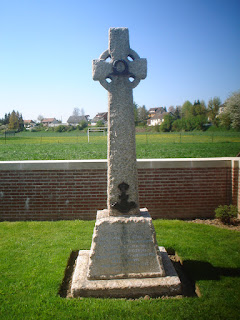


Memorial Fricourt

Somme - Lochnagar Crater

Lochnagar Crater


In preparation for the assault on La Boiselle two large mines had been laid under the salient formed by the trenches around La Boiselle. To the north was Y Sap, 40,000 pounds, and to the south, Lochnagar, 60,000 pounds.

The mines were detonated 2 minutes before zero hour, the crater left by the Lochnagar explosion remaining to this day.
http://www.flashearth.com/?lat=50.015601&lon=2.697328&z=15.1&r=0&src=msl


 Friends of Lochnagar Crater

Somme - La Boiselle

 The plan was the 34th Division (including the Tyneside Scottish and Tyneside Irish Brigades) to attack on the right. The axis of attack was on the Fricourt Spur astride Sausage Valley as far as La Boiselle. On the left, the 8th Division would capture the German defences north of the Baupane Road on the western slope of the Ovillers spur, as well as the village of Ovillers.


Counter Battery fire had failed to silence the German guns mainly as a result of poor cooperation with the Royal Flying Corps.
The 34th Divisional Artillery had conducted a series of 6 lifts. Each lift would then search back form its line meaning the infantry could not stay close to the fire. The attack failed.

In October 1914 the Tyneside Irish requested Artillery Brigade. The 160th Brigade RFA was raised in early 1915 by Alderman Stanefield Richardson, the Mayor of Sunderland and the Recruiting Committee. The Brigade was allocated to the 34th Divisional Artillery and supported the Tyneside Brigades during the Battle of the Somme.

The Tyneside Scottish and Irish seat was unveiled on the 20th April 1922 by Marshal Foch.


Marshal Foch unviels Tyneside Scottish memorial April 1922

Tyneside Scottish Memorial April 2011

***

MARSHAL FOCH

Somme - Thiepval

 The 32nd Division’s objective was to capture the village of Thiepval. On the left flank, the 96th Brigade, including the 16th Battalion Northumberland Fusiliers (Newcastle Commercials) kicking a rugby ball ahead of them, were cut down by heavy machine gun fire on leaving their trenches, many being forced into the 36th Division area,


The preliminary bombardment saw a good concentration of guns of all calibre allocated counter battery fires. However, with only six, eight or twelve rounds per target, fire was nor affective, and the enemy guns were not silenced.

During the attack, the barrage ran away from the infantry as they were slowed down by the heavy German machine gun fire. Command and control was at a higher level, consequently deviations from the plan to deal with troublesome machine guns could not be dealt with by the batteries. Two 9.2 inch howitzers tasked with the destruction of machine guns at Thiepval were themselves destroyed when one had a premature.

Thiepval


Laying a wreath on behalf of 101 Regiment Royal Artillery (Volunteers)