Thursday, 3 November 2016

New York 2016 - Washington Square

Washington Square is situated at the start of 5th Avenue. The Square was formed in 1826 when the land was levelled and made into a parade square. It was used by volunteer militia companies to train.

To celebrate the centennial of George Washington's inauguration, a temporary archway made from wood and plaster was erected in 1889. The structure was so popular that a permanent arch made of marble was constructed in 1892. The design was based upon the Arc de Triomphe in Paris, and includes two statues of George Washington, one at War (as Commander in Chief) and one at Peace (as President).

Washington Square Arch looking up 5th Avenue
New York City
The military use of the square extended into the 20th century, with Victory Parades from both World Wars featuring American troops marching through the arch.

Washington Square Arch NYC
WW 1 Victory Parade
Washington Square Arch NYC
WW2 Victory Parade

World Trade Centre viewed from
Washington Park NYC

New York 2016 - New York City Hall

City Hall is the seat of the New York City Government. It t is located in Lower Manhattan between Broadway and Park Avenue, and opposite the entrance onto the Brooklyn Bridge.


City Hall
New York City
Brooklyn Bridge
New York
 
 Construction on the building commenced in 1803, and completed in 1811. In 1861, City Hall could have become the seat of government for an independent New York City State. There were growing tensions between the Northern and Southern States over the question of Slavery. Those in the North were largely anti-slavery, however New York City as a America's financial hub made large revenues from goods and services supplied to the Slave States. Many had Southern sympathies and in City Hall, as was happening in the Southern States, debate about leaving the Union took place.
 
 
New York City Hall
Council Chamber
 On 12th April 1861, tensions between North and South developed in to War. The Southern Confederate States commenced bombardment of Fort Sumter, near Charleston, South Carolina, and the American Civil War commenced.  Fort Sumter fell to Confederate Forces the next day.
 
Fort Sumter South Carolina
Bombardment 12th April 1861
 
American Civil War
Union and Confederate States
The attack on Fort Sumter raised powerful feelings in New York and led to may displays of loyalty to the Union, the biggest being a rally in Union Square.

City Hall Park, became the focus for recruitment of Union Volunteers and enlistment offices were set up. By the end of  May 1861, 30,000 men had volunteered for the Union cause. Over 150,000 would enlist over the course of four years of war.


City Hall Park Recruitment


City Hall Park - IJ

7th New York Volunteer Infantry Regiment
New York City Hall


New York 2016 - American Merchant Mariners Memorial

Located in Battery Park, NYC, near Pier A is a memorial to American Merchant Mariners who have lost their lives at sea from the American Revolutionary War in 1775 to the present day. The memorial looks onto new York Harbour with views towards Ellis Island and Liberty Island.

 
American Merchant Mariners Memorial Pier A
Battery Park NYC
 
 The inscription on the Memorial on the memorial reads:
 
Dedicated to all Merchant Mariners who have served America from the Revolutionary War through the present day. In the prosecution of war and in pursuit of peaceful commerce, unrecognized thousands have lost their lives at sea. Their sacrifices have helped secure America’s liberty and prosperity.
The sculpture was inspired by a photography of the victims of a submarine attack on an American merchant ship during World War II. Left to the perils of the sea, the survivors later perished.

This memorial serves as a marker for America’s Merchant Mariners resting in the unmarked ocean depths.
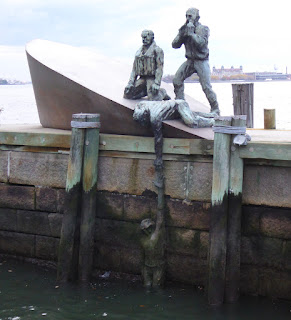

American Merchant Mariners Memorial
NYC
  The memorial is based upon an incident which was photographed by a German submarine after they has sank an American merchant ship. It depicts three seamen in a lifeboat, one of who is trying to rescue a sea mate from the water. At low tide the whole torso of the man can be seen in the water, at high tide only his head and outreached hand. The German submarine did not pick up the survivors and the men were lost at sea.

Pier A  NYC


New York 2016 - Battery Park Korean War Memorial

Korean War Memorial
Battery Park NYC

Korea had been a Japanese Colony since 1910. Following Japan's defeat in World War Two, Korea was partitioned along the 38th Parallel. To the North  it was under the influence of Soviet Russia, the South was under control of an American military administration.


The Soviets supported a  Stalinist regime under the control of Kim Il-sung. They created the North Korean Peoples' Army and equipped it with Russian tanks and artillery. The American backed administration in the South was under the presidency of of Syngman Rhee, whose openly declared aim was the imposition of national unity by force. The forces in the south consisted only of a lightly armed gendarmerie, lacking tanks, artillery and combat aircraft.

The tensions in Korean were only one part of rising political differences between East and West which would be defined as the Cold War.

Tensions on the 38th parallel had caused a number of incidents. This finally escalated into War when the North Koreans began an invasion of the South on 25th June 1950.


The North Korean Army advanced rapidly against the lightly equipped South Koreans. They pushed south, rapidly occupying much of Korea, their intent was to occupy the vital port of Pussan. 


In response, America hurriedly despatched troops form the Army of Occupation in Japan. Under command of Colonel Smith, Task Force Smith deployed to Korea. The first engagement of American troops took place 5th July 1950 at Ossan and the port of Pussan remained in control of the South.

The deployment of more US Troops, plus troops directed by the United Nations led to the front being stabilised. In September 1950 the American lead forces launched an offensive, striking out of the bridgehead in the south and landing two divisions deep in occupied territory at Inchon.


The Offensive was a success. The North Koreans were not only pushed back North of the 38th Parallel, American and United Nation troops advanced deep into North Korea towards the Chinese Border.


 In Peking the Chinese fearful of  American intervention in China began a build of troops on the Korean Border. Over 200, 000 troops were secretly amassed and on 25th October 1950 the Chinese launched their offensive.


The attack took the American forces by surprise and they were forced back. A US counter offensive in November failed and the Americans were forced back to the 38th Parallel. Fighting continued through the first half of 1951, but a stalemate resulted .


Talks for an Armistice began 10th July 1951. The talks would drag on another two years and would result in borders being established on the 38th Parallel and a De-Militarised Zone between the 2 countries.


The Korean War involved United Nations troops from United States, United Kingdom, Canada, Turkey, Australia, Ethiopia, Philippines, New Zealand, Thailand, Greece, France, Colombia, Belgium, South Africa, Netherlands, and Luxembourg, in support of South Korean forces.

The losses for the UN Forces amounted to 178,405 dead and 32,925 missing and  566,434 wounded.
 

New York 2016 - Battery Park

Battery Park located on the tip of Manhattan was used since the 17th Century as the location for an artillery battery to protect the seaward approaches to the Port of New York.

Artillery Battery 1793
Manhattan Island


 The fort was built 1811, and was known as the West Battery. It was one of five forts built to protect the harbour of New York. The East Battery was located on Governors Island. The battery never saw action. In 1815 the fort was named Castle Clinton, named after the Mayor of New York.

⍐                   Battery Park Island
                New York


The island was joined to Manhattan between 1853 and 1872 by landfill, and the area landscaped.


Port of New York
Battery 'Island' converted into a Park
 
Manhattan Island
Battery 'Island' converted into a Park


Battery Park
Castle Clinton

Battery Park
Castle Clinton
Located in the gardens around Castle Clinton is the 'Sphere' which was located in middle of the World Trade Centre Towers. It managed to remain relatively undamaged after the 9/11 attacks and was removed. Exactly six months after the attacks, it returned to Manhattan to it's present location.   An eternal flame burns in front of the Globe in memory of those lost on 9/11.

The Sphere  and Entrnal Flame
Battery Park NYC


Battery Park
Looking up West Street towards One World Trade Centre
 
 The Staten Island Ferry Terminal is located next to Battery Park.
 
Staten Island Ferry


Wednesday, 2 November 2016

New York 2016 - Mychal F Judge Street - 31st

On the 11th September 2001 the Chaplain of the New York Fire |department, Father Mychal Judge, joined the First Responders at the World Trade Centre. Establishing himself at an emergency command post in the North Tower, he offered comfort to the rescuers and those injured.  When the South Tower collapsed at 9:59 am, debris from the building flew into the North Tower, and amongst those killed was Father Judge.

Shortly after the collapse, his body was found and carried out of the North Tower. Father Judge was later designated as the first victim of the attack.

To remember the Fire Department's Chaplain, 31st Street in New York, has been named as Father Mychal F. Judge St.


A memorial to Father Judge can be found at the Fire House for Engine 1, Ladder 24, 142 West 31 Street.

FDNY Memorial to Father Mychal Judge
Fire House West 31 Street New York

Father Mychal Judge
FDNY Chaplain

Mychal Judge

New York 2016 - O'Haras Bar

O Hara's Bar is situated on the corner of Greenwich Street and Cedar Street. The bar is located adjacent to the World Trade Centre Memorial.

New York
O'Haras Bar & One World Trade Centre
The interior is covered in badges from Fire and Police departments across America and the World.

New York O' Haras Bar
 
New York O' Haras Bar


In the bar is a scrapbook recording the events of 9/11 and O'Haras bar.

O'Haras Bar
9/11 Scrap Book

O'Haras Bar Greenwich Street

O'Haras Bar Greenwich Street
O'Haras Bar US Soldiers

O'Haras Bar IJ


New York 2016 - Trinity Church

Trinity Church is located on Broadway near the intersection of Wall Street., 400 metres south of the World Trade Centre.

New York
Trinity Church Broadway
The original Trinity Church was built in 1698, and was destroyed in the Great New York City Fire of 1776. A replacement was consecrated in 1790, however this was structure was weakened by severe storms in the winter of 1838-39, and pulled down. The current church was constructed in 1846, and it's 86m (260ft) spire was the tallest building in New York till 1890.

When the World Trade Centre was attacked on 9th September 2001 and the Twin Towers collapsed, the church was undamaged apart from a few broken windows, despite it's proximity of the WTC.


The church became a place of shelter for the rescue workers at Ground Zero, a place they could rest, be fed and seek comfort. Volunteers manned the church to provide the facilities. Inside the church banners and messages from all over world were sent in support of the Ground Zero workers.

Sanctuary at Ground Zero

The rescue workers would sleep on the pews within the church. exhausted by the work and conditions many would rest in their work clothes, the boots and heavy equipment leaving scratch marks on the pews. The marks were left as a reminder of those involved in the Ground Zero rescue efforts.

The Pews at St. Paul's Chapel - National September 11 Memorial


To remember those lost on 9/11 and to recognise the part played by Trinity Church in supporting those at Ground Zero,  the church has a simple memorial chapel.    
 
New York
Trinity Church 9/11 Chapel Altar
New York
Trinity Church 9/11 Chapel Exhibit