Showing posts with label Menin Gate. Show all posts
Showing posts with label Menin Gate. Show all posts
Friday, 7 March 2025


Sunday, 15 March 2020
Ypres 2020 - Menin Gate Last Post
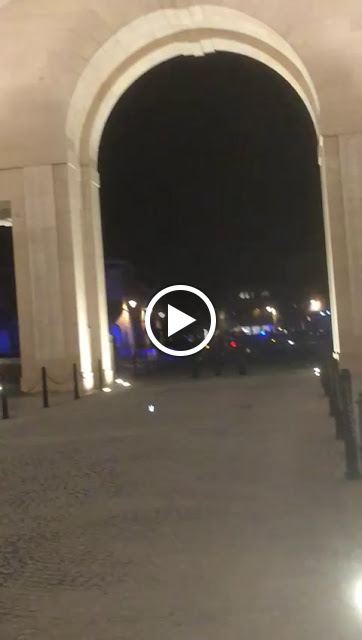
Menin Gate Last Post Ceremony Sunday 15th March 2020.

On the 14th March 2020, Belgium went into a lockdown as part of the response to the Covid-19 virus. The Last Post Association announced that public attendance at the daily 20:00 ceremony was suspended. The Fire Brigade buglers would continue with the daily ceremony in remembrance of the soldiers of the British Commonwealth.

The ceremony on Sunday 15th March 2020 was conducted with no crowds and no formal ceremony, only the buglers sounding Last Post.

On the 14th March 2020, Belgium went into a lockdown as part of the response to the Covid-19 virus. The Last Post Association announced that public attendance at the daily 20:00 ceremony was suspended. The Fire Brigade buglers would continue with the daily ceremony in remembrance of the soldiers of the British Commonwealth.

The ceremony on Sunday 15th March 2020 was conducted with no crowds and no formal ceremony, only the buglers sounding Last Post.
 |
Menin Gate Last Post
Sunday 15th March 2020
|
 |
Ypres Cloth Hall
Sunday 15th March 2020
|


Ypres 2020 - LEGO Menin Gate
 |
| LEGO Menin Gate |
Located in the Commonwealth War Graves Commission information centre in Ypres is a LEGO model of the Menin Gate. The model consists of 54,000 bricks, one for every casualty named on the Menin Gate.
 |
| LEGO Menin Gate |
 |
| LEGO Menin Gate inscription |
 |
LEGO Menin Gate
Buglers and Pipe Band
|
 |
LEGO Menin Gate
Spectators
|
 |
Op Drum - Menin Gate 2012
Somme Battlefield Pipe Band
|
 |
| CWGC Information Centre Ypres |
Friday, 13 March 2020
Ypres 2020 - Post WW1 Ypres
An exhibition chronicling the reconstruction of Ypres after World War One was on display on the In Flanders Field Museum.
Ypres developed as a prosperous city based on the trading of textiles during medieval times. Two iconic buildings, the Cloth Hall and St Martins Cathedral were built at the beginning of the 11th century, each taking over 100 years to complete.
During the First World War Ypres was destroyed by German shelling, starting in November 1914 during the First Batle of Ypres when the Cloth Hall caught fire.
As the war concluded, the citizens of Ypres began to return to their ruined city, intent on rebuilding it. The was not the view shared by the British Government, notably War Minister Winston Churchill who stated;
" I would like us to acquire the whole of the ruins of Ypres. A more sacred place for the British race does not exist in the world"
British Empire troops had fought around Ypres continuously from October 1914 till the last shells fell in October 1918, as the Allies pushed back the Germans from the area. During those four years, the Ypres Salient had claimed the lives of 185,000 British Empire troops, with many more injured, and affected the lives of all who served there.
The British regarded Ypres as the "holy ground of British arms" and placed notices in the ruins to that affect.
A compromise was reached with the British being given permission for the building of a monument to the British Empire troops, and the Belgians would reconstruct Ypres.
In September 1919, Sir Reginald Blomfield of the Imperial War Graves Commission (forerunner to the Commonwealth War Graves Commission) recommended that a memorial to the missing be built at the Menin Gate "because it was by the Menin Gate that our men went out to fight"
The Menin Gate lies on the west of Ypres and it's entrance before World War One was marked by two stone lions.
Construction of the Menin Gate commenced in July 1923, and completed in April 1923.
The Menin Gate was unveiled on 24th July 1927 by Field Marshal Lord Plummer.

 |
In Flanders Field Museum
|
Ypres developed as a prosperous city based on the trading of textiles during medieval times. Two iconic buildings, the Cloth Hall and St Martins Cathedral were built at the beginning of the 11th century, each taking over 100 years to complete.
 |
| Ypres Cloth Market and St Martins Pre War |
During the First World War Ypres was destroyed by German shelling, starting in November 1914 during the First Batle of Ypres when the Cloth Hall caught fire.
 |
| Ypres Cloth Hall pre World War One |
 |
| Ypres Cloth Hall on fire November 1914 |
 |
| Ypres Cloth Hall ruins during WW1 |
As the war concluded, the citizens of Ypres began to return to their ruined city, intent on rebuilding it. The was not the view shared by the British Government, notably War Minister Winston Churchill who stated;
" I would like us to acquire the whole of the ruins of Ypres. A more sacred place for the British race does not exist in the world"
 |
| Ypres in ruins after World War One |
British Empire troops had fought around Ypres continuously from October 1914 till the last shells fell in October 1918, as the Allies pushed back the Germans from the area. During those four years, the Ypres Salient had claimed the lives of 185,000 British Empire troops, with many more injured, and affected the lives of all who served there.
The British regarded Ypres as the "holy ground of British arms" and placed notices in the ruins to that affect.
 |
| Ypres Cloth Hall 2020 - Notice of Holy Ground |
 |
| Ypres 1919 - Notice of Holy Ground |
 |
British perception of Ypres
"Holy ground of British Arms"
|
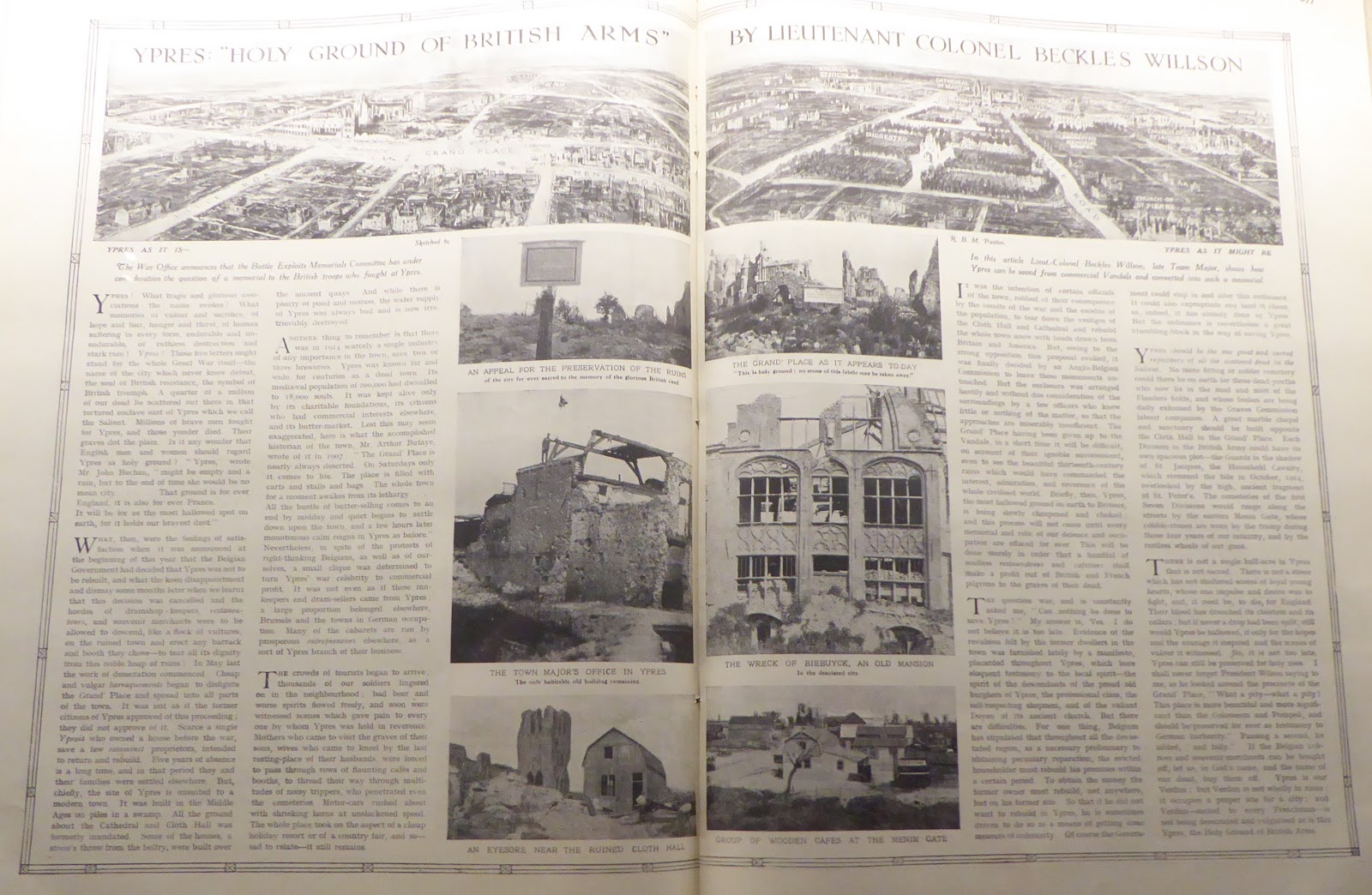 |
British perception of Ypres
"Holy ground of British Arms"
|
 |
| In Flanders Field Museum Exhibition |
A compromise was reached with the British being given permission for the building of a monument to the British Empire troops, and the Belgians would reconstruct Ypres.
 |
| Re-construction of Ypres |
 |
| Re-construction of Ypres |
 |
| 2020 Ypres Cloth Hall |
In September 1919, Sir Reginald Blomfield of the Imperial War Graves Commission (forerunner to the Commonwealth War Graves Commission) recommended that a memorial to the missing be built at the Menin Gate "because it was by the Menin Gate that our men went out to fight"
The Menin Gate lies on the west of Ypres and it's entrance before World War One was marked by two stone lions.
 |
| Menin Gate pre World War One |
During the First World War thousands of soldiers would pass through the gate going to and form the front line.
 |
| Soldiers going to and from the front line |
Construction of the Menin Gate commenced in July 1923, and completed in April 1923.
 |
| Menin Gate under construction |
The Menin Gate was unveiled on 24th July 1927 by Field Marshal Lord Plummer.
 |
| Invitation to citizens of Ypres to attend unveiling of Menin Gate |
 |
| Unveiling of Menin Gate 24th July 1927 |
 |
| Menin Gate and unconstructed Ypres through the gate |
 |
| Menin Gate and re-constructed Ypres through the gate |
 |
| 2020 Ypres Menin Gate |

Saturday, 2 July 2016
Ex Reflect Somme - 2nd Northumbrian Brigade RFA
 |
| 2nd Northumbrian Brigade RFA Ypres Extension Cemetery |
The Germans had released gas and tried to breakthrough the British lines, but were held by gallant actions of Canadian and British troops.
The 50th Northumbrian Division were used to reinforce formations fighting in the Salient. The 2nd Northumbrian Brigade RFA deployed in support of 28th Division.
 |
| 2nd Northumbrian Brigade RFA Location 24th May 1915 |
capture the Bellewaarde Ridge. The Brigade War Diary of records intensive artillery fire from the early morning.
At 7pm a German shell exploded on No. 1 gun killing 5 of the detachment and severely wounding the No 1. The war dairy records the loss of;
Corporal JA Carr and Gunners JW Clarke, G Robinson, JW Rowbottom, AW Venus.

At 08:30 Driver Wilson was killed.

The six men were buried at 11:20

The Gunners remains were discovered in 2013. They were identified from their shoulder titles which identified them as members of the North Riding Battery from the 2nd Northumbrian Brigade RFA. Two of the six men could be identified; Gunners JW Rowbottom, AW Venus.
They were all reinterred on April 20th 2016 at a ceremony held in Ypres Town Cemetery Extension Cemetery. In the presence of the British Ambassador to Belgium and families, a burial party from 4th Regiment RA finally laid the men to rest.
 |
| Ypres Town Cemetery Extension Cemetery |
 |
| North Riding Battery Graves Ypres Town Extension Cemetery |

F II Grave 33
A SOLDIER OF THE GREAT WAR
Royal Field Artillery

F II Grave 34
A SOLDIER OF THE GREAT WAR
Royal Field Artillery

1308 Gunner
A.J. ROWBOTTOM
Royal Field Artillery

F II Grave 36
A SOLDIER OF THE GREAT WAR
Royal Field Artillery

F II Grave 37
A SOLDIER OF THE GREAT WAR
Royal Field Artillery

F II Grave 38
1817 Gunner
A.W. VENUS
Royal Field Artillery
At the Last Post Ceremony at the Menin Gate on the eve of the 1st July 2016 I laid a wreath in memory of the men of the 6 Gunners of the 2nd (Northumbrian) Brigade Royal Field Artillery.
 |
| Menin Gate 1st July 2016 |
Subscribe to:
Posts (Atom)