Showing posts with label Operation Dynamo. Show all posts

Sunday, 11 March 2018

Dunkirk - Dunkirk Memorial


The Dunkirk Memorial commemorates 4,505 casualties of the British Expeditionary Force who have no known grave, most of whom were lost during the Battle of Dunkirk.

Dunkirk Memorial

The centre piece of the memorial is a window depicting scenes from the Dunkirk Evacuation in 1940.

Dunkirk Memorial
Window of scenes from Dunkirk Evacuation

Dunkirk Memorial
Window of scenes from Dunkirk Evacuation

Dunkirk Memorial
Window of scenes from Dunkirk Evacuation


Dunkirk Memorial Window
Wreaths 

The memorial is inscribed:

Here beside the graves of their comrades are commemorated the soldiers of the British Expeditionary Force who fell in the campaign of 1939–1940 and have no known grave.

The memorial records the names of 542 men of the Royal Artillery.

Dunkirk Memorial
Remembering the men of the Royal Artillery

On the side of the memorial are panels recording the names of some of those who were lost.


Dunkirk Memorial
1st Battalion Tyneside Scottish
Black Watch

A series of pylons record more names.

Dunkirk Memorial

Dunkirk Memorial
Royal Artillery panel

 One of those lost whose name is on the memorial is John Travers Gray of 74 (Northumbrian) Field Regiment RA (TA) from South Shields.


 The memorial lists 9 Gunners from 72 (Northumbrian) Field Regiment RA (TA)

Rank
 

Initials
 

Surname
 

Date of Death
 

Gnr

J

HORNER

23/05/1940

Sjt

J

INGLIS

23/05/1940

L/Bdr

F

JAMES

31/05/1940

Gnr

RR

SHEPHERD

26/05/1940

Gnr

J

BIRTLEY

23/05/1940

Gnr

GT

COXON

31/05/1940

L/Bdr

M

KIRVEN

31/05/1940

Gnr

WH

LEWIS

31/05/1940

Gnr

F

McCRINDLE

31/05/1940

CWGC Gunner Joseph  Horner
CWGC Serjeant John Inglis
CWGC L/Bdr Frederick James
CWGC Gunner  Richard Raymond Shepherd
CWGC Gunner James Birtley
CWGC Gunner George Thomas Coxon
CWGC L/Bdr Michael Kirven
CWGC Gnr William Henry Lewis
CWGC Gnr Frederick McCrindle

Adjacent to the Dunkirk Memorial is the Dunkirk Town Cemetery.
 
Dunkirk Town Cemetery
 
 
The cemetery contains 1,042 graves from both World Wars. There are 460 casualties from the First World War. The town was shelled through out WW1 and was a hospital centre.  
 The 792 graves from the Second World War include 213 unidentified casualties. As well as those killed during the Battle of Dunkirk, the cemetery contains graves of bodies washed up on the beaches in the aftermath of the evacuation.
 

Dunkirk Town Cemetery
Cross of Sacrifice

Dunkirk Town Cemetery
Rifleman E Ricketts Cameronians
25th May 1940
Gunner JL Boyd Royal Artillery
27th May 1940
2nd Cameronians
11 Bty. 3 Searchlight Regiment RA 


Dunkirk Town Cemetery
Lt Col PA Kirsop MC & Bar TD RA
Died 27th May 1940

 
Lt Col Purves Alexander Kitson was killed whilst serving with 58 Light Anti-Aircraft Regiment Royal Artillery. During WW1 he was commissioned in the Argyll and Sutherland Highlanders winning his first MCin 1916 whist seconded to the Suffolk Regiment. He was awarded bar to the MC in July 1918 with the 8th Argyll and Sutherland Highlanders. After the war he served with 9th Battalion Argyll and Sutherland Highlanders, retiring in 1933 after commanding the Battalion. He was awarded the Territorial Decoration in 1928. In August 1939 he was recalled to the Colours to command  58 LAA Regiment RA.
 
Dunkirk Town Cemetery
Lt Colonel ENW Birch OBE RASC
27th May 1940
Private CN Rigby West Yorks
31st May 1940


Dunkirk Town Cemetery
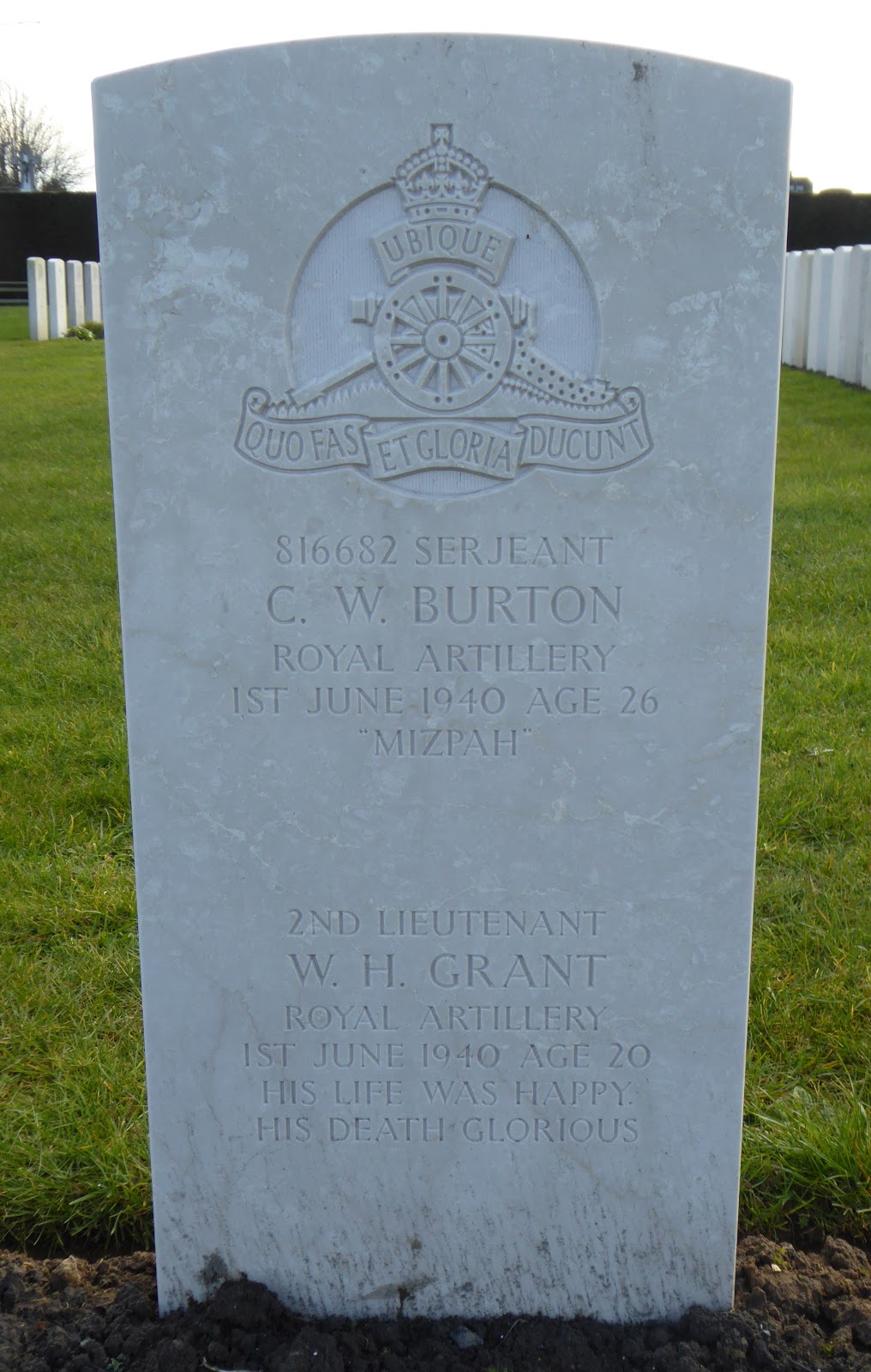
Serjeant CW Burton Royal Artillery
2/Lt WH Grant Royal Artillery
Both died 1st June 1939
 
21st Anti-Tank Regiment RA
 
Dunkirk Town Cemetery
L/r MGH May Royal Artillery
1st June 1940
Unknown Soldier of 1939-45 War
21st Anti-Tank Regiment RA
 
During the evacuation the losses included 9 destroyers and 200 merchant vessels. This resulted in many losses at sea and in the weeks after the operation bodies were washing up on the beaches around Dunkirk. The dates on headstones after 3rd June are indications that some of the graves belong to those whose bodies were found in the aftermath of the evacuation.
 
Dunkirk Town Cemetery
Unknown Lance Bombardier Royal Artillery
Soldier Rank and Regiment unknown
16th June 1940

Dunkirk Town Cemetery
Unknown Soldiers of the Second World War
Two Soldiers 14th August 1940
Five Soldiers 12th August 1940
Three Soldiers 12th August 1940
 

In the Dunkirk Town Cemetery are the graves of two Northumbrian Gunners, Gunner Robert Lawrence Massam [72 (N) Field Regiment RA (TA)] and Gunner Joseph Ridley  [74 (N) Field Regiment RA (TA)].

Dunkirk Town Cemetery
Gunner RL Massam
31 May 1940
72 (Northumbrian) Field Regiment RA (TA)


Dunkirk Town Cemetery
Gunner J Ridley
27 May 1940
74 (Northumbrian) Field Regiment RA (TA)
 
Dunkirk Beach


Dunkirk - Dunkirk Harbour

 
In May 1940 the British Expeditionary Force were withdrawing to Dunkirk to be evacuated to England. The intent was to rescue the troops from three beaches and the harbour of Dunkirk. Operation Dynamo would resulted in the evacuation of 338,226 troops, of which 239,446 would be rescued from Dunkirk, the vast majority from the East Mole.

Dunkirk Harbour
Looking towards the East Mole
Dunkerque
Dunkirk

On the 27th May 1940 the German Luftwaffe heavily bombed Dunkirk. As well as causing extensive damage to the town, the harbour facilities were rendered inoperable. The towns water supplies were knocked out making the extinguishing of fires impossible.

Dunkirk 1940
German Luftwaffe Air Raids
Dunkirk 1940
German Luftwaffe Air Raids
Dunkirk 1940
Oil facilities burning
 
Dunkirk 1940 - Dunkirk Harbour
Dunkirk 1940 - Ruins
Dunkirk - scene in March 2018
 
The lack of harbour facilities together with the difficulties of evacuating from the beaches meant it took hours to fill the ships waiting offshore. During this time they were vulnerable to air attack from the German Luftwaffe.

The Senior Officer at Dunkirk, Captain William Tennant,  decided to survey the two moles which protected the harbour. The structures were designed to act as breakwaters, they were never intended as loading facilities for ships. The East  Mole was 1,460 (1,600 yards) long, constructed of wood and could only accommodate troops standing three abreast. Despite it's limitations, the mole offered hope to the beleaguered troops. On the 28th May the passenger steamer Queen of the Channel successfully became the first ship to  dock against the mole, 950 troops boarding her, and within a hour she was bound for England.  By the end of the day 11,874 soldiers were taken from the East Mole.

Queen of the Channel
Dunkirk 1940
Troops on the East Mole
Dunkirk 1940
Ships alongside East Mole
Dunkirk 1940
Troops on the East Mole
Dunkirk 1940
Troops boarding ships on the East Mole

Dunkirk 1940
Troops boarding ships on the East Mole
Dunkirk March 2018
Looking towards the East Mole.

To protect the mole, a makeshift collection of available anti-aircraft guns were assembled under the command of CO 1st HAA Regiment. Heavy guns and three light guns on the mole its self were deployed to concentrate fire to protect the ships as they embarked the troops and headed out to sea.

Dunkirk 1940
Anti-Aircraft Guns

Despite a heavy air raid on the 29th May the mole remained in use. On the 30th, Anthony Eden, Secretary of State for War instructed that  going forward the ratio of evacuations should be on a 50-50 basis with the French Army. The Commander of the BEF, Lord Gort, departed from the Mole on the 31st May, by which time his actions had lead to nearly half of the BEF being saved. Gort had wanted to stay to the last, but was ordered home by Prime Minister Winston Churchill.

Amongst those evacuated on the 1st June were 151 (Durham Light Infantry) Brigade from the 50th (Northumbrian) Division. The history of 8 DLI records;

 "it was of with a feeling of relief that the anxious men climbed out of their slit trenches. The long line of troops moved slowly along the mole with the British one one side of the causeway and French on the other. The beaches and harbour were under light shellfire and in the town of Dunkirk many large fires were burning. The mole itself and ships alongside, mostly minesweepers were not under fire and a group of British and French soldiers had been stationed just short of the ships to regulate the flow of men to ensure that Allied troops were embarked in equal numbers" 

"After passing the regulating party , the men of the 8th Battalion scrambled thankfully over the low rails of a destroyer and were a sea within a few minutes."

"The flames in Dunkirk reached up to the night skies and the dull boom of gunfire came from somewhere inland. The ship set sail for Dover and suddenly everything seemed so quiet and peaceful."

Dunkirk 1940
Royal Navy Destroyer

By the 2nd June the constant attacks from the air had caused many ships to be lost.  Of the 41 destroyers that had began the evacuation, only 9 remained operational. Many civilian ships had been sunk and damaged. it was decided that the last few days of the evacuation would be conducted at night.

The evacuation of the BEF ended on the night of the 3rd June 1940. French troops, mainly from the 12eme and 68eme Divisions, had fought gallantly to hold the German assault on the town of Dunkirk, thereby allowing the operation to be conducted.

The Royal Navy returned on the night of the 4th June and rescued 25, 553 men.

Dunkirk 1940
French troops evacuated from Dunkirk

 In the period from the 28th May, when the East Mole was first used, to 4th June, 231,777 men were evacuated. The pier master for the mole, Commander Jack Coulson Royal Navy , was sadly killed returning to England. In total 239,446 were evacuated form Dunkirk Harbour.
 

To remember the sacrifices of those who lost their lives during the Battle of Dunkirk a memorial stands near the harbour wall leading to the East Mole.  Over a two hundred and thirty thousand men would have passed this spot as they made their way on to the East Mole.

Dunkerque Memorial


Dunkirk - Beaches

On 26th May 1940 Operation Dynamo was ordered, the evacuation of the British Expeditionary  Force from the Beaches East of Dunkirk.

Bray Dunes looking along the beaches to Dunkirk
 The British Expeditionary Force would retreat along a defended corridor towards three beaches, La Panne, Bray Dunes and Malo.

 
 The first troops were evacuated form the beaches on 28th May when 5,930 men were rescued. The process was slow, using only ships lifeboats this restricted the numbers that could be picked up from the beaches. On the same day the Royal Navy began requesting small ships for use in ferrying troops from the beaches to ships awaiting offshore. The "Little Ships" of Dunkirk made their way across the Channel and began their task.
 
Dunkirk Beaches
Awaiting Evacuation

Dunkirk little ships
To reach the ships offshore men would wade out to the ships often waiting in the water for hours to be rescued. 
 
Dunkirk Beaches
Men wading to ships off shore
Dunkirk Beach Head
 At La Panne and Bray Dunes improvised jetties were constructed from lorries driven into position and planks placed on the top.
Dunkirk Beaches
Improvised lorry jetty
Dunkirk Beaches
Awaiting Evacuation
Dunkirk Beaches
Looking along towards Malo and Bray Dunes
Dunkirk Beaches May / June 1940

Dunkirk Beaches
Looking towards Dunkirk East Mole
 
By the 28th May 1940 the BEF had withdrawn into the defensive perimeter established to protect Dunkirk and the  Beaches. Over the next three days the use of the little ships and improvised jetties meant that 89,484 troops had been evacuated by the night of 1st June 1940.

Sit Rep 30th May 1940
 
The 50th (Northumbrian) Division had fought back from a blocking position between Poperinge and the River Yser, near Ypres. On the eve of the 30th May 151 (Durham Light Infantry) Brigade from the Division were defending part of the Dunkirk Perimeter near Bulscamp. 150 Brigade were to their rear. Remnants from the 23rd (Northumbrian) Division reinforced the 50th.  

On the night of 1st June the Division withdrew to the beaches at Bray Dunes for evacuation.

Sit Rep 1st June 1940

On the evening of 1st June 1940 150 Brigade, RASC and the Gunners of the Division were lifted from the beaches. The Gunners of the 72nd and 74th Field Regiment would return with their gun sites intact, their guns destroyed before they entered the Dunkirk Perimeter. The men of 151 (DLI) Brigade had been ordered to Dunkirk and would be evacuated from the Mole.

Not all of the Division were evacuated on the 1st. It was discovered some of 150 Brigade remained. They marched to Dunkirk to be evacuated from the Mole on the night of 2nd June.


Bray Dunes

Bray Dunes 1940

Bray Dunes 1940
Bray Dunes
Looking towards Dunkirk
Bray Dunes
Looking towards La Panne
Bray Dunes
March 2018

Bray Dunes
1940
Bray Dunes 1940
Soldiers of 1/6 Battalion Staffordshire Regiment
Source: http://59div.morssweb.com/?1-6_1940
Bray Dunes March 2018
DM & IJ
The evacuation from the beaches reached it's peak on the 30th May when 29,512 men were rescued from the beaches. The last troops were evacuated on 4th June when Operation Dynamo was terminated. The Little Ships, the improvised jetties and the men standing for hours in the water had resulted in 98,780 men being taken from the beaches to England.


One trace of the evacuation  that remains is the wreck of the Devonia. Prior to WW2, the paddle steamer was based in Bristol. In 1939 it was converted into a minesweeper and carried out a number of operations before it became involved in the evacuation. The ship came under heavy air attack on 30th May 1940. As a result of the damage sustained it was thought it would be unable to make the crossing to England. Consequently the decision was made to beach the ship. The remains of the wreck are still visible.

Bray Dunes 1940
Devonia beached
Bray Dunes
March 2018

Bray Dunes 1940
Devonia beached
Bray Dunes 2018
Devonia wreck