Showing posts with label royal navy. Show all posts

Saturday, 30 September 2023

Royal Marines Concert Sage Gateshead


Sage Gateshead

Newcastle Millennium Bridge

Massed Bands of the Royal Marines in concert at the Sage Gateshead Saturday 30th Novemeber. 


Royal Marines Massed Bands

The Royal Marines Band Service provides musical and ceremonial support to the Royal Navy and Royal Marines. As well as providing military bands, they can provide a range of activities from a small ensemble to a full orchestra. In addition to their rendering of military tunes, thier repertoire includes modern and popular music.

The Royal Marine Corps of Drum consists of military side drummers, buglers and fanfare trumpeters.

The musicians and bandsmen have an operational role providing medical support to the Royal Navy on board a casualty receiving facility or supporting 3 Commando Brigade Royal Marines.


The concert at the Sage consisted of an orchestra drawn from three Royal Marines Bands, Corps of Drums, RM fanfare trumpeters and vocalists. The concert also featured participants from the 'Music is Magic' Project which helps people with learning disabilities. 

Royal Marine Orchestra and Drummers

Royal Marines Corps of Drums

Royal Marine Fanfare Trumpeters

Royal Marine Orchestra and Singers

Royal Marines Band Concert Finale

Friday, 13 May 2022

Newcastle - Crown Posada Ships

The Crown Posada near the Quayside in Newcastle is an iconic pub. It was built in 1880 and was orgininally called 'The Crown'. It became the 'Crown Posada' in 1897. Posada is the Spanish word for 'resting place' and there are various stories as to why it was added to the pubs name. 

Crown Posada Newcastle

'The Crown' Newcastle

'Posada' - Resting Place

Crown Posada Newcastle

It may have been added to welcome the many Spanish sailors who docked their ships on the quayside when it was a place that cargos were unloaded. 

Newcastle Quayside 1897

It is also said the pub was bought by by a Spanish sea captain for his mistress on Tyneside.


Crown Posada IJ and VM

Crown Posada Newcastle

The pub has two stained glass windows, one depicting a Tudor Gentlemen drinking, the other a lady pouring beverages. 

Crown Posada Newcastle
Tudor Gentleman Drinking

Crown Posada Newcastle
Serving Lady

Another feature is the in pub entertainment, a 1950's record player and vinyl records.

Crown Posada Newcastle
1950's Record Player and Vinyl Records

The Crown Posada was a favoured location for a 'run ashore' for Royal Navy sailors from ships  visting the River Tyne.  To mark their visitt some left their sailors caps bearing the names of their ships.

Crown Posada Newcastle
Royal Navy Ships

HMS Appolo - Leander Class Frigate

HMS Appollo

HMS Lincoln - Salisbury Class Frigate

HMS Lincoln

HMS Blake -Tiger Class Cruiser

HMS Blake

Crown Posada Newcastle
Royal Navy Ships

HM Submarines  
HMS Onslaught an Oberon Class Submarine was one vessel that visited the Tyne.

HMS Onslaught

HMS Antrim - County Class Destroyer

HMS Antrim


Saturday, 12 March 2022

Portsmouth 2022 - CWGC Royal Naval Memorial

 The Portsmouth Naval Memorial commemorates 24,659 sailors of the First and Second Word Wars who have no known grave but the sea.

Portsmouth CWGC Naval Memorial


At the end of the First World War, the Admiralty decided that a memorial should be built in each of the three manning ports, the location of where a man was allocated for administrative purposes when he joined the Navy. Three identical memorials were built at Plymouth, Chatham and Portsmouth. The memorials, built by the Imperial (now Commonwealth) War Graves Commission, consisted of an obelisk prominently located so it could be seen by all vessels using those ports. 

The First World War obelisk is mounted on a plinth which records the Naval actions of WW1 and the names of those lost, over 9,600. 

Portsmouth CWGC Naval Memorial
World War One Obelisk

Portsmouth CWGC Naval Memorial
World War One Commemoration

Portsmouth CWGC Naval Memorial
World War One General Actions at Sea

Portsmouth CWGC Naval Memorial
World War One Single Ship Actions

Portsmouth CWGC Naval Memorial
World War One Actions with Enemy Land Forces

The memorial was extended after World War Two, when low walls were added to an enclosure north of the obelisk and panels added to record nearly 15,000 additional names. 

Portsmouth CWGC Naval Memorial
World War Two Commemoration Wall


Portsmouth CWGC Naval Memorial
World War Two Commemoration

Portsmouth CWGC Naval Memorial
World War Two Commemoration


Portsmouth 2022 - Royal Navy Submarine Museum Memorials

The Royal Navy Submarine Museum, Gosport, houses memorials to the Submarine Service. 

RN Submarine Museum
HMS Alliance Lost Submarines Memorial IJ

The Lost Submarines Memorial at the Royal Navy Submarine Museum records the names of vessels that have been lost since the formation of the Royal Navy's Submarine Service in October 1901.

RN Submarine Museum Lost Submarines Memorial

The first loss was that of HMS A1 which was accidentally sunk in the Solent on 18 March 1904 during a training exercise when hit by the mail steamer, SS Berwick Castle en route from Southampton to Hamburg. 

The first submarine lost to enemy actions was HMS D5 which struck a mine laid by SMS Stralsund on 3 November 1914 after responding to a German attack on Yarmouth by cruisers. During World War One 48 submarines were lost as a result of accidents and enemy action. 

World War Two would see the loss 82 submarines, the first lost to enemy action being HMS Seahorse which failed to return from a patrol in January 1940. 

Pre WW1        6
WW1             48
Inter-War      11
WW2             82
Post War         3

The Royal Navy Submarine Museum features an "Area of Remembrance" that contains a wall of names listing all British submariners killed on active service.

RN Submarine Museum
Area of Remembrance


RN Submarine Museum Submariners Memorial Wall


Portsmouth 2022 - Royal Navy Submarine Museum

 The Royal Navy Submarine Museum is based in Gosport. It exhibits the history of the submarine from an initial use of an underwater craft from the American Revolutionary War through to todays modern nuclear deterrent. 


The museum's primary exhibit is HMS Alliance, a Cold War Era vessel.

HMS Alliance

 
In 1775, the first ever use of a submersible in warfare was recorded when The Turtle was used in an unsuccessful attempt to blow up British ships in New York Harbour. 

The Turtle
New York Harbour 1775

The Turtle replica RN Submarine Museum

Experimentation continued over the next 100 years, the concept of the use of submarines becoming more prominent with the development of metal hull ships, the internal combustion engine and the weaponising of vessels with the invention of the torpedo.

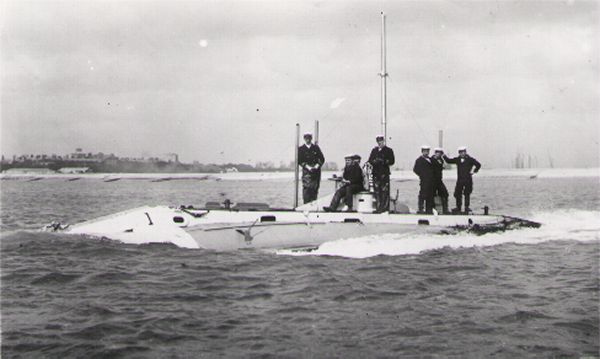
The Royal Navy's commissioned it's first submarine in 1901, HMS Holland 1. It was one of six boats armed with a single torpedo tube and carried 3 torpedoes. 

HMS Holland 1

HMS Holland 1 RN Submarine Museum


The prominence of the submarine and it's impact on warfare came with both World Wars.


World War One Submarines


World War Two Submarine

The end of WW2 brought about the Cold War and the submarine became the foundation of British Defence Policy, the mainstay of the nuclear deterrent. In 1961, HMS Resolution became the first submarine in the Royal Navy to carry nuclear Polaris missiles.

Cold War Submarines

HMS Resolution Polaris missile carrier

Polaris missile Firing Panel

Polaris Missile

In 1982, the submarine was used in it's more traditional role of targeting surface ships during the Falklands Campaign. On 2nd May 1982, HMS Conqueror sank the Argentinian light cruiser General Belgrano.

HMS Conqueror returns from the Falklands 1982

Falklands Campaign 1982