World War One
At the begining of the Great War Blyth harbour was closed to the public, hoever the beaches continued in use till 1915.
The construction of the Blyth Battery commenced in August 1916 by the Durham Fortress Engineers RE and completed in February 1918. The battery was operated by the Tynemouth Royal Garrison Artillery.
The battery consisted of two 6 inch coastal guns,and two 90cm searchlights put in place by the Tyne electrical engineers. An observation / command post, blockhouses and ancialry buildings were also built.
 |
| Blyth Battery plan |
From
Northumbrian Gunner
WW1 Obervation Tower
The Observation tower coisted of a two storey building. The top floor housed a Barr and stroud range-finder housed in an armoured steel turret. During the war it was disguised with a false roof. The ground floor housed signallers and the Fire Controller contolleding the firing of the guns and also linked to the searchlights.
Gun Emplacements
Two gun emplacements housed 6 inch coastal guns.
BL 6 inch Mk VII naval gun
The guns were capable of firing an 100 pound (45kg) shell to a range of 18,000 yards (16,000 metres), with a potential rate of fire of 5 rounds per minute.
Magazine
The main magazine was located to the rear of the gun emplacements, built into the dunes. This design was necesitated as it was not possible to build the magazine below the guns due to the sandy conditions.
The magzine consisted of a shell room (unfused shells), cartridge room, lamp room (which also held fuses and firing tubes) and shifting lobby where men changed from uniforms into overalls.
Searchight Buildings
Two searchlights were installed just to the north of the gun area. Each was trained on the harbour entrance with slightly different angles to provide a wide coverage. The building was protected by steel shutters which were drawn back when the light was in use. To the rear of the searchlights an engine contained a generator and backup generator.
Inter-War Years
At the end of the First World War, coastal defences were wound down. The seachlights were removed in January 1919, though it was not until 1924 that the dismantling of the guns was ordered. The gun emplacements were filled with concrete.
Between the wars the battery was used as a cafe, a St John's Ambulance post and council storage of equipment for the beach area.
World War Two
At the commencement of the war the Royal Marines installed two 6 inch guns on re-useable platforms just to the south of the battery together with a seachlight. Early in 1940, the battery was reactivated by the installation of two 6 inch BL MkVII guns, and the tempoary battery dismantled. One of the seachlight buildinds was also brough back into use.
The original observation post was found to be obselete, and a new observation and command post was built. The gun emplacements were enhanced by the construction of concrete shelter.
With the fall of France and the evacuation of the British Expedionary Force from France, the major threat to Britain was a seaborne invasion. Coastal Artillery units were expanded, coastal defences improved and emergency coastal batteries established.
In July 1940, the Tynemouth Heavy Regiment RA(TA) was the basis for the formation of three new Regiments. 508 (Tynemouth) Coast Regiment RA(TA)would man the guns at Tynemouth,509 (Tynemouth) Coast Regiment RA(TA)would cover the Wear at Sunderland and 510 (Tynemouth) Coast Regiment RA(TA)was tasked with the Blyth.
As well as manning the Blyth Battery, and Emergency Coast Battery was established at Gloucester Lodge to the south. This was armed with two 6 inch Mk XII naval guns and two searchlights.
As well as defending the River Blyth to protect merchant shipping, buliding and reparing of Royal Naval ships, it safegaurded HMS Effin, a support depot for submarines operating in the North Sea and beyond.
 |
| Mouth of the River from Obseravtion Post |
|
|
|
 |
| Range Finder in WW2 Observation Post |
From
Northumbrian Gunner
Blyth also acted as a command centre for emergency coastal batteries at Berwick, Amble, Druridge and at Gloucester Lodge
By 1943, the invasion threat was reduces, consequently the Gloucester Battery was placed into maintenance. The Blyth Battery continued in its primary roll until November 1944, when it was placed into care and maintenance. 510 (Tynemouth) Coast Regiment RA(TA) was incorporated into 508 (Tynemouth) Coast Regiment RA(TA) with it's HQ at Tynemenouth In spring 1945 United Kingdom coast defences were stood down.
Post WW2
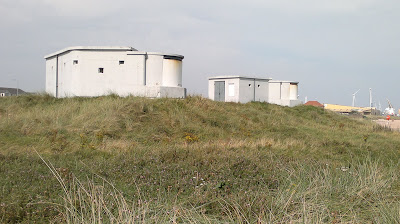
In 1949 the guns were removed and the buildings reverted to their peacetime use of First Aid posts and storage under the control of Blyth Corporation. In June 1987 the Blyth Battery became a Grade II listed building, however it was not until 2009 that it opened to visitors.
 Blyth Battery