Saturday, 23 March 2024

Reims 2024 - Battle of Verdun

 The Battle of Verdun took place between the French and German Armies from February to December 1916.  It was the longest battle of WW1 lasting  9 months, 3 weeks and 6 days. It was also one of the bloodiest, with around 300,000 men killed and over 400,000  wounded, from both sides.

Verdun is situated 224 kilometres West of Paris and in 1916 it was 30 kilometres from the German Border. The town had gained strategic significance after the Franco-Prussian War (1870-71) when Alsace-Lorraine was  annexed by Germany. This shifted the French German border 75 kilometers.

Verdun lies in the valley of the of the River Meuse. The area in World War One was a mix of forests and agricultural land.  A double ring of 19 forts on the valley top  and surrounding hills commanded the area.


Fort Douaumont, the largest of the 19 forts that defended Verdun, was located on the highest point. It looked out 70km across Fort Douaumont, the largest of the 19 forts that defended Verdun, was located on the highest point. It looked out 70km across the Woevre Plain towards Germany.


Fort Douaumont looking across Woevre Plain

The defences  were built in the 1880’s and upgraded until the start of the WW1.   
The forts were constructed from steel and reinforced  concrete 13 metres thick, with earth on the top to absorb  artillery fire. Armaments included 155 mm and 75 mm guns, as well as machine guns, operating out of fixed and retractable turrets.  The artillery comprised of around 1,000 guns. The defences were linked by a road network, a narrow gauge railway system as well as telephone and telegraph lines. 

Fort Douaumont

In 1914 when the Germans invaded Belgium their heavy artillery, 30 cm and 42 cm gun engaged Belgian forts in Liege, Namur and Antwerp destroying or neutralising them. The French took a a fresh look at the usefulness of their forts defending Verdun. They decided the guns, ammunition and troops would be better used to support the campaigns in the Artois and Champagne.  Orders were issued for the gradual disarmament of the forts.    Going forward the area would be defended in depth by the construction of four fortified lines, though only the first of line had been completed by January 1916. 

By 1916 the Germans were fighting a war on two fronts and the allied blockade of their ports was limiting resources to fight the war. The allies were The Allies were beginning to strengthen as Kitchener's New Armies began arriving on the Western Front to augment the British Expeditionary Force. German war aim was  to win the war quickly before Germany grew too weak and the Allies grew too strong.

The German Chief of Staff General von Falkenhayn’s intent was to attack one of the nerve centres of the Western Front, Verdun.  The French High Command were however convinced that the Germans would not launch an attack in that sector.


At 07:15 on 21st February 1916, 1,200 German guns opened fire on the French defences on the East Bank of the River Meuse. Two thirds of the artillery consisted of heavy guns and super heavy guns. The shellfire targets French defences along a 40 kilometre front destroying trenches, forests and villages.
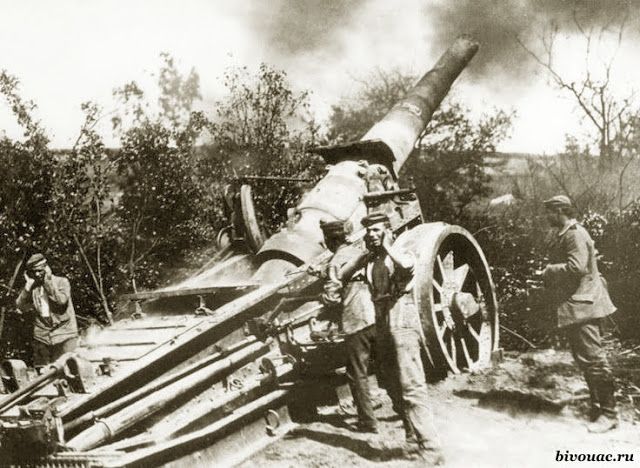
Verdun German Artillery

Verdun French Troops under bombardment

The forts at Marre, Vacherauville, Charny, Douaumont and Vaux were  decimated by large calibre German guns. 

Verdun Forts under bombardment

At 16:30 the German infantry attacked on a 10 kilometre frontage along the east bank of the River Meuse. The assault was lead by Stormtroopers using flame flowers and grenades.

Verdun German Attack

The intense German bombardment had not destroyed the French Army's resistance. Whilst the there as confusion, dislocation and loss of cohesion, small groups of French soldiers were able to engage the attacking German infantry and impede their progress allowing reiforcements to be brought into the line. 

Verdun French Defence

Despite the heroic actions and reinforcement of the French positions, the German assault continued on the East bank of the River Meuse. By the 25th February German forces had advanced 7 kilometres on a front of 12 kilometres. Fort Douaumont had been abandoned by the French and it was occupied by the enemy.

German Advance 21st to 25th February

On 26th February General  Pétain took over as Commander of the French Second Army who were responsible for the Verdun Sector.  Pétain ordered that the existing front line position be consolidated and any forts that had not been captured be re-occupied and rearmed. Reinforcements were brought into the French line to strengthen their defensive position.

As well as the resistance form the French during the initial assault, the consolidation of the French defences, the German advance was hampered by a thaw in the weather turning the shellscaped battlefield into a swamp. Their assault came to an end and the French line held. 

Verdun Battlefield

Pétain then began to bombard the Germans with French artillery on the West bank and created pockets of resistance to mount an attack from the west into the German flank. 

To neutralise the threat from the West bank General von Falkenhayn began preparations for an attack. The artillery of the two Corps assigned to the operation were reinforced by 25 heavy artillery batteries. Artillery command was centralised and artillery on the east bank incorporated into the plan. 

The German operation on the West bank began on the 4th March. Their aim was to capture the high ground of Hill 304, Mort Homme and Cumieres, then to destroy the French artillery on the West bank. It would take the Germans a week to secure those objectives at a cost of 70% casualties. They failed to destroy the French Artillery. Over the next two months the Germans made further gains, but there was no decisive action.

German Attack on the West Bank of River Meuse

By May the fighting in Verdun had reached stalemate and the break through the  German High Command had desired had failed.  One further attempt to penetrate the French line was made in June but this also failed. The battle became one of attrition and German operations were limited to local attacks. 

Verdun Situation 14th June

As the Germans battled at Verdun the Russian’s launched a major offensive on the Eastern Front., The Brusilov offensive. On 1st July the British attacked in the Somme Sector. The German Army made one more final attempt to breakthrough at Verdun. Some gains were made but it would be the furthest German troops would advance. German troops were required elsewhere, and the attempts to breakthrough ended.  

Verdun Final German Offensive

However, the Germans continued a battle of attrition with constant infantry attacks on the French line and bombardments by heavy artillery. The aim being to draw in French reserves and ultimately defeat them.

Verdun Battlefield

General von Falkenhayn's lack of progress and his justification of the heavy losses in men in order to conduct a war of attrition to “bleed France white” would lead to his dismissal by Kaiser Willem II at the end of  August. Falkenhayn would be replaced by General von Hindenberg who ended all major operations at Verdun.

It was now the French who took the initiative at Verdun.  The French began to mount attacks and regain ground. On 24th October, after a two day bombardment, French troops launched their attack on the East bank of the River Meuse. In four hours they successfully regained the ground lost since 25th February and Fort Douaumont was recaptured .

French Troops capture Fort Douaumont

French Counter Attack October 


To consolidate the French position, another attack was made on the 16th December recapturing more ground that had been lost.

French Counter Attack October 

The battle of Verdun finally came to an end on 18th December 1916, 9 months, 3 weeks and 6 days after it commenced on the 21st February 1916.


Verdun Battlefield 1916

Verdun Battlefield 2024


Friday, 22 March 2024

Reims 2024 - Battle of the Aisne


The Battle of the Aisne took place between the 13th to 18th September 1914 following the German withdrawal from the River Marne.

The Battle of the Marne brought an end to the German Schlieffen Plan that intended to defeat France before Russia mobilised.  The battle had created a gap between the German First and Second Armies which resulted in the German armies in the west withdrawing to the River Aisne.

German Cavalry withdrawing to the River Aisne

 The French and British Armies advanced in pursuit. The Germans began to prepare defences on the high ground north of the River Aisne.

German defences on the River Aisne

 They formed a new army, the seventh to fill the gap between the First and Second Armies.

Battle of the Aisne Strategic Situation

The French and British forces reached the River Aisne by the 12th of September. Their intent was to force passage across the River Aisne in order to secure the high ground on the north bank on which the German Army had began to entrench. 

The British Expeditionary Force Operation Order no 23 issued on 12th September defined the intent; The Army will continue pursuit at 7 am 13th September and reach a line Terny—Chavignon-Lierval. 


The British Expeditionary Force (BEF) were located along the River Aisne between  Soissons and Bourg. The ground along the valley was flat agricultural land with no natural cover between steep valley sides. The northern plateau commanded good fields of fire. 

River Aisne Valley

In the BEF’s area were a number of bridges across the River Aisne and the Canal Lateral which ran parallel to the river. The German engineers made attempts to destroy the bridges. The British Expeditionary Force were five Divisions strong and bridges were allocated to the Divisions for passage across the River Aisne.

River Aisne Battlefield

The bridge at  Venizel was allocated to the 4th Division, part of III Corps.

River Marne Pont de Venizel

One of the four charges placed on the bridge by the Germans had failed. Whilst the bridge was damaged, the Royal Engineers deemed it could be used with care.  On the night of the 12th / 13th September men of the 11th Brigade began to pass over the bridge in single file. The contents of ammunition carts were unloaded and passed by hand over the damaged bridge. 

By 03:00 the Brigade of 4,000 men had crossed in the dark in single file and were in position to launch an attack at first light securing the high ground above the bridge. The following morning 12th Brigade crossed and the Royal Engineers began strengthening the bridge. The 10th Brigade remained on the south bank to secure the bridge.

River Marne Pont de Venizel IJ

The British Expeditionary Force (BEF) through III Corps efforts had established their first bridgehead on the North bank of the Aisne. The remainder of the BEF, I and II Corps waited till daybreak before attempting to cross their allocated bridges.

The bridge at Missy allocated to the 5th Division of II Corps was found to have had two of it’s three spans had been destroyed. The Royal Engineers were tasked to build a raft capable of    carrying 60 men as a means of crossing the river.  The 14th Brigade supported by 121 Battery Royal Field Artillery would protect the crossing point.

River Marne Missy

18 pounder guns River Aisne

The Sappers completed the raft by 12:00 and began to ferry 14 Brigade across the Aisne. Heavy fighting took place during the afternoon and the evening. The action succeeded and 14 Brigade established them selves on the north bank. The 15th Brigade began moving across the river at 21:00. The Royal Engineers built some smaller rafts and obtained a boat aiding the passage. The 15th Brigade and part of the 13th Brigade were complete on the north bank at first light. 

It was the Missy crossing point where Captain William Johnston of the Royal Engineers was awarded the Victoria Cross for his actions on  14 September 1914.

His citation read:

At Missy, on 14th Sept., under a heavy fire all day until 7 p.m., worked with his own hand two rafts bringing back wounded and returning with ammunition; thus enabling advanced Brigade to maintain its position across the river.

— The London Gazette, No. 28985, 25 November 1914 

Capt Johnston Royal Engineers VC action

The other bridge allocated to the 5th Division was at Conde where the bridge had been left intact. A tributary flowing into  the river Aisne created an open meadow area.


 It was assessed the crossing would be heavily defended and possibly a trap to entice the British into the open ground. It was decided not to attempt to use the Bridge at Conde.

The 3rd Division of II Corps were allocated the bridge at Vailly. There the bridge had been broken in the middle, however a single plank over the gap in the bridge had been left in place by the Germans. It was over the single plank that the 8th Brigade began to cross the river at 13:00. Under fire they crossed to the north bank taking till nightfall to complete their passage over the river.  During the night of 13 / 14 September the 9th Brigade used the plank to cross to the north bank.

8th Brigade cross the Bridge at Vailly 1914
 
 NVAA cross the Bridge at Vailly 2014

In the I Corps area two bridges were allocated to 2nd Division. The bridge at Chavonne had been destroyed, but a temporary trestle bridge was still in place. The 2nd Battalion Coldstream Guards were able to cross the temporary bridge. However, out of artillery range for support they were forced to withdraw. The Division’s main effort would be the bridge a Pont D’Arcy. 

Bridge at Pont D’Arcy

That  bridge had only been partially damaged.  Although the roadway was impassable, it was possible to cross on the girders that supported the road. The bridge was also weakly defended so the 5th Brigade were able to cross with little opposition and secured the north bank. 

5th Brigade crossing Pont D'Arcy

The final crossing point allocated to the British was at Bourg where the 1st Division were tasked with crossing the Aisne. Here the river bridge had been destroyed. However, a road bridge over the Canal Lateral was still intact, and an aqueduct carrying the canal over the River Aisne was only partially damaged.  

Bourg bridge over the Canal Lateral

Bourg Aqueduct over the River Aisne

The aqueduct allowed the passage of the 1st Division over the Aisne and they were able to secure the heights overlooking the crossing. By 18:00 on 13th September all the infantry of the division, around 10,000 men were across the river. Assisted by the success of the French Fifth Army on their right flank the 1st Division were able to take high ground above Bourg.

At Cerny, 7 kilometers north of Bourg,  on the high ground above the River Aisne valley is a memorial to the 1st Battalion Loyal North Lancashire Regiment. This monument marks the extent to which the British Army advanced during the battle. 

1st Battalion Loyal North Lancashire Regiment
Memorial Cerny

1st Battalion Loyal North Lancashire Regiment
Memorial Cerny

By the night of the 14th September the British Expeditionary Force, together with their French Allies had established bridgeheads on the north banks of the River Marne.  The  long marches of advance and withdrawal, together with the fighting, had left the  combatants exhausted. Movement  came to a halt and the line stabilised. 


The British Expeditionary Force Operation Order 26 of 15th September 1914 outlined the Commander’s intent; 
The  Commander in Chief wishes the line now held by the Army is strongly entrenched, and it is his intention to  assume a general offensive at the first opportunity.

British troops entrenching in the River Aisne valley


Reims 2024 - Soissons Memorial

 The Soissons Memorial commemorates almost 4,000 officers and men of the United Kingdom forces who died during the Battles of the Aisne and the Marne in 1918 and who have no known grave. The memorial was designed by G.H. Holt and V.O. Rees, with sculpture by Eric Kennington. It was unveiled by Sir Alexander Hamilton-Gordon on 22 July 1928.

Soissons Memorial

The memorial lists those lost by Regiment on a series of panels. 

Soissons Memorial Royal Artillery Panel

On the 27th May 1918 the Germans launched their third operation of their Spring Offensive, Operation Blucher. 

German Spring Offensive 1918

The 50th Northumbrian Division having been heavily engaged during the German’s first two operations were sent to the area of the Chemin des Dammes north of the River Aisne near Craonne to recuperate.  

 50th Northumbrian Division Chemins des Dammes

However,  on the 27th May 1918 the 50th Northumbrian Division once again involved in a major German offensive. The German assault began  at 01:00 with a bombardment that included a mix of high explosives, smoke and tear gas.

Operation Blucher

Two Northumbrian Gunner Officers,  Lieutenant FA Richardson and Lieutenant EC Earle, were killed during the initial onslaught and their names are recorded on the Soissons Memorial. 

Soissons Memorial

Soissons Memorial NVAA Wreath
Remembering Northumbrian Gunners

Lieutenant Francis Aylmer Richardson was serving with A Battery 250 Brigade, (1st Northumbrian Brigade) when the Germans launched their assault. A Battery fought their guns till 06:00 when a lifting barrage was closing in on the guns. The BC ordered the breech blocks and sights removed then withdrew.
 At 07:30 a party of 4 officers, 6 telephonists and 4 servants continued their withdrawal and crossed the River Aisne at around 10:00. As the came out of a wood they were caught in a German barrage and Lt Richardson was badly hit. He was carried  through the  German barrage, to Chaudardes where he was found to be dead.

Lieutenant Ernest Charles Earle was serving with D Battery 250 Brigade (South Shields Battery) when the Germans launched their assault. The battery was overrun by the German infantry and Lt Earle together with two infantry  officers and a corporal (the only men not overcome by gas) were seen working the last gun in action.


Reims 2024 - Marne La Ferte Sous Jouarre

At  La Ferté-sous-Jouarre on the River Marne is a British Memorial commemorating the Battle of the Marne which took place in September 1914.  

La Ferté-sous-Jouarre British Memorial

The Battle of the Marne was a pivotal battle of World War One being the point at which the French and British stopped retreating after German armies swept through Belgium and went on the offensive. 

In August 1914 the German Army invaded Belgium triggering the start of World War One.  They enacted the Schlieffen Plan which was a wide flanking movement by three German armies to envelope Paris, then proceed east to attack the French Army from the rear.

The German first and second armies swept through Belgium, engaging Belgian, British and French forces in what became know as the Battle of the Frontiers. Whilst the German Army was victorious, their planned  progress was impeded by strong and unexpected resistance from the Belgian Army and the sabotage of railways essential to the plan. 

Von Kluck, the German First Army commander, tasked with the sweep around Paris thinking the French Army was on the run and the British Expeditionary Force (BEF) defeated, to shorten his lines of communication decided to pass Paris to the east, rather than to the west as per the Schlieffen Plan. 

Unbeknown to Von Kluck the French had formed a new Army, the Sixth. This consisted of garrison troops from Paris and two Corps that were moved from other French Armies.

General Joffre, French Commander in Chief’s intent was to attack into the exposed German flank, requesting the BEF to assist in the operation. 


The French Sixth Army prepared to assault the German Firsts Army along the River Ourcq. As part of that preparation Paris Taxis used to transport 4,000 men of the 62nd Division to the battlefield north of Meaux. 

Battle of the Marne Taxis

The Battle of the Ourcq commenced on the 5th September as reconnaissance units clashed. The initial assault and a German counter attack necessitating von Kluck to move troops northwards from the River Marne to reinforce his main body. 


The French Ninth Army attacked the German Second and Third Armies to the east in the area of the Saint-Gond Marshes. 


The effect of the French offensive operations was to force a gap between the German First and Second Armies. It was into this gap that the French Fifth Army and the British Expeditionary Force advanced. The British moving from south of the River Marne force passage over two smaller rivers, the Grand Morin and the Petit Morin.

The British Expeditionary Force (BEF) advanced as the Germans withdrew. British cavalry units leading the advance clashed with German cavalry units covering the withdrawal. 

9th Lancers clash with German Cavalry

German Army commander von Moltke  fearing the First Army could be lost ordered the three German armies to withdraw to the  River Aisne, 50 kilometres to the North, bringing the Marne Battle to an end.

The British and French Armies began a pursuit of the Germans with an aim to forcing their continued withdrawal. To enable the pursuit it was necessary to cross the River Marne. However the Germans had destroyed road bridges as they withdrew. A pontoon bridge was built at La Ferté-sous-Jouarre to enabling the British III Corps to cross the River Marne. 

Pontoon bridge La Ferté-sous-Jouarre

River Marne La Ferté-sous-Jouarre

River Marne La Ferté-sous-Jouarre IJ

The British Expeditionary Force sustained 12,733 casualties, who were killed or  wounded. Those who were killed who have no known grave are commemorated on a memorial at  La Ferte sous Jouarre located on the banks of the Marne. 

La Ferté-sous-Jouarre British Memorial

La Ferté-sous-Jouarre British Memorial River Marne

La Ferté-sous-Jouarre British Memorial


The memorial lists those lost by Regiment on a series of panels. 

La Ferté-sous-Jouarre British Memorial Royal Artillery