Blog Search


Sunday, 28 June 2015

Alnwick - Beating of Retreat

 
On the 18th May 1915 the Tyneside Scottish Brigade paraded on the pastures in front of Alnwick Castle to be inspected by His Grace the Duke Of Northumberland.

TS Brigade inspected by His Grace Duke of Northumberland
18th May 1915
To commemorate the occasion a Beating of Retreat was held in Alnwick Castle. The occasion had an international flavour with the presence of the Somme Battlefield Pipe Band (SBPB) from Peronne in France.  The SBPB commemorate the fallen in both World Wars by each individual member of the band wearing a uniform of a Scottish Regiment.

  
Somme Battlefield Pipe Band
Alnwick Castle
 
Northumbria ACF Cassino Band Marching Display 

The massed Pipes and drums consisted of the Tyneside Scottish Pipe Band, Somme Battlefield Pipe Band, and the Northumbria & Lothian Borders ACF Pipe Bands.

Massed Pipes and Drums enter Alnwick Castle
Massed Pipes and Drums march on
 
Massed Bands Music Display

Highland Dancers
Massed Bands March Off

Somme Battlefield Pipe Band march on
 
Somme Battlefield Pipe Band marching display 


Somme Battlefield Pipe Band

Somme Battlefield Pipe Band Pipers

Somme Battlefield Pipe Band

Somme Battlefield Pipe Band march off

Combined Bands


Massed pipes and Drums form up

Massed Pipes and Drums March on
 
Massed Pipes and Drums Highland Cathedral
 
Video of the Tri-Service Pipes and Drums, Somme Pipes and Drums and 101 Regiments Tyneside Scottish Pipes and Drums playing Highland Cathedral at last nights beating retreat in Alnwick Castle.
Posted by Northumbria Army Cadet Force on Sunday, June 21, 2015
 

Massed Pipes and Drums march off

Cassino Band Beat Retreat


Monday, 8 June 2015

Bovington Tank Museum - WW1 Tanks

Bovington Tank Museum in Dorset is the museum of the Royal Tank Regiment and the Royal Armoured Corps.
 
Bovington Tank Museum Dorset

Royal Tank Regiment Memorial
Bovington

The stalemate on the Western Front dominated by trenches, fortifications and the machine guns created the problem of how to breach the enemy front line and achieve a breakthrough.

The problem - Fortifications and the Machine Gun
Winston Churchill formed the Admiralty Landships Committee in February 1915, tasking them with developing a war engine able to cross a 5-foot (1.5 m) trench. Initial experiments by an agricultural firm, William Foster & Co. of Lincoln, using imported American tracks failed. William Tritton, a director of William Foster & Co, and Lieutenant Walter Gordon Wilson, a Royal Naval Reserve Officer, came  up with a new design. On the 9th September 1915 the No 1 Lincoln Machine, nicknamed Little Willie made it's first test run.

Little Willie
Bovington Tank Museum


The trials with Little Willie led to the  development of an effective track system, however the low profile was not adequate for the Western Front. This led to the development of a rhomboid shaped vehicle which would become the go forward design in World War One.

The shape of the vehicle was necessary as a long track was required to enable the crossing the wide trenches prevalent on the Western Front battlefields. The guns were at the side in sponsons. German defensive parapets could be up to 4 feet high, a turret on top would have been top heavy when moving across the defences.  The prototype was ready by December 1915, and the term tank began to be used in order to maintain secrecy and disguise it's true purpose.

The first tank was demonstrated in early 1916 and impressed David Lloyd George, Minister of Munitions who arranged for his ministry to take responsibility for their production.  The first order for tanks was placed on 12 February 1916.

 
On the 15th September 1916, the tank was used  in battle for the first time at the Battle of Flers Courcellete on the Somme.


British Mark I Tank
Bovington Tank Museum
Tanks were classified as Male, mounting 6 pounder guns, or Females mounting machine guns.  Minor improvements were made to the first tanks leading to the introduction of the Mark II in January 1917.

British Mark II Tank
Bovington Tank Museum

British Mark II Tank
Bovington Tank Museum

 
Tanks would have a crew of 8. A commander, driver, two gearsman, two gunners and two loaders.


Tank Commander


Gearsman


The Mark IV tank, which was an up armoured Mark II went into production in May 1917, going into action at the Battle of Messines Ridge in June 1917.

British Mark IV Tank
Bovington Tank Museum
The first use of large numbers of tanks was the Battle of Cambrai 20th November to 7th December 1917.

 
Battle of Cambrai
 A new design was introduced in 1918, the Mark V which was first used in the Battle of Hamel in July, and they were used during other battles during the 100 Day Offensive. Some went to Russia when the allies intervened in the Russian Civil War in 1919.

British Mark V Tank
Bovington Tank Museum

The first German tank, the Sturmpanzerwagen A7V did not go into production until October 1917. It was equipped with six 7.92 mm MG08 machine guns and a 5.7 cm Maxim-Nordenfelt cannon, with a crew of 18.

German Sturmpanzerwagen A7V Tank
Bovington Tank Museum

Friday, 29 May 2015

Quintinshill

On the 22nd May 1915 the worst rail disaster in the UK occurred at Quintinshill near Gretna Green, Scotland. The collision that occurred and the subsequent fire resulted in over 220 killed and 240 injured. The majority of casualties were from 1/7th Battalion Royal Scots, Territorials from Edinburgh, heading to Gallipoli.


Quintinshill near Gretna Green
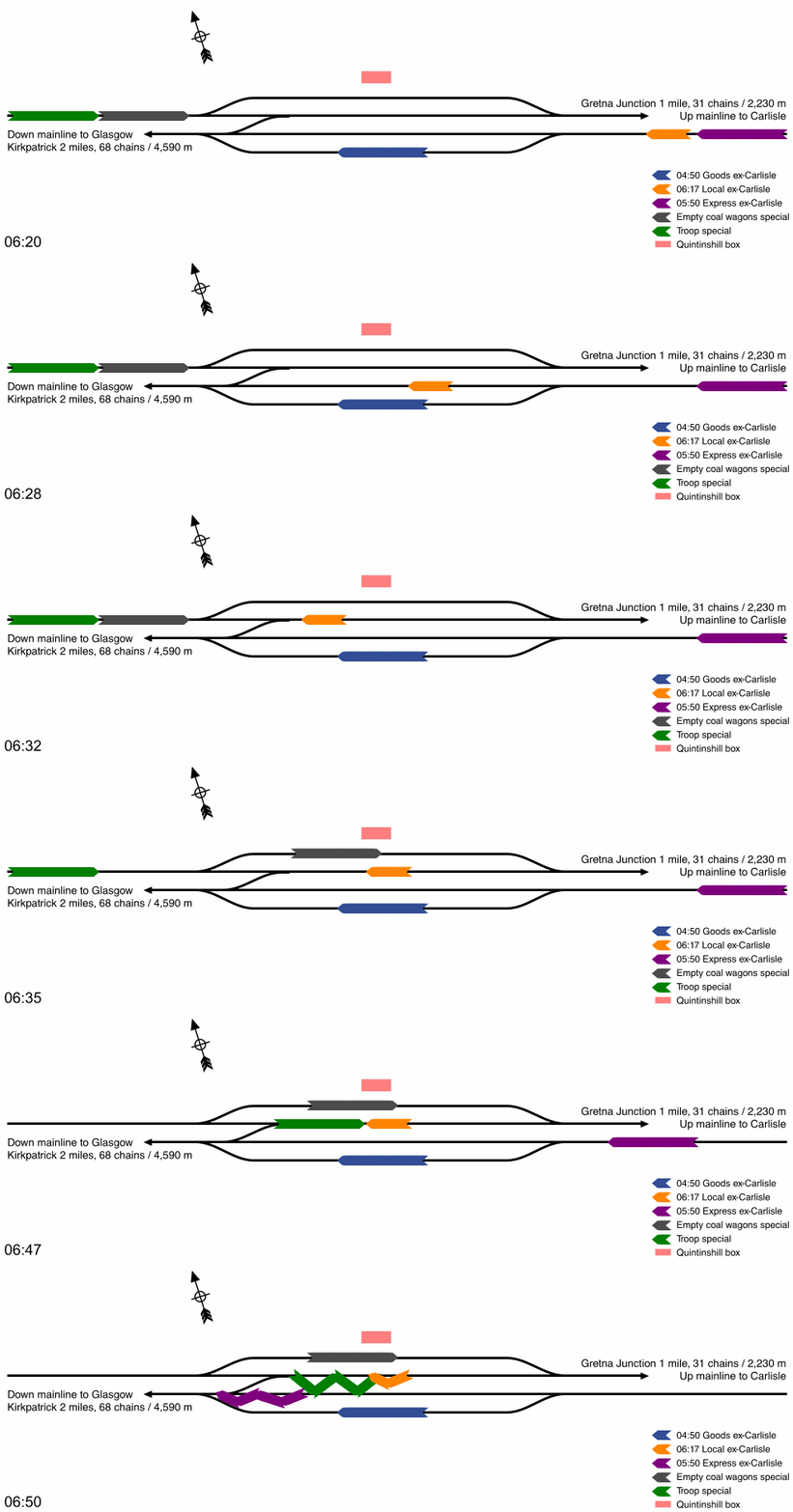
Quintinshill is on the main West Coast railway line from London Euston to Glasgow. At the location are two passing loops where slower trains can be held in order that express trains can pass. In 1915a signal box was located at Quintinshill overlooking the passing loops.


Quintinshill - Track layout


Quintinshill - Signal Box

On the morning of the 22nd May a troop train containing half of the 1st / 7th (Leigh) Battalion Royal Scots, 498 men, left Larbert Station, Stirlingshire en route to Liverpool to board a troop train. The Battalion were Territorials, mobilised in 1914, and were on their way to join the fighting in Gallipoli.

Caledonian Railway McIntosh 4-4-0 no 121
Locomotive headed the troop train to Liverpool.
The troop train was a high priority and any slower train on it's route would need to let it pass. Despite the additional traffic on the main line generated by the war effort, the London-Glasgow expresses continued to be given priority. On the morning of 22nd May, two priority trains, the troop train from the north, and an express from the south were approaching Quintinshill.

To ensure they were not delayed, a goods train had been routed into the up line passing loop (northbound) whilst an empty coal wagon special has been routed into the down line passing loop (southbound), thus both passing loops were occupied.

At 06:17 a local train proceeding north from Carlisle arrived in Quintinshill which needed to be held there in order to allow the passage of a north bound express train. With both passing loops occupied, the signal man had no choice other than to shunt the train onto the southbound line, hold it there and  allow the express to pass. It would however block the passage of the south bound troop train.


Quintinshill - North bound local train
Quintinshill - Local Train on Southbound mainline
The situation 06:37 22nd May was the northbound mainline was clear to allow the London-Glasgow to pass, the southbound line was blocked, and the troop train would need to be held till the local train could be shunted back onto the line north.

Quintinshill - 22nd May 1915
 
 The signalmen at Quintinshill should have changed over at 06:30. However, a practice had been adopted whereby the incoming signalman, to save a mile and half walk,  would catch the local train from Gretna. When it was held at Quintinshill, he would dismount and proceed to the signal box to take over the shift. To cover the practice, the train register was not filled in, any movements were recorded on a scrap of paper, and the register would be updated with the details by the incoming signal men in his hand writing.

On the morning in question, George Meakin, who had worked the night shift, was relived by James Tinsley who had just arrived on the local train which had been shunted onto the southbound line. As well as the breach of regulations on the handover, the firemen from the trains held were in the signal box which could have been distracting to Tinsley. A further breach of rules had taken place as the firemen from the local train should have checked that a collar had been placed over the signal lever which controlled the entry into the Quintinshill sector, physically stopping the signal at the beginning of the sector being set to clear, thus protecting the train on the southbound line.

 Although having just arrived on the local train, possibly distracted by updating the train register and the firemen in the signal box, Tinsley accepted a signal to receive the troop train into the Quintinshill sector on the south bound line blocked by the stationary local train.

Four minutes later, he accepted a northbound express onto the clear north bound line.


Quintinshill - situation 06:49 22nd May 1915

 At 06:49 22nd May 1915 the troop train containing the 1/7th Royal Scots collided head on with the stationary local train.

Quintinshill Rail Disaster
Sequence of events 22n May 1915
By Emoscopes, Tevildo [CC BY-SA 3.0 (http://creativecommons.org/licenses/by-sa/3.0)], via Wikimedia Commons
The troop train overturned, mostly onto the neighbouring north-bound mainline track and, a minute later, the Glasgow-bound express ploughed into the wreckage causing it to burst into flame. The troop train carriages were old obsolete wooden stock with gas tanks underneath and this led to a ferocious fire.
Quintinshill Rail Disaster 22nd May 1915
 It was estimated that  226 people were killed and 246 injured in the accident. The 1/7th (Leigh) Battalion Royal Scots lost 216 all ranks in the disaster. Out of the half battalion of 498 men,  only 64 paraded after the disaster.


Quintinshill Rail Disaster
CO 1/7th Royal Scots musters the 64 unscathed survivors


QUINTINSHILL MEMORIAL

Quintinshill Memorial Plaque


Monday, 25 May 2015

Royal Armouries - Machine Guns

Rapid fire weapons which could be characterised by the ability to provide multiple shots were in existence as early as 1580. The ability to achieve automatic loading and high rates of fire came in 1862 with the American Gatling Gun.

The Gatling gun consisted of multiple barrels on a cylinder which was rotated by hand which provided sequential firing and reloading. Although replaced by the machine gun, modern Gatling guns are able to combine automatic firing with multi-barrelled weapons.


 The first automatic weapon which reloaded by the recoil power of the previous round fired was the Maxim gun invented by Sir Hiram Maxim in 1884.

In 1896 the Vickers Company acquired the Maxim Company and improved the design of the Maxim gun to produce the Vickers Machine Gun.


The British Army formally adopted the Vickers gun as its standard machine gun on 26 November 1912.

Vickers Machine Gun Mk III 1913
 In 1911, US Army Colonel Isaac Newton Lewis invented the Lewis Gun. Lewis had difficulties persuading the US Army to adopt the gun, so he retired and moved to Belgium in 1913. He established the Armes Automatique Lewis company in Liège to facilitate commercial production of the gun. Lewis had been worked closely with the Birmingham Small Arms Company Limited (BSA), and in 1914 they purchased a licence to manufacture the Lewis machine gun utilising the British .303 round. In 1914, Lewis moved his Belgian factory to England.

The Lewis Gun was approved for service on the 15th October 1915.


Lewis Light Machine Gun Mk 1 1916
The Lewis Gun was adopted as a light machine gun and issued to infantry units. The Vickers machine guns were withdrawn from the infantry units, and grouped together of a newly formed Machine Gun Corps.


The Long, Long Trail: the British Army in the Great War

The Machine Gun Corps (MGC) was created by Royal Warrant on October 14 followed by an Army Order on 22 October 1915. The MGC would eventually consist of infantry Machine Gun Companies, cavalry Machine Gun Squadrons and Motor Machine Gun Batteries.

A depot and training centre was established at Belton Park in Grantham, Lincolnshire. A total of 170,500 officers and men served in the MGC, of which 62,049 were killed, wounded or missing. Seven members of the MGC were awarded the Victoria Cross.

The MGC was disbanded in 1922.

Royal Armouries Leeds - Machine Gun Corps Equipment 
Royal Armouries Leeds - Machine Gun Corps Medal
Royal Armouries - Machine Gun Corps
Trench Art & Chinaware