Wednesday, 23 August 2017

Guernsey 2017 - Occupation Commemorations

North Esplanade
Guernsey St Peter Port

Located in St Peter Port near the North Esplanade is St Julians Pier. On the pier are a number of plaques that commemorate  events relating to the German Occupation of the Channel Islands 1940-45. The main memorial is the Liberation Memorial.


In June 1940, following the fall of France, the decision was taken to demilitarise the Channel Islands and evacuate civilians. Those that left Guernsey would have departed form the Quays on which a commemoration plaque is located.


Guernsey Evacuation Commemoration

On the 28th June 1940 the German Luftwaffe conducted an armed reconnaissance raid on the Channel Islands, unaware that the Islands had been demilitarised. They bombed the harbours in Guernsey and Jersey. The air raid on St Peter Port killed 34 people.

Air Raid St Peter Port
28th June 1940
 
Guernsey Air Raid Commemoration June 28th 1940

In October 1940 the Germns issued their first anti-Jewish Order. Most of the  Jewish citizens of Guernsey had been evacuated, those that remained, 18 people, were required to register with the German authorities. Restrictions were placed upon those people, including closing businesses, confiscation of radios and curfews.

On 21st April 1940, three Jewish women, who had fled to Guernsey in 1930s to escape persecution, were deported to France. Later, in 1942 they were shipped to Auschwitz where they died.


Guernsey Jewish Deportation Commemoration

In retaliation for the expelling of German citizens in Soviet / British controlled Persia during the  Summer of 1942, Hitler issued orders for the deportation of citizens from the Channel Islands. Those residents who were not born in the Channel Islands were liable for deportation.

The memorial records that 1,003 citizens of Guernsey and Sark were deported and lists the 16 , men, women and children who died in captivity.

Guernsey Deportees Commemoration
 
The opportunities for resistance in the Channel Islands was limited. The Germans outnumbered the Islanders and the small size of the Islands meant there was no where to hide, consequently aggressive resistance was not practical.
 
Acts of Resistance were confined to minor acts of sabotage, listening to the BBC, and disseminating news. Help was also provided to British Commandos involved in reconnaissance of the Islands and to the forced labourers on the Islands.
 
Seven Guernsey residents died in captivity after being deported for Resistance activities.
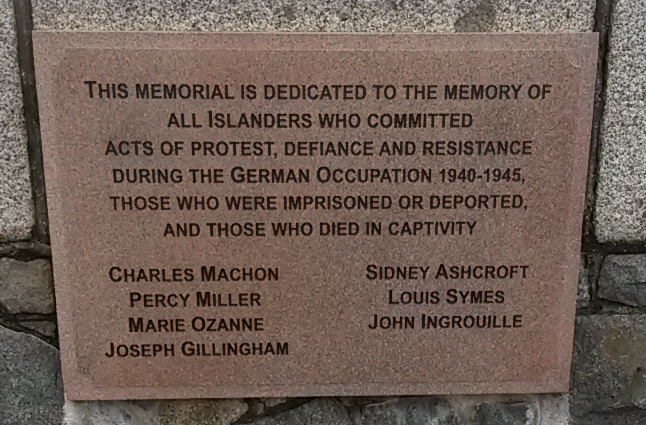
Guernsey Resistance Commemoration

Source: BBC

Sidney Ashcroft - convicted of serious theft and resistance to officials in 1942. He is thought to have died after a selection of weak prisoners were taken from Straubing prison, Germany, on 24 April 1945
  • Joseph Gillingham - imprisoned for recording and distributing news, last seen on 2 February 1945
  •  
  • John Ingrouille - found guilty of treason and espionage and sentenced to five years hard labour. He survived a hard labour prison in Brandenburg, but died in a displaced persons camp on 13 June 1945
  • Charles Machon - brainchild of GUNS (Guernsey Underground News Service - an underground newspaper)  , received the longest sentence of the five and was sent to Rheinbach prison in May 1944, then four months later on to Hameln prison where he died on 26 October

  • Percy Miller - sentenced to 15 months for wireless offences he was sent to Frankfurt-Preungesheim in July 1943 where he was caught passing a note to a fellow prisoner and confined in a punishment cell where he died on 16 July 1944

  • Marie Ozanne - refused to accept the ban placed on the Salvation Army she would preach in public and was vocal in her protests about the treatment of Jews and slave labourers and became ill in prison and after her release died from peritonitis on 25 February 1943.

  • Louis Symes - sheltered his son 2nd Lt James Symes, who was on a commando mission to the island with 2nd Lt Herbert Nicolle. Mr Symes was sent to Cherche-Midi prison in Paris where he died in unconfirmed circumstances - just days before his sentence was revised and he would have been released
  •  


    Occupation finally ended when the Channel Islands were liberated on 9th May 1945.

    Liberation Troops arrive at Victoria Pier 9th May 1945
     
    Guernsey Liberation Memorial
    The Liberation was remembered  60 years later when Her Majesty the Queen unveiled a commemorative stone. 

    Guernsey Liberation
     60th Anniversary Commemoration Stone
     *

    Guernsey 2017 - RCAF Pilot Memorial

    Guernsey - Castle Pier overlooking Havelet Bay
    RCAF Pilot Memorial
    On Castle Pier, the path from St Peter Port to Cornet Castle, is a memorial overlooking Havelet Bay dedicated to a Royal Canadian Air Force pilot, Flight Lieutenant John Walton Saville.
    Guernsey - Castle Pier RCAF Pilot Memorial

    Flight Lieutenant John Walton Saville
    Royal Canadian Air Force
     
     
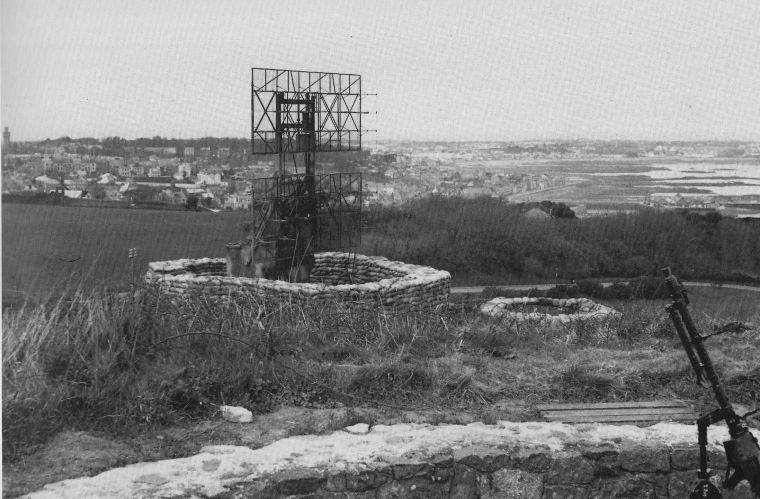
    John Walton Saville was killed on 5th June 1944 during a mission to destroy Freya early warning radars as part of the preparations to support the Normandy D-Day Landings. Two Freya radars were located at Fort George near St Peter Port.
     
    Guernsey Fort George

    Guernsey Fort George
    Freya Radar locations

    Guernsey Fort George
    Freya Radar 

    Guernsey Fort George
    Freya Radar
    Guernsey Fort George
    Freya Radar
    The Freya Radars had a range of 200km (120 miles) and their coverage threatened the air routes for the American Airborne and Glider landings on the Contenin Peninsular. It was vital to remove the threat of detection from the Freya Radars so as not to compromise surprise from the airborne operations.
     
    Guernsey Fort George
    Freya Radar coverage.
     
     The task of destroying the Freya Radars was allocated to 439 Squadron Royal Canadian Air Force equipped with Hawker Typhoon aircraft.

    439 Squadron RCAF Insignia

    Hawker Typhoon aircraft

    The squadron attacked Fort George on 3rd June 1944. The mission was not totally successful so it was planned to attack again on 4th June. Bad weather prevented that attack, however the Squadron were able to conduct the mission on 5th June.
     
    The 439 Squadron War Operations Record Book details the mission of 5th June:
    "Carrying two nose-fused (instantaneous) 500lb bombs each, the squadron led by Flt Lt Saville against the highly defended target [descended] in a long dive from 11,000ft to 3,000ft in an easterly direction.

    "All of the bombs appeared to burst on or near the target itself. A large explosion was reported in the sea about a mile offshore and at the time it was believed to have been a bomb.

    "Flt Lt Saville was not seen after the dive and it was later presumed that his aircraft had been hit by the intense flak and failed to recover from the dive.

    "Immediately upon their return, a section of four aircraft led by Flying Officer Burton was dispatched to search for traces of the missing aircraft.

    "The search was unsuccessful."
    Courtesy of Michael Melnick

    439 Squadron RCAF Attack on Fort George
    5th June 1944
     The memorial to Flight Lieutenant Saville overlooks Havelet Bay where the Canadian Officers plane crashed. The sight was located by divers in the early 70's and the memorial was unveiled in June 2017.

    John Walton Saville is also commemorated on the Air Crew Memorial located at Guernsey Airport. The memorial commemorates 153 Allied Air Force crewmen who lost their lives in the waters around Guernsey. The losses include those on missions where the target locations were in France.

    The memorial incorporates a flight of Spitfires and a B-17, remembering the contribution of the United States Air Force.

    
    Air Crew Memorial
    Guernsey Airport
    Air Crew Memorial Inscription
    Guernsey Airport
    Air Crew Memorial Royal Canadian Air Force names
    Guernsey Airport
     GUERNSEY AIR CREW MEMORIAL
    

    Tuesday, 22 August 2017

    Guernsey - German Military Hopsital

    Guernsey
    German Military Hospital
    The German Military Hospital is situated beneath a low hill in the area of La Vassalerie, St Andrews, Guernsey. Construction started in 1940 under the control of the Todt Organisation. and involved the use of hundreds of forced labourers.

    
    Guernsey Military Hospital
    Forced Labourers.

    Guernsey Military Hospital
    Tunnels under construction

    The tunnels cover an are of 7,000 sq meters and took 3 1/2 years to construct. The underground facility was split into two sections, a hospital and ammunition store.
    
    German Military Hospital - Ground Plan
    Hospital and Ammunition Store
    German Military Hospital
    Entrance
    
    The hospital comprised of two main corridors running parallel with each other . Between the corridors were the medical facilities; wards, operating theatre, x-ray room, laboratory, dispensary and staff quarters. Running off one corridor were a cinema, store rooms, and a mortuary. At the end of the corridors were power plants and kitchens.

    German Military Hospital
    Hospital Section Plan
    Guernsey Military Hospital
    Entrance to Military Section
    Guernsey Military Hospital
    Hospital Corridor
    Guernsey Military Hospital
    Hospital Ward
    Guernsey Military Hospital
    Hospital Ward
     
    Guernsey Military Hospital
    Escape Shaft

    The ammunition store occupied the second part of the underground complex. During the occupation thousands of tons of ammunition was stored there.

    Guernsey Military Hospital
    Ammunition Storage

    Guernsey Military Hospital
    Ammunition Store signage

    The hospital was only used for a period of three months following the Allied landings in Normandy 6th June 1944. Several hundred wounded soldiers were brought  by ship from Cherbourg to Guernsey. The hospital was not beneficial to the casualties, after a few weeks the patients were white from lack of sunlight and the damp conditions did not aid recovery. They were transferred above ground.

    Today the empty dank cavern is a depressing reminder of those who laboured 3 1/2 years in atrocious conditions to build a facility that was no real use.

    Guernsey Military Hospital 
    Dark, Damp, Depressing
     
    Guernsey Military Hospital
    Memorial to Forced Labour Workers


    Sunday, 20 August 2017

    Guernsey 2017 - German Occupation Museum

     
    German Occupation Museum
    Guernsey

    The Guernsey Occupation Museum chronicles the German Occupation of Guernsey from 1940 to 1945.  
     
    EVACUATION
     
    18th June 1940 - Following the fall of France evacuation of women, children and men of military age announced. Channel Islands demilitarised.


    Guernsey Evacuee
    INVASION

    1st July 1940 - . Major Albrecht Lanz arrives at Guernsey Airport together with German troops. He announces Guernsey is under German Occupation.


    OCCUPATION  

    
    German anti-aircraft gun
    German Searchlight
     
    German  uniforms and anti-aircraft gun

    German officer and picture of St Peter Port

    German Uniforms

    
    German Vehicle
    
    Occupation Street

    The people of Guernsey tried to about life as normal.....
    
    Civilians go about daily business

    
    VM Occupation Street

    
    Schooling carried on


    However ................


    British Bobby - but under German control
    German Army never far away
    Civilians were restricted from military and coastal areas  
    
    Restrictions and rules were introduced


    Cinemas were segregated
    With so many Germans on the island (one German to every islander), and the small size providing no places to hide, meant aggressive resistance was not practical. The civilian population took to passive resistance, underground newspapers  and low scale sabotage. Churchill's 'V for Victory'  sign appeared on buildings and other locations.
    
    Passive resistance 'V ' sign


    Fortress Guernsey

    October 1941 - Hitler Decrees Channel Islands should be turned into a impregnable fortress. Organisation Todt tasked to build fortifications using force labour.

    
    Guernsey - German Fortifications

    
    Forced Labourer

    
    Guernsey - Miras Battery

    
    German range finders


    June 1942 -   All wireless sets belonging to the civilian population are ordered to be handed over to the Germans.

    Occupation Kitchen - To keep in touch with what was happening in the War, people hid wireless sets or constructed crystal sets and tuned into the BBC to obtain their news.

    Occupation Kitchen. - listening to the BBC
    The penalties for listening to the BBC could result in imprisonment. As well as the German authorities, clandestine radio listeners needed to be careful of being denounced by collaborators.

    Letter from collaborator to German authorities

    German Occupation - Deportation of Civilians

    September 1942 -  Over 2,000 Channel Islanders are deported to internment camps principally at Biberach, Laufen, Dorsten and Wurzach.


    Biberach montage

    Biberach Camp model

    Biberach Camp accommodation

    RED CROSS SHIP 'SS VEGA'

    December 1944 - The Red Cross ship 'Vega' arrives in Guernsey with much needed food supplies to save the population from starvation.

    SS Vega
    Arrival of the SS Vega

    Red Cross Parcels

    Red Cross Parcel contents
    LIBERATION

    9th May 1945 - The Germans surrender to combined British forces, Force 135 led by Brigadier Snow lands on Guernsey and the long five years of German occupation are finally over.

    Welcome sign for the Liberators

    Liberation

    War is over...Peace and Liberation

    Meeting a Gunner from Force 135