Saturday, 23 March 2019

Pas De Calais - Krupp K5 Rail Gun

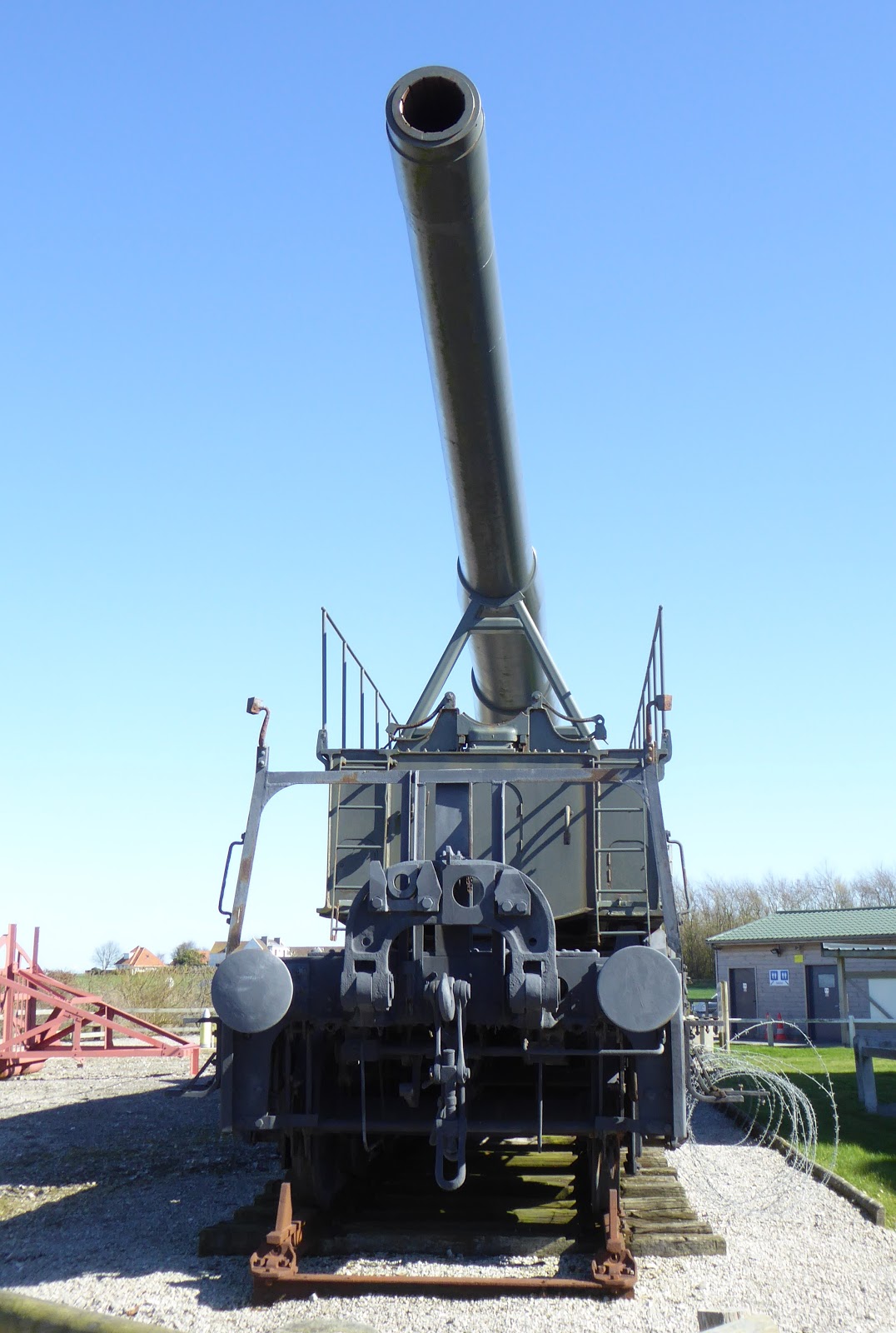
Krupp K5 280mm Rail Gun
Following the fall of France in June 1940, the Germans began deploying rail guns to the Pas de Calias to support Operation Sea Lion, the invasion of Britain.  In addition permanent coastal batteries would be built between Calais and Boulogne to control the English Channel. 
English Channel Gun Batteries
 The Germans established five main locations for 280mm Krupp K5 rail guns in the Pas De Calais area.  The batteries consisted of four two gun batteries and a single one gun battery.
Normally only one gun would be firing, the other undergoing maintenance.


Calais Grables                                         (2x Guns)
Sangatte-Cement Factory                      (2x Guns)
Les Alleux                                                (2x Guns)
Hydrequent-Le Carre de Marabee       (1x Guns)
Wimereux-Les Oiles                               (2x Guns)


Pas De Calais - German Rail Gun Locations.
The guns were housed in Dombunkers, reinforced concrete shelters, or in railway tunnels to protect the guns when they were not firing.  The guns would be brought from their shelter, prepared for firing, the mission carried out, then return to their protected shelters.
Krupp K5 Railgun emerging from Dombunker
 Twenty five Krupp K5 Rail Guns were produced, but only two remain today. One of the remaining guns is located at the Atlantic Wall Museum,  Audinghem, 20 km (12 miles) north of Boulogne. 

Krupp K5 280mm Rail Gun
Atlantic Wall Museum Audinghem
 The development of the K5 began in 1934 with the first testing following in 1936. Eight guns were available for the invasion of France in 1940.

The K5 had a range 64 km (40 miles) firing a 255 kg (562 pounds) high explosive shell.
 

The time taken to prepare for firing and the low rate of fire (15 rounds per hour)  limited the guns to land based targets.  Dover and the South Coast were targeted. 


Krupp K5 280mm Rail Gun
Firing on Dover
The guns had a limited traverse consequently to set the bearing required, the gun needed to be rotated on a railway turntable or moved along a curved track. 


Krupp K5 280mm Rail Gun


The guns were moved to and from the firing position by a WR360C14 diesel shunter locomotive.
Krupp K5 280mm Rail Gun
Moving using WR360C14 diesel shunter locomotive 
A small gauge railway track was laid from the ammunition storage to the gun in order to move the 255 kg (562 pounds) high explosive shell and cartridges. The shell and cartridges would be lifted by the gun's hoist onto a small ammunition trolley at the rear of the gun.
Krupp K5 280mm Rail Gun
Ammunition Hoist
  
Krupp K5 280mm Rail Gun
Cartridges being hoisted onto the gun

Krupp K5 280mm Rail Gun Atlantic Wall Museum Audinghem
Ammunition and rear of gun
Krupp K5 Atlantic Wall Museum Audinghem
Shell  hoisted on to ammunition trolley

Krupp K5 Atlantic Wall Museum Audinghem
Ammunition loading trolley

Krupp K5 280mm Rail Gun
Cartridges and Shells
The ammunition trolley moved along rails on the loading platform to position the shell onto the loading tray. The shell and then the cartridges would be loaded into the chamber and the breach closed.
Krupp K5 280mm Rail Gun
Loading platform
 
Krupp K5 Atlantic Wall Museum Audinghem
Shell on loading tray
 The gun was prepared for firing, then fired by means of a lanyard attached to the firing mechanism.
Krupp K5 280mm Rail Gun
Ready to fire


Krupp K5 280mm Rail Gun
Gun being fired
 
Krupp K5 280mm Rail Gun
Fire !
Krupp K5 280mm Rail Gun
Schuss über ...Shot Over
Krupp K5 280mm Rail Gun
Schuss über ...Shot Over
Once the run had been fired the empty cartridge cases would be removed.

Krupp K5 280mm Rail Gun
Post firing

Krupp K5 280mm Rail Gun

Krupp K5 Leopold

 
Krupp K5 Leopold
Atlantic Wall Museum Audinghem


Krupp K5 Leopold
Atlantic Wall Museum Audinghem

Two Krupp K5s were sent to Italy to target the Allied bridgehead at Anzio. The guns were nicknamed Leopold and Robert by the German Gunners, to the Allied soldiers under their distinctive fire, they were termed Anzio Annie and Anzio Express. The two guns were abandoned when the Allied forces broke out of the Anzio Beachhead.  


Leopold has been restored and  located at the Atlantic Wall Museum, Audinghem in the Pas de Calais.


Friday, 22 March 2019

Raversyde - Battery Saltzweddel Neu

The Battery Saltzweddel Neu built during World War Two has been preserved providing an insight of the defences that made up the Atlantic Wall.


Raversyde - Battery Saltzweddel Neu
IJ / DM
On 10th May 1940 Germany launched their invasion of Belgium sweeping through the country forcing the Belgian, French and British Armies to withdraw. Eighteen days later Belgium surrendered and four and half years of occupation commenced.

To consolidate their gains, the Kreigsmarine began the construction of a coastal battery in Summer 1941 to protect the port of Ostend. The first armaments installed were captured Belgian 120mm guns which were re-designated 12 cm K 370 (b). The guns fired a 22kg (48 pound) shell up to a range of 17.5 km (11 miles).
 

The gun emplacements were open platforms.

Raversyde - Battery Saltzweddel Neu
Captured Belgian 120mm guns 12 cm K 370 (b).
 
Raversyde - Battery Saltzweddel Neu

Inspection of Captured Belgian 120mm guns 12 cm K 370 (b).
 On the 23rd March 1942 Hitler issued Fuhrer Order 40 to create the Atlantic Wall, a series of coastal defences stretching from Norway to the Spanish Coast to prevent an allied invasion of Europe.


 The Battery Saltzweddel Neu was incorporated into the Atlantic Wall, its defences strengthened and it was re-named Battery Tirpitz. As part of the Atlantic Wall, guns were to be housed in casemates for protection.

In 1943, four R671 Casemates were constructed housing 10.5 cm SK C/32U guns which were also used on U-Boats. They fired a 15kg (33 pound) shell 15 kilometres (9 miles).

 
Raversyde - Battery Saltzweddel Neu
Casemate Type R671 plan

Raversyde - Battery Saltzweddel Neu
10.5 cm SK C/32U
 
To protect the flanks two R612 Casemate were constructed to house 7.5 cm PAK 40, an anti-tank gun with a range of 1,800 metres. The gun could be removed from the casemate on to an external platform to give a wider field of fire.
 
Raversyde - Battery Saltzweddel Neu
Casemate Type R612 plan
 
Raversyde - Battery Saltzweddel Neu
7.5 cm PAK 40
Raversyde - Battery Saltzweddel Neu
Casemate Type R612 designed to allow gun to be removed
Raversyde - Battery Saltzweddel Neu
7.5 cm PAK 40 deployed in open
 The Battery was controlled from an Observation / Command Bunker. It was operated by the Marine Artillerie Abteilung 204. Its establishment consisted of a Battery Commander, 20 NCO's and 100 Other Ranks. Gun detachments were 8 men strong.

Raversyde - Battery Saltzweddel Neu
Observation / Command Bunker

Raversyde - Battery Saltzweddel Neu
Observation / Command Bunker
Raversyde - Battery Saltzweddel Neu
Command Bunker
Raversyde - Battery Saltzweddel Neu
Command Bunker

Raversyde - Battery Saltzweddel Neu
Observation Bunker
Raversyde - Battery Saltzweddel Neu
Commanders with Enigma Codong Machine

Other bunkers were constructed to accommodate the Gunners manning the Battery and it's logistic support.

Raversyde - Battery Saltzweddel Neu
Ammunition Bunker
Raversyde - Battery Saltzweddel Neu
Accommodation Bunker
Raversyde - Battery Saltzweddel Neu
Rations stores Bunker


Raversyde - Battery Saltzweddel Neu
Accommodation / Office Bunker

Connecting the bunkers and gun emplacements are a series of tunnels and trenches that protected personal when moving around the battery. 
Raversyde - Battery Saltzweddel Neu
Connecting Tunnels
Raversyde - Battery Saltzweddel Neu
Connecting Tunnels / Trench
Raversyde - Battery Saltzweddel Neu
Battery Commanders Accommodation / Office

Raversyde - Battery Saltzweddel Neu
Battery Commanders Office
Raversyde - Battery Saltzweddel Neu
Range Finder
Raversyde - Battery Saltzweddel Neu
Range Finder WW2


Raversyde - Battery Saltzweddel Neu
Beaches

As part of the Atlantic Wall defences to protect the beaches from amphibious landings, obstacles of various types were erected.
Raversyde - Battery Saltzweddel Neu
Atlantic Wall Beach Obstacles
Raversyde - Battery Saltzweddel Neu
Atlantic Wall Beach Obstacles
Raversyde - Battery Saltzweddel Neu
Renault FT-17 Tank Turret 37 mmgun

In December 1943, Field Marshall Rommel inspected the defences at the Saltzwedel neu / Tirpitz Battery. 

Raversyde - Battery Saltzweddel Neu
Rommel's inspection December 1943
Raversyde - Battery Saltzweddel Neu
Rommel's inspection December 1943
Anti-aircraft guns were added during 1944. Their intent was to disrup Allied aircraft en route to, and returning from, air raids on Germany.

Raversyde - Battery Saltzweddel Neu
Anti-aircraft emplacement


Raversyde - Battery Saltzweddel Neu
Anti-aircraft emplacement

Raversyde - Battery Saltzweddel Neu
Anti-aircraft gun sighting mechanism
Raversyde - Battery Saltzweddel Neu
3.7cm Flak 36
The 3.7cm Flak 36 had a maximum effective range of 4,200 metres (4,600 yards) in an anti-aircraft role. The gun had a 8 round clip feed system with a practical rate of fire of 150 rounds per minute.

 
Raversyde - Battery Saltzweddel Neu
4 cm Flak 28 Bofors
The  cm Flak 28 Bofors had a range of 4,2000 metres (4,600 yards) in the anti-aircraft role. The  practical rate of fire was 150 rounds per minute. The weapon was produced by the Swedish Armaments Company Bofors. The company was 1/3  owned by the German Arms manufacturer Krupp.  The Bofors was sold to both sides during World War Two and was the main armament of Light Ant-Aircraft units of the Royal Artillery.  


Raversyde - Battery Saltzweddel Neu
Wurzburg Reise Eisenbahan-Ausfuhrung Fu65E Radar

Following the Allied Invasion of Normandy in June 1944, it was recognised that the Pas de Calais was unlikely to be the scene of any landings .  Attention was turned inland  and PAK 36 37mm Anti-Tank guns with a range of 5,500 metres (6,000 yards) were added for protection.

Raversyde - Battery Saltzweddel Neu
PAK 36 37mm Anti-Tank gun

The Battery was abandoned and the guns destroyed in September 19544 in the face of the Allied advance along the Channel Coast.