Friday, 22 March 2019

Raversyde - Aachen Battery

Battery Aachen Battery

In August 1914 the German Army swept through Belgium occupying most of the country. To consolidate their gains, they began to construct coastal defences. The Battery Aachen was built to protect the port of Ostend, it was one of a number of batteries on the Belgian Coast. It was manned by the 2nd Matrosen-Artillerie-Regiment.

Principal Batteries Belgian Coast
Construction of observation bunkers, four artillery emplacements, ammunition magazines and barracks  commenced in January 1915.

Aachen Battery
Construction 1915 installation of Gun
 

The Battery would consist of four 15 cm SK L/40 Naval Gun which had a range of 13.7 km (8.5 miles)


SK L/40 Naval Gus

The mounting of guns on rotating turrets gave the battery the capability of 6,400 mills shooting. As a consequence the guns could engage targets out to sea and shoot inland,  to shell the front along the River Yser.

Aachen Battery
Inland Arc of Fire
 The Battery was supplied by ammunition by a narrow gauge double rail track that ran to the rear of the guns.

Aachen Battery
image: Visual Dimension bvba

Aachen Battery
Artillery Barracks
Aachen Battery
Aachen Battery
Gun Emplacement

Aachen Battery
Aachen Battery
Spring 1915

Aachen Battery
Spring1915
Aachen Battery
Gun reconstruction March 2019

Aachen Battery
Gun reconstruction March 2019


Raversyde - Atlantic Wall Museum

The Raversyde - Atlantic Wall Museum is situated 5km (3 miles) south west of Ostend.

Raversyde Museum Ostend


The museum preserves fortifications from both World Wars, built by the Germans during their occupations of Belgium. 

The museum consists of over 60 bunkers and two miles of tunnel which were built on land belonging to Prince Charles, Count of Flanders, who wished to keep the fortifications intact as a national monument. He lived in a cottage on the land until his death in 1983.
 

Raversyde
Prince Charles of Flanders Cottage
Raversyde
Battery Saltzweddel  abd Neu Aachen Battery
 
Aachen Battery

 The Battery Aachen was built in 1915 to defend the port of Ostend and was one of a series of German coastal batteries on the Flanders Coast. 

Raversyde
View of Aachen Battery towards Ostend
 
Battery Saltzweddel Neu 
 
The Battery Saltzweddel Neu was inaugurated in September 1941 as part of the defence of the German occupied port of Ostend. In 1942 it was incorporated into the Atlantic Wall, a coastal defence system that stretched from Norway to Spain. Anti-aircraft guns were added to engage Allied bombers crossing the Flanders Coast when travelling to and from bombing raids.

Raversyde
View of  Battery Saltzweddel Neu


Saturday, 9 March 2019

205 (3DVA) Battery Royal Artillery

205 (3DVA) Battery
South Shields
Opportunity to return to the old Battery and meet up with a few familiar faces.


Saturday, 23 February 2019

London - Royal Artillery Memorial

Royal Artillery Memorial
London Hyde Park
The Royal Artillery Memorial commemorating those who lost their lives in the First and Second World Wars stands on Hyde Park Corner in London.

Royal Artillery Memorial
London Hyde Park
The memorial was unveiled in October 1925 by H. R. H, the Duke of Connaught. It was dedicated to the 49,076  Gunners who lost their lives during the First World War.


*


Royal Artillery Memorial
London Hyde Park
The memorial was designed by  Charles Sargeant Jagger MC. It features bronze figures and sculptured reliefs depicting the Gunners activities in WW1. It is surmounted by a sculptured 9.2 inch Howitzer.


Royal Artillery Memorial
London Hyde Park
9.2 inch Howitzer
Royal Artillery Memorial
London Hyde Park
Royal Artillery Memorial
London Hyde Park
Royal Artillery Officer
Royal Artillery Memorial
London Hyde Park
 
Royal Artillery Memorial
London Hyde Park
Theatres of War
Royal Artillery Memorial
London Hyde Park
Theatres of War
 In 1949 three bronze panels were added to commemorate the  29,924 Gunners killed during the Second World War. They were unveiled by Princess Elizabeth, the future Queen. 


Wellington Arch
London Hyde Park Corner 
RA Memorial seen through the Arch

Saturday, 19 January 2019

Tynemouth - Collingoood Monument.

At the mouth of the River Tyne, at Tynemouth, stands the Collingwood Monument. It is dedicated to Admiral Lord Collingwood who served the Royal Navy for 49 years, and played a prominent role in the Battle of Trafalgar.   
Collingwood Monument
Tynemouth


Admiral Cuthbert Collingwood

Cuthbert Collingwood was born in Newcastle on the 26th September 1748. He was educated at the Royal Grammar School Newcastle, before going to sea at the age of twelve. He first saw active service in the American Revolutionary War (1775-1783), fighting at the Battle of Bunker Hill (17-June-1715). Collingwood was commissioned as a Lieutenant on the same day.

He first met Nelson when they served together on HMS Lowestoff. He would later succeed Nelson as commander of HMS Badger. Collingwood's first major command was HMS Sampson. He would go on to command HMS Mediator serving in the West Indies Squadron alongside Nelson.

In June 1791 Collingwood married Sarah Blackett, daughter of the Newcastle merchant and politician John Erasmus Blackett. Blackett Street in Central Newcastle is named after him. When not at sea Collingwood resided in Morpeth or at the family home in Chirton, North Shields.

Following the French Revolution a series of conflicts ensued between the French First Republic and Great Britain. Collingwood would fight a number of  engagements against the French Navy. The conflict would last from April 1792 till March 1802, ending with the signing of the Peace of Amiens, only for hostilities to resume in again in 1803.

Collingwood was promoted to Vice Admiral in 1804.  
Whilst France dominated Continental Europe, the British Royal Navy controlled the seas and established a blockade on France. The blockade made it difficult for the Franco-Spanish Fleet to be effectively supplied reducing it's effectiveness. In September 1805 the Franco-Spanish Fleet was in Cadiz, and Nelson was making plans to attack the fleet should it leave port.
On 21st October 1805, under the command of the French Admiral Villenueve, the fleet made a break from Cadiz towards the Straits of Gibraltar, and Nelson gave pursuit. By 11:45 Nelson was ready to do battle and hoisted his famous signal, England expects every man will do his duty.

Vice Admiral Nelson

Nelsons Signal
England expects that every man will do his duty
By Ipankonin - Vectorized from raster image, CC BY-SA 3.0

Nelson' plan was to attack the enemy fleet in two lines, the first lead by himself in HMS Victory, the other by Vice Admiral Collingwood in HMS Royal Sovereign.  

Battle of Trafalgar
Battle Plan
As the two lines approached the French Spanish Fleet, the Royal Sovereign sped ahead penetrating the enemy's centre and closed on the Santa Ana, damaging it severely , before any other British Ship had opened fire.  

Battle of Trafalgar
Royal Sovereign engages the Santa Ana

Battle of Trafalgar
Clash of the Fleets
 More and more British Ships joined the Battle, a melee developed during which Nelson was killed.
Battle of Trafalgar
Death of Nelson
 Admiral Collingwood took command and by the end of the day the Royal Navy were victorious destroying 22 ships for the loss on none. 

After Trafalgar, Collingwood was given a peerage becoming Baron Collingwood, of Caldburne and Hethpool in the County of Northumberland, and given an annual pension of £2,000. He was appointed Commander in Chief Mediterranean Fleet. In 1809 Collingwood's health started to fail. He set sail for England in March 1810, dying en-route on the 7th March.

Collingwood Memorial
Tynemouth
The Collingwood Monument was erected in 1845, its costs being met by public subscription. The monument was designed by John Dobson.

The statue of Collingwood is 7 metres high, mounted on a 15 meter high plinth, was sculptured by John Graham Lough.

Admiral Collingwood Statue
Collingwood Monument Tynemouth
 
Admiral Collingwood Statue
Collingwood Monument Tynemouth

c
Inscription
In 1849, four guns from Collingwood's flagship at Trafalgar, HMS Royal Sovereign, were added to the monument.


Collingwood Monument Tynemouth
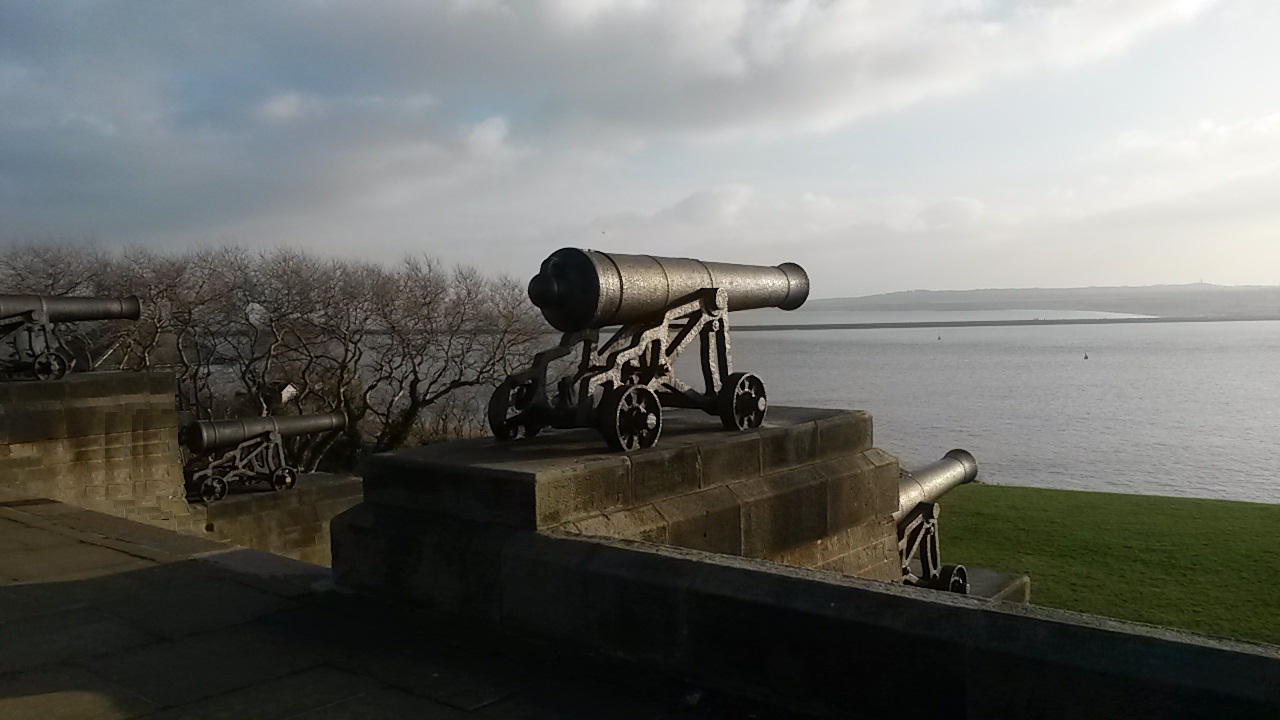
Guns from Royal Sovereign overlooking the Tyne 

Collingwood Monument Tynemouth
Gun from Royal Sovereign

Collingwood Monument Tynemouth
Gun from Royal Sovereign
 
There is also a memorial to Admiral Collingwood in St Nicholas Cathedral in Newcastle.

Collingwood Memorial
St Nicholas Cathedral Newcastle
 
Collingwood Memorial
St Nicholas Cathedral Newcastle


Friday, 18 January 2019

Newcastle Silver Gallery

RAA Members with Lord & Lady Mayor of Newcastle

The Lord Mayor of Newcastle, Councillor David Down, hosted members of the Royal    Artillery Association in the Sliver Gallery within Newcastle Civic Centre.

Veteran Gunners from the Northumbrian Volunteer Artillery Association, Tynemouth Volunteer Artillery, Tyneside Scottish and Newcastle Branches RAA were shown round the Silver Gallery by the Lord Mayor.

The Mayor  outlined  information on silver pieces and other gifts presented to the City of Newcastle by Armed Forces organisations.

 
Newcastle Civic Centre
Silver Gallery

One of the pieces on display was the presentation to the City from 101 Regiment Royal Artillery to mark the occasion of the Freedom of Newcastle in 1980. 

Brought back memories of nocturnal drives around Newcastle for the rehearsals, the actual parade and the luncheon afterwards.


One of the pieces on display was the presentation to the City from 101 Regiment to mark the occasion of the Freedom of Newcastle to the Regiment in 1980.  The opportunity was taken to further the  Mayors knowledge by recounting the Freedom Parade and it’s      preparations. Memories of nocturnal drives around Newcastle for the rehearsals, the      parade and the freedom dinner will be familiar to many members.