Blog Search


Wednesday, 20 August 2014

Op Ducy - Tyneside Scottish Gold Beach

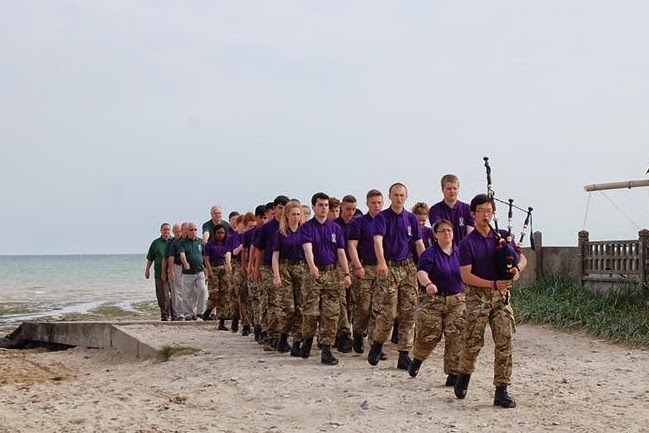
Around midday 12th June 1944 the main body of the 1st Battalion Tyneside Scottish (Black Watch) arrived offshore of Gold Beach. The advanced party were already ashore, having landed 12 hours earlier.  By 15:00 the men were disembarking and moving from  the beach to their assembly area at ESQUAY SUR SEULLES.

Gold Beach

Gold Beach

Gold Beach TS arriving on the beach

Gold Beach TS marching off


Gold Beach TS piped off the beach

Op Ducy - Arromanches

In order to exploit beyond the Normandy Beachhead it was essential that port facilities were available for bulky cargo, vehicles and supplies in order to sustain operations.

In August 1942 a raid on Dieppe had failed, and it became obvious that trying to take heavily defended ports was not viable. For the Normandy operation it was therefore decided to create a port made up of pre-fabricated components.

The port would consist of concrete caissons sunk offshore to create the port infrastructure, connected to the shore by floating runways. Old ships would be sunk as block ships to provide breakwaters. Two harbours would be constructed , one off Omaha Beach and one off Gold Beach.


Mulberry Harbour Concept

The harbours were constructed in multiple locations around the United Kingdom and towed across the channel into position. On 9th June 1944 (D plus 3), both harbours were in position.


Mulberry caissons being towed into position


Mulberry Harbour

Mulberry Harbour roadway

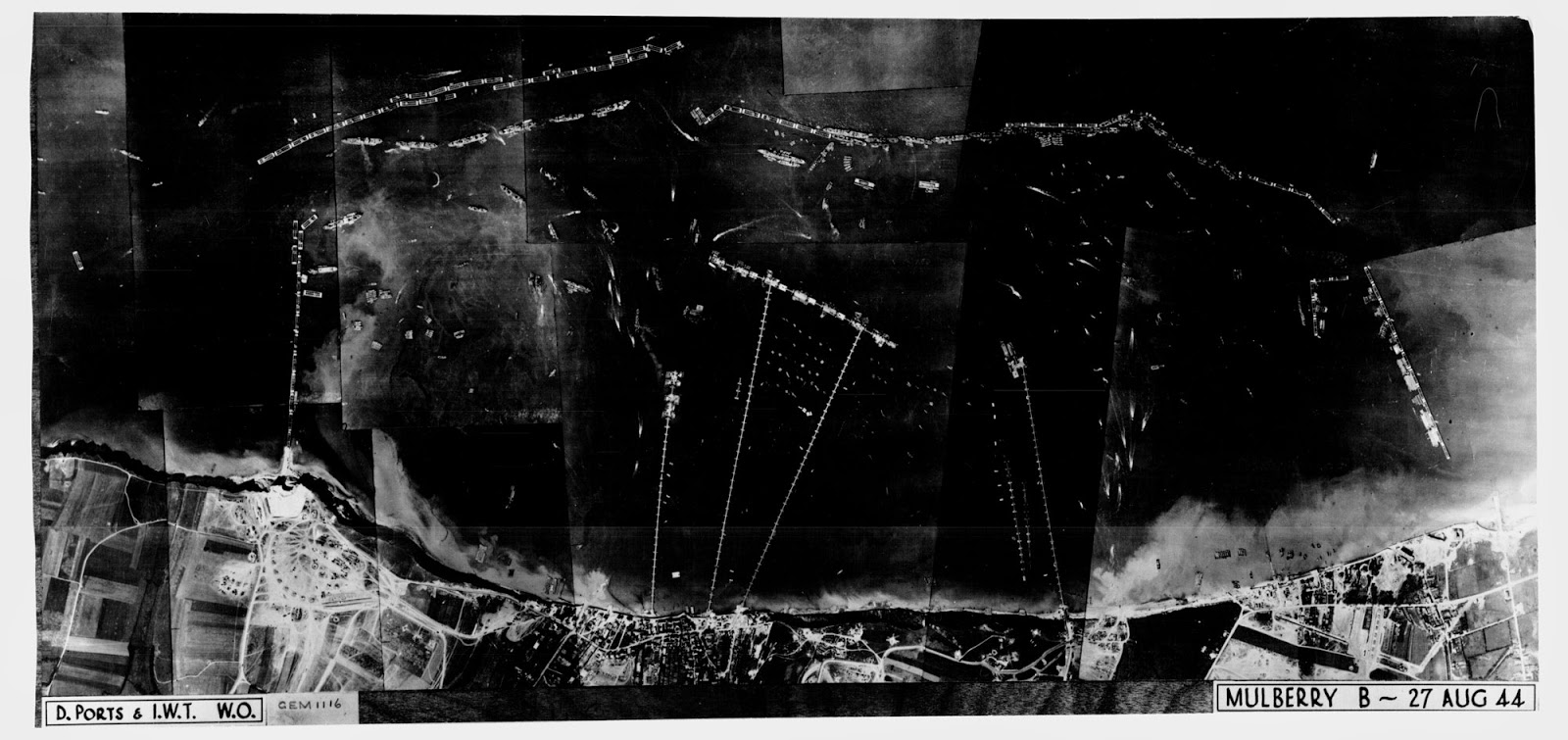
The Royal Engineers constructed the harbour at Arromanches with 33 jetties and 10 miles (15 km) of roadway, and it was named PORT WINSTON. 

Mulberry B harbour - Arromanches


Arromanches Map

Arromanches Panorama - Port Winston

Arromanches Mulberry Harbour remains

Arromanches

Arromanches Roadway remains

Op Ducy - Port En Besin

On the 6th June 1944 the 47th Royal Marine Commando was tasked with the capture of the small harbour of PORT EN BESSIN. The harbour was located 9 miles (12 km) to the west of GOLD BEACH. The fishing port was an important objective as it was to be the Normandy terminus for PLUTO (Pipe Line Under The Ocean), the mechanism by which fuel oil would be moved from the UK to France.

Port En Bessin location

Port En Bessin 1944
EAST                                                                            WEST

Port En Bessin 2014
EAST                                                                             WEST
 
The fishing port lies in a hollow with high sides rising up to 200 feet (60 metres),which were know as the Western and Eastern features.
 
Defending PORT EN BESSIN were elements of the German 352nd Infantry Division who held the high ground defended by concrete bunkers, wire entanglement's and mines. To the south concrete entrenchments covered the Bayeux Road.


Panorama from Eastern feature - moving through west & south 

Port En Bessin - Western feature
 
Port En Bessin - Eastern feature

The plan was 47 Commando would land on GOLD BEACH,  move inland, infiltrate through enemy lines and attack the village from the rear.


Port En Bessin 
WEST                                                             EAST


The operation began at 05:00 6th June 1944 when 420 men of 47 Commando with 420 men loading into landing craft 8 miles (13 km) off the Normandy coast. The German coastal guns opened fire on the craft as they approached the beach sinking one craft, another four were sunk when they hit mines attached to underwater obstacles. During the landing much of the units radio equipment was lost.

Around 300 men mustered on Gold Beach. Having borrowed radio equipment from the 231st Infantry Brigade they set off across country. The force managed to avoid contact until they were engaged at La  Rosière. The Commandos overcame the Germans, taking weapons and equipment to replace  the losses during the landings. By nightfall they reached Point 72 at Escures, 1.5 miles (2.4 km) from the port, where they dug in, ready to attack next morning.

The attack began by charging and overcoming the defensive position at the south of the village.

One troop then attacked the western feature. The feature was mined, rifle and machine gun fire was heavy, and the defenders were able to roll grenades down the hill. Unknown to the Marines, two Flak ships had been moved into the harbour, and they were able to bring fire onto the advancing troops, forcing them to withdraw.

The situation worsened when a German counter attack captured the Commandos rear HQ and cut off the troops in Escures.

The Marines began to clear the harbour area, but the Western and Eastern features were stubbornly defended by the Germans


Port En Bessin - Harbour
Captain Cousins found an unobserved path and was able to capture a concrete bunker. The Commandos then began to fight their way up the Eastern feature, concrete entrenchments, mines nd barbed wire. Through the night German positions were captured one by one and by dawn the Eastern feature as in the possession of 47 Commando. The positions near Escures were recaptured. At 04:00 8th June, the German garrison commander and 300 men surrendered.

Of the 420 Commandos who embarked, 116 were killed or drowned, and 40 wounded.


Port En Bessin Memorial
 

D-Day - Port en Bessin

Battle of Port En Bessin

Battle for Port En Bessin - People's War

D-Day: Heroic battle in Port-en-Bessin

Op Ducy - Ver Sur Mer

50th Divisional Artillery Memorial Ver sur Mer

D-Day - Royal Artillery Run In Shoot


50th Northumbrian Division
Divisional Artillery Memorial
Ver Sur Mer


Sexton Self Propelled Gun
Ver Sur Mer


Op Ducy - Juno Beach Centre

D-DAY - Juno Beach


 Juno Beach Centre


Juno Beach Visitors Centre

Juno Beach Visitors Centre


Op Ducy - Merville Battery


The German MERVILLE BATTERY is located 2 miles SE of the port of OUISTREHAM covering the mouth of the RIVER ORNE. Crucially for the planed landings on D Day it was situated 5 miles East of SWORD QUEEN BEACH, and it was assessed that the battery could cause serious problems for the troops landing on the beach.

Merville Battery Threat


The battery consisted of 4 concrete casemates, the type used normally housing 150mm guns, and this was what concerned the D-Day planners, consequently it was deemed necessary that the battery be destroyed prior to the main beach landings.

The battery was heavily bombed by the RAf on 16th May 1944, but little damage was inflicted, though the Battery Commander was killed as he visited his mistress.

A ground assault was therefore planed.

The defences for the battery were formidable:
  • 20mm anti-aircraft guns
  • 15 machine gun positions
  • Wire obstacles in an area 640 by 460 m surrounded by two barbed wire obstacles 15 4.6 m thick by 1.5 m high.
  • 100 m deep  minefield
  • Anti-tank ditch covering any approach from the nearby coast.
  • Areas to the East of the battery were flooded as part of a wider defence plan
Merville Battery June 1944

 
As part of the overall plan to secure the left flank of the D-Day landings, 9th Battalion Parachute Regiment, supported by Royal Engineers in Horsa Gliders, was tasked with the destruction of the battery. The Pathfinders would drop just after midnight to secure and mark the dropping and air landing zones. Main body would arrive 13:00, and the operation needed to be complete by 05:00 when a naval bombardment from HMS Arethusa would commence. Prior to the ground assault, RAF Lancaster Bombers would bomb the battery.

The Pathfinders drop was successful, however, their radio beacons had been damaged, and the smoke and debris from the RAF bombing, which was off target, obscured th landing lights.

The main drop and air landings were scattered as the DZ / LZ were not marked. Only 150 men out of a battalion of 800 arrived at the assembly point. There were no engineers and no infantry support weapons (anti tank guns) or jeeps. 

A reconnaissance party had managed to reach the battery, mark 4 routes through the minefield  and  cut a route through the barbed wire.

Merville Battery Assault

The reduced battalion managed to penetrate into the Battery and neutralised the gun by throwing fragmentation and phosphorous grenades through the gun apertures.


Merville Battery Casemate

The German garrison resisted and only 75 paratroopers withdrew from the battery shortly before 05:00.

The guns were only neutralised. Two guns were in action later in the day, though it transpired that the guns were only 100mm aged Czech WW1 guns.

The battery would not be captured till 17th August 1944.


Merville Battery Plan


Merville Battery Dakota

Merville Battery

On guard

Op Ducy - Piper Mallin

On 6th June 1944 the 1st Special Commando Brigade commanded by Brigadier Simon Fraser, 15th Lord Lovat, landed on Sword Beach.


1 Special Commando Brigade landing on Sword Beach

Landing with Lord Lovat was his personal piper, Bill Mallin, who played the Commandos ashore whilst under heavy fire.

Piper Billy Mallin

The Commandos were tasked with linking up with the Ox & Bucks Light Infantry who had captured Pegasus Bridge by landing by glider in the early hours of the morning of D-Day. At 13:00 the Commando's arrived at the bridge to relieve the glider borne troops.

The Commandos advanced across the bridge to the sound of Piper Millin's pipes.


Piped across Pegasus Bridge 2014

Piper Mallin display
Pegasus Bridge Centre

Piper Mallin's Pipes


Op Ducy - Pegasus Bridge Visitors Centre

Pegasus Bridge Memorial Centre
 
Pegasus Bridge Memorial Centre


Pegasus Bridge

Ranville Bridge
  
Glider Pilot Regiment
 

Air landing Memorabilia

Ox & Bucks Light Infantry Memorabilia
Air landing
 
British Paratrooper