The CWGC records 3,587 graves and 34,952 names on the memorial. It is always so peaceful and tranquil, in stark contrast to those who fought and died in the shell torn, gas filled, quagmire that was On th Raod Passchendaele.
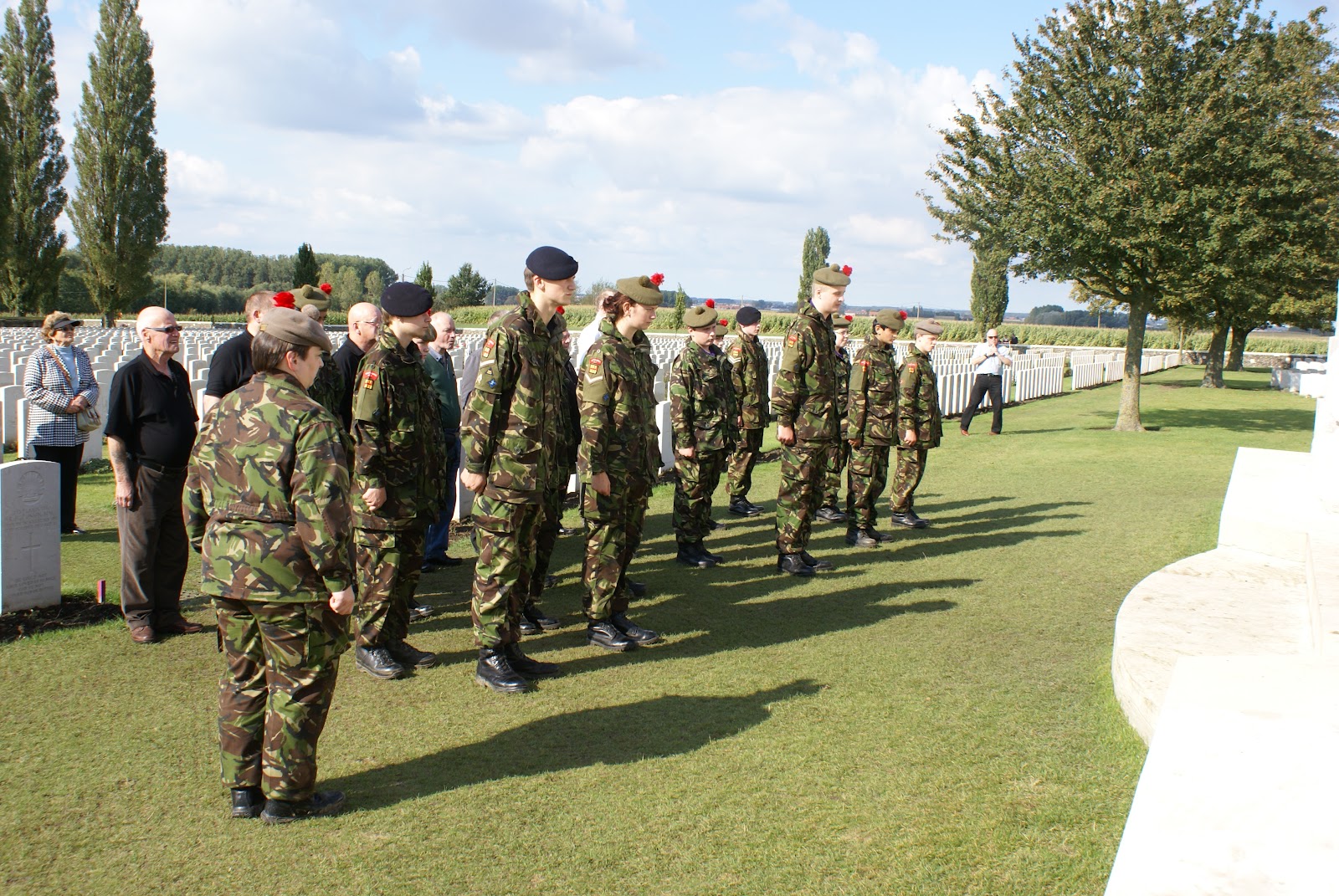
The silence as we held a small parade at the Cross of sacrifice and at the memorial wall of the Northumberland Fusiliers (remembering 77 Tyneside Scottish commemorated there) was an opportunity to reflect on the sacrifices made.
Great opportunity to get into the trenches and tell the cadets about how the soldiers lived and died in those surroundings. leading the whole contingent through the long tunnel in total darkness was an interesting experience.
Sanctuary Wood Northumbria ACF in the trenches
Though less than convinced with the group photo on the Colours.....................
A visit to Essex Farm Cemetery. The CWGC lists 1,097 casualties, and given it's location adjacent to a dressing station many would have died from wounds.
It was in Essex Farm Cemetery that Lieutenant-Colonel John McCrae of the Canadian Army Medical Corps wrote the poem ' In Flanders Fields' in May 1915.
There is the too familiar site of the graves of Royal Artillery all together, that died on the same date or near.
The counter battery fire on the Salient could result in an entire gun detachment being killed in a single incident. With in the cemetery 5 Gunners from 261 Siege Battery are buried together, four lost on 10th August 1917, the remaining casualty recorded as 12th August 1917. The Battery was equipped with 6 inch Howitzers and in August 1917 was part of the 65th HAG.
Royal Garrison Artillery
261st Siege Battery
Gnr GA Moore Cpl T Teague Gnr D Marnock Gnr AW Dodd Gnr LJ Drury
Recently paraded at the Menin Gate with the Royal Artillery Association Tyneside Scottish Branch. Lead by the Somme Battlefield Pipe Band, who included the Flanders Jocks in their ranks, we marched from the Grote Market upto the Gate. Heaton Manor (Tyneside Scottish) Detachment ACF.
The ceremony was as ever very moving. The exhortation 'For the Fallen' by L.Binyon being read by Colonel David Middleton Commandant Northumbria ACF.
Hearing Highland Cathederal echoing around the arches was excellent.
The march off entailed a counter march under the Menin Gate before marching back down the Meninstraat with the skirl of the pipes from Somme Battlefield Pipe Band playing on the road to Paschendaele.
In 2010 the President of the of the Royal Artillery
Association Tyneside Scottish Branch, Colonel Tony Glenton, was contacted by Yves Holbecq, Pipe Major of the Somme Battle Field
Pipe Band about a drum he had purchased from a French lady. The drum had been
found by her father in law in May 1940 near Fervant in Northern France during
the British retreat to Dunkirk. He hid it away in his attic fearing the Germans
would not look too kindly on the holding of British Army equipment, and there
it remained, forgotten, until 2010.
On the drum, a small plaque was dedicated to 2/Lt William
Basil Catto, 4th Battalion Tyneside Scottish. Yves recognised the historical
importance of the drum and began a quest to repatriate the drum back to the
Tyneside Scottish.
Memorial Plaque on the Drum
The Tyneside Scottish were formed as part of Kitchener’s’
call to arms in 1914. The response for volunteers was so overwhelming that four
service battalions of the Northumberland Fusiliers formed the Tyneside Scottish
Brigade.
Decimated on the opening day of the Somme, they were withdrawn to
regenerate in the area of Armentieres. It was during this period that 2/Lt William
Basil Catto was killed on the 11th September 1916 whilst commanding
a working party. He was buried in the church yard at Erquninghem-Lys the
following day.
The Tyneside Scottish went
on to fight at Arras and Paschendaele, going into suspended animation in 1919.
As the war clouds gathered over Europe in 1939, the Territorial
Army was doubled in size and units were required to form duplicates. The 9th
Battalion Durham Light Infantry based at Alexander Road, Gateshead, formed the
12th Battalion Durham Light Infantry and adopted the honour title
Tyneside Scottish. Their intelligence officer, Lt. Archie Catto would be a
second generation of Catto’s to serve in the TS. The battalion sought to
strengthen its Scottish links, and in February 1940 became 1st
Battalion Tyneside Scottish (Black Watch).
Officers of the Tyneside Scottish 1940 Lt Archie Catto in glengarry - 2nd row left
They deployed to France as part of
the British Expeditionary Force, complete with pipe band. The battalion were tasked with the construction of airfields,
their pipe band entertaining the local population. As the panzers rolled across
France, the battalion formed a blocking position at Fichieux, near Arras. They
held the advancing German armour for vital hours, sustaining heavy casualties,
before withdrawing to Dunkirk. Amongst the equipment left behind was the drum
dedicated to 2/Lt Catto. The battalion would return to France in 1944, before
going into suspended animation.
On the reforming of the Territorial Army in 1947, the honour
title was resurrected in the Royal Artillery. Today the title is held by 204
(Tyneside Scottish) Battery RA (V), former serving members having formed their
own branch of the Royal Artillery Association.
In 2010, the Tyneside Scottish Association began their
planning for the repatriation of the Catto drum back to Tyneside under the
leadership of Major Ian Jones.
An initial meeting was held with Yves Holbecq in Albert during
the Northumberland Volunteer Artillery Association’s Somme Battlefield tour in
2011.
Meeting with Yves Holbecq Albert 2011
At this point the history of the drum took an interesting turn of fate.
Amongst those on the tour was an officer from 204 (Tyneside Scottish) Battery RA
(V) who had served with Major (now Lt. Col) John Catto in Afghanistan. It
transpired that a third generation of Cattos had commanded Tyneside Scottish
soldiers. 204 Battery RA (V) provide reinforcements to5th Regiment Royal Artillery on Op
Herrick.
The initial part of the drum’s journey back to Tyneside was a
ceremonial handover at the grave of 2/Lt Catto at Erquinghem-Lys in France.
On parade were the members of Royal Artillery Association
Tyneside Scottish Branch and Heaton Manor (Tyneside Scottish) Detachment
Northumbria ACF, a fine representation of veterans and youth.
Royal Artillery Association Tyneside Scottish Branch on parade
Heaton Manor (Tyneside Scottish) Detachment Northumbria ACF on parade
The Somme Battlefield
Pipe Band provided the skirl of the pipes, and a Belgian re-enactment group,
the Flanders Jocks, formed an honour guard.
Flanders Jocks and Somme Battlefield Pipe Band on parade
Amongst the guests were Catto family members,
Lt Col Ian Vere Nichol and Allan Solly of the Royal Artillery Association, as
well as representatives from the Royal British Legion.
On the 6th October 2012, Yves Holbecq and Madame
Peitie, daughter in law of the gentleman who found the drum, handed it to Lt
Col. John Catto who accepted it on behalf of the Tyneside Scottish.
Yves Holbecq & Madame Petite handover the drum to Lt Col. John Catto RA
Lt Col. John Catto hands over the drum to Tyneside Scottish Cadets for it's onward journey to Tyneside
Catto Drum at the grave of 2/Lt William Basil Catto
The final part of its
journey will be a handover to the Regimental Museum of 101 (Northumbrian)
Regiment RA (V).The location of the
museum…..Alexander Road, Gateshead, from where the Tyneside Scottish was
resurrected in World War 2 and where the drum probably commenced its journey
over 70 years ago.
Flanders Jocks / Lt Col. John Catto and Yves Holbecq


 #
#








.JPG)